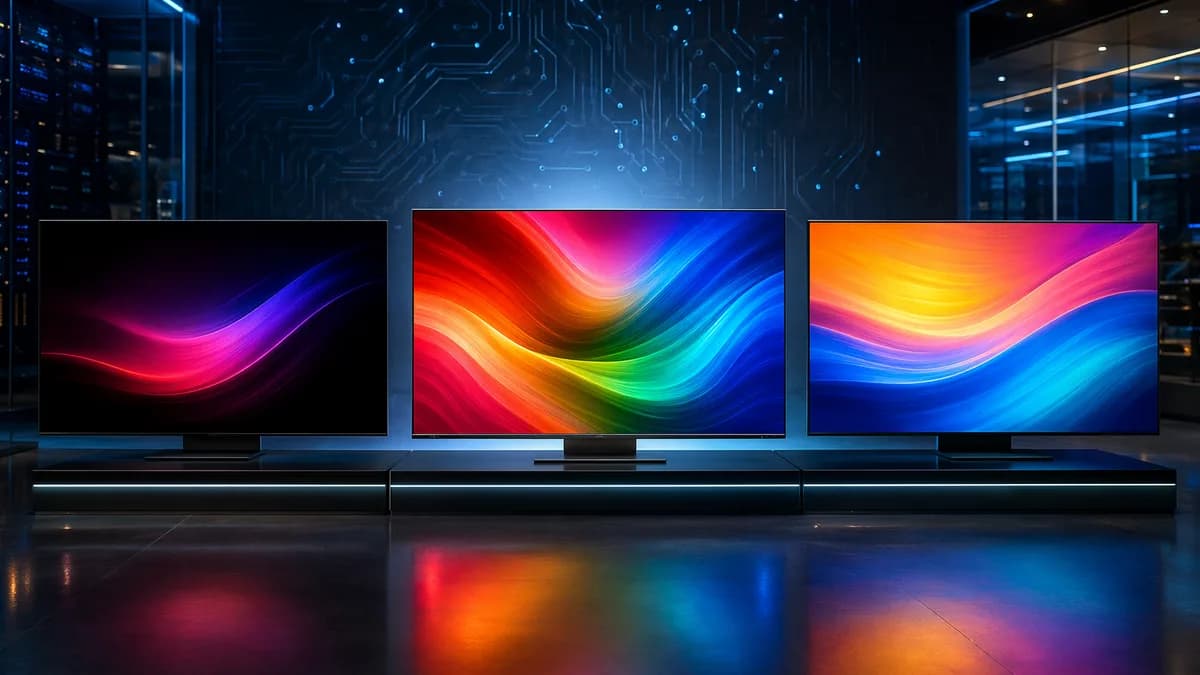
Three Samsung TV display types now compete at the top of the company’s lineup, and the surprise is that Micro RGB is no longer just a brighter QLED story, it’s Samsung’s most serious attempt yet to attack OLED on color, contrast, and longevity at the same time.
XOOMAR
Summary
That’s the real signal in the latest Samsung OLED vs QLED vs Micro RGB comparison from ZDNet, which weighs the new Samsung R95H Micro RGB against the Samsung QN90F QLED and Samsung S95H OLED. ZDNet’s writer ultimately gives the edge to Micro RGB, saying the new panel “managed to pull off the impossible: outshine the OLED.”
“While the Micro RGB screen still has a lot to prove, from what I've seen so far, it managed to pull off the impossible: outshine the OLED.”
That doesn’t make OLED obsolete. It does make Samsung’s premium TV strategy more interesting. The company now has three distinct answers for buyers who care about contrast, screen size, gaming, price, and burn-in risk. The best choice depends less on the acronym and more on what you actually watch, how long you keep static content on screen, and how much early-adopter pricing you’re willing to absorb.
3 Samsung display families now compete for the premium TV buyer
The Samsung OLED vs QLED vs Micro RGB question matters because these TVs solve the picture problem in different ways.
Samsung S95H OLED uses individually lit LEDs that can switch on and off independently. ZDNet frames that as the reason OLED can deliver deep blacks, bright whites, and sharp contrast without the halo effect that can erase detail in darker parts of an image. The S95H also has dual Pantone validation, covering testing against more than 2,000 colors in Pantone’s Formula Guide and more than 130 in the SkinTone Guide.
Samsung QN90F QLED is the practical option. ZDNet describes QLED as older and more established, with cheaper, easier-to-manufacture LED panels and a balanced picture for live news, sports, console gaming, and streaming on Samsung TVs. It also has the broadest size range, from 43 inches to 115 inches, and starts at $999.
Samsung R95H Micro RGB is the new swing. Samsung’s older approach used a blue LED backlight behind panels made of red, green, and yellow LEDs. ZDNet says that worked, but “it isn't very accurate.” The R95H changes that by integrating blue LEDs directly into the same unit as red and green LEDs, arranged through millions of specially designed micro lenses. Samsung says this lets the TV cover up to 100% of the BT.2020 color gamut.
The distinction is important. Micro RGB is not just a badge for another big, bright Samsung TV. ZDNet positions it as a hybrid-style premium panel that shares DNA with QLED while chasing OLED-like contrast and detail.
The $999 to $3,200 gap explains Samsung’s real segmentation
The spec sheet tells a sharper story than the branding.
| Samsung model | Display type | Size range | Refresh rate | VRR support | Starting price |
|---|---|---|---|---|---|
| Samsung R95H | Micro RGB | 65 to 85 inches | 165Hz | AMD FreeSync Premium Pro | $3,200 |
| Samsung QN90F | QLED | 43 to 115 inches | 120Hz | AMD FreeSync Premium Pro | $999 |
| Samsung S95H | OLED | 55 to 83 inches | 165Hz | AMD FreeSync Premium Pro, Nvidia G-Sync | $2,500 |
The QN90F QLED wins on entry price and size flexibility. It starts at less than one-third of the R95H’s starting price and stretches all the way to 115 inches, though ZDNet says the 115-inch QN90F retails for about $25,000.
The S95H OLED sits in the premium middle on starting price. It costs more than QLED but less than Micro RGB. Its sharpest claim is contrast, helped by individually controlled light output. It also has the strongest listed gaming compatibility among the three because it supports both AMD FreeSync Premium Pro and Nvidia G-Sync.
The R95H Micro RGB is Samsung’s technical showcase. It starts at $3,200 for the 65-inch model and reaches $6,500 for the 85-inch version, according to ZDNet. That premium buys the new RGB LED structure, a matte finish to reduce glare, the Micro RGB AI Engine Pro, Samsung Vision AI, Microsoft Copilot access, generative wallpaper, enhanced picture-and-sound mode, and AI Soccer Mode.
For buyers, that means Micro RGB has to clear a higher bar. It can’t merely look good in a demo. It needs to prove that its color, motion, and burn-in advantages justify the price.
Blue LEDs are the small component carrying the biggest claim
The most consequential technical shift in the R95H is blue.
ZDNet spends real time on this because blue LEDs were historically difficult and expensive to develop. The scientists behind the blue LED won a Nobel Prize, and the technology later became critical to white LED lighting. ZDNet notes that LED bulbs can last tens of thousands of hours and be up to 90% more efficient than incandescent bulbs.
For the R95H, blue matters because Samsung is no longer relying on the same workaround described in the source. By integrating blue LEDs with red and green LEDs in the display structure, the R95H targets a wider color range and cleaner accuracy.
That is why the Samsung OLED vs QLED vs Micro RGB debate is not only about brightness. ZDNet’s argument is that Micro RGB attacks OLED where OLED usually has the advantage: color and contrast. It also avoids the burn-in concern ZDNet flags for OLED-style use cases, because the R95H “doesn't rely on a delicate organic substrate.”
That claim is especially relevant for content creators or streamers who keep static interface elements on screen for long periods. It’s not a universal reason to skip OLED, but it is a clear use-case advantage for Micro RGB in ZDNet’s analysis.
Gamers get three different trade-offs, not one obvious winner
Samsung’s three models split the gaming pitch cleanly.
The R95H Micro RGB has a 165Hz base refresh rate and supports AMD FreeSync Premium Pro. ZDNet also says it can boost the refresh rate to 240Hz for gameplay. That gives it the strongest motion claim in the source, especially for players who also worry about static HUD elements.
The S95H OLED matches the R95H’s 165Hz refresh rate and adds Nvidia G-Sync support. ZDNet frames that as good news for content creators and streamers who want a high-end screen in a multi-monitor setup for video production.
The QN90F QLED is less extreme on paper at 120Hz, but it still supports AMD FreeSync Premium Pro. For many buyers, its advantage is price and size choice, not maximum spec bragging rights.
This is where a connected-device mindset matters. New TVs increasingly bundle assistants, casting, AI modes, and account-linked features. That doesn’t mean a Samsung TV faces the same risks as enterprise networking gear, but it does mean buyers should treat smart screens as networked computers. Our coverage of how attackers targeted a Cisco SD-WAN vulnerability is a useful reminder that connected hardware should be patched and managed, not ignored after setup.
QLED still has the clearest mass-market job
The QN90F QLED is not the sexiest model in this comparison. It may be the easiest one to justify.
ZDNet says QLED gives buyers “a balanced picture” across news, sports, gaming, and streaming. It also supports AirPlay and, after a quick update, Google Cast. There’s even a phone-as-microphone karaoke feature. Samsung also promises years of firmware and security updates, according to the source.
That makes QLED the rational choice for households buying by room, size, and budget. A 43-inch option can fit a bedroom or office. A much larger option can anchor a living room. The spread is wider than OLED or Micro RGB.
This is different from buying a small accessory on sale. A discounted tracker deal like our AirTags Prime Day Deal Cuts Trackers to $22.50 Each is a low-stakes impulse purchase. A TV that starts at $999, $2,500, or $3,200 is a multi-year screen decision. Specs matter, but so does whether the TV fits the room and the content mix.
Micro RGB is the surprise winner, but not the automatic buy
ZDNet’s writer chooses Micro RGB because the R95H combines OLED-like contrast ambitions with a wider color claim and no OLED burn-in concern. That is the correct headline from the source.
XOOMAR’s analysis: the buying decision is still more segmented than that. The R95H is the most compelling technology story. The S95H OLED remains the clearest pick for buyers who prioritize OLED contrast and Pantone-validated color. The QN90F QLED remains the value and size-flexibility play.
The R95H’s biggest problem is not capability. It’s price discipline. At $3,200 to start and $6,500 at 85 inches, Micro RGB needs to prove its advantage outside controlled demos and beyond the first wave of reviewers.
Samsung’s next TV cycle will show whether Micro RGB becomes a durable flagship tier or an expensive showcase. The evidence to watch is simple: lower starting prices, more screen sizes, and repeated testing that confirms the R95H’s color and contrast advantages hold up against OLED in normal homes. If those arrive, Samsung’s newest display type becomes more than a surprise winner. If not, QLED and OLED will keep doing what they already do well: winning buyers through price, size, and proven picture strengths.
Key Takeaways
- Samsung now has three distinct premium TV technologies competing for buyers with different picture-quality priorities.
- Micro RGB could pressure OLED by improving brightness, color, contrast, and longevity in one display type.
- The best choice depends on viewing habits, burn-in concerns, screen size needs, and price tolerance.
Samsung Premium TV Display Types Compared
| Display type | Model cited | Main strength | Key caveat or buyer fit |
|---|---|---|---|
| OLED | Samsung S95H OLED | Individually lit pixels deliver deep blacks, bright whites, and sharp contrast without halo effects. | Still relevant for contrast-focused buyers, but faces stronger competition from Micro RGB. |
| QLED | Samsung QN90F QLED | Older, more established, and positioned as the practical premium option. | Best for buyers prioritizing price, reliability, and mainstream availability. |
| Micro RGB | Samsung R95H Micro RGB | ZDNet says it outshines OLED by targeting color, contrast, brightness, and longevity together. | Still has more to prove and may carry early-adopter pricing. |
Samsung S95H OLED Pantone Validation Coverage
Primary Sources & Disclosures

Written by
XOOMAR
Data desk
XOOMAR publishes free market data from primary sources, with an open API. When something we publish is wrong, it's corrected in place.