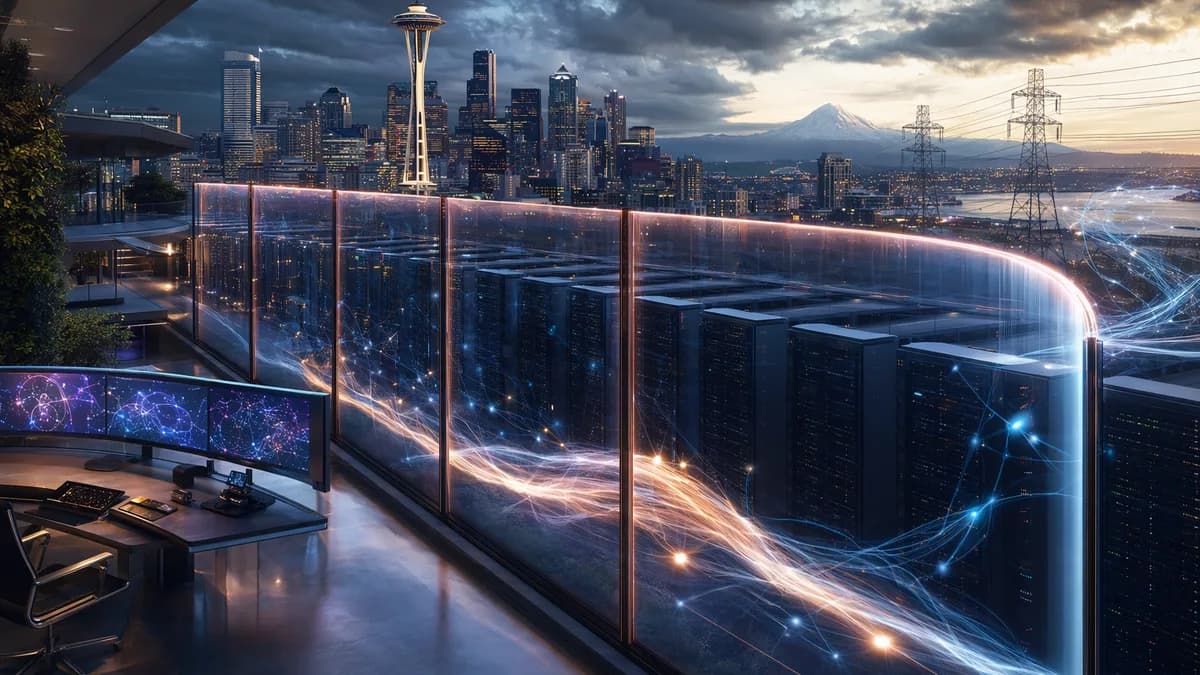
Seattle just turned AI compute from back-end infrastructure into a citywide power fight. The city council voted unanimously on Tuesday to impose a year-long moratorium on new datacenters, making the home metro of Amazon and Microsoft the largest US city to pass such a pause, according to Guardian World.
XOOMAR Intelligence
Analyst Take
The signal is sharper than a routine zoning delay. Seattle is saying that large AI datacenters will be judged like heavy industrial users of electricity, land, water, and public trust. XOOMAR analysis: the vote doesn't slow AI demand by itself. It changes who gets to set the terms.
Seattle just told AI builders that cheap political permission is over
The moratorium gives Seattle officials 365 days to study how large datacenters affect infrastructure, water usage, utility rates, land use, jobs, public health, and community well-being, according to the Seattle City Council. The council also said the pause could be extended by six months, and a public hearing is required within 60 days of adoption.
That sequence matters. The city isn't simply rejecting one building. It's creating time to write a new rulebook before the next wave of high-power facilities locks in.
Mayor Katie Wilson framed the pause as a way to decide whether datacenters are a “good use of urban land.” She also raised the possibility of new conditions for approval, including requirements that developers invest in local transit and housing initiatives in exchange for construction permits.
“There are times when public pressure forces elected officials to do something they don’t want to do, but in other cases, public pressure just supports and helps to spur on elected officials to do things that they already want to do,” said Wilson. “I think this was one of those latter cases.”
That quote captures the politics. Public anger did not drag city hall into unfamiliar territory. It gave officials cover to act on concerns already sitting inside the permitting process.
For readers tracking Seattle’s two hometown tech giants beyond datacenter politics, XOOMAR’s related company coverage includes Amazon’s $17.5B AI loan, June Grab: Amazon Prime Day 2026 Ditches July Chaos, and 208 CVEs Turn Microsoft Patch Tuesday Into a Fire Drill.
The electricity math made delay politically easy
The trigger was scale. After the Seattle Times reported in April that five proposed datacenters could consume up to a third of the city’s current demand for electricity, lawmakers moved quickly toward a moratorium.
The City Council said four companies had approached Seattle City Light about building five large-scale datacenters in the Seattle area. Those projects would have a combined maximum demand of 369 megawatts, enough to power approximately 300,000 homes.
That is the core fact behind the vote. AI infrastructure may look like warehouse real estate from the street, but to a city utility it can resemble a major new industrial load landing all at once.
The council also said Seattle already has about 30 small datacenters. The issue is not whether servers exist inside city limits. They do. The fight is over a new class of proposed facility whose power needs sit in a different category.
| Category | How Seattle is treating it during the pause |
|---|---|
| New large-scale datacenters | Blocked for one year under the moratorium |
| Existing datacenters | May apply for expansions requiring up to 20 megawatts of additional power |
| Civic-purpose systems | Lawmakers cited facilities tied to health services and emergency-call systems as distinct from large AI-focused centers |
The amendment allowing existing facilities to expand is now the pressure point. Activists worry it could undercut the moratorium by letting power demand rise during the pause. Lawmakers say the carveout separates existing civic and business systems from the large AI projects driving public concern.
Tech-worker backlash changed the politics of AI infrastructure
Seattle’s fight is unusual because opposition did not come only from neighborhood groups. Local tech workers joined it.
Activist groups including Amazon Employees for Climate Justice met with policymakers and supported a letter-writing campaign that sent nearly 100,000 emails to local lawmakers, according to the Guardian. Ben Jones, a spokesperson for 350 Seattle, said a “huge number” of tech workers organized against the datacenters because AI is “synonymous with people losing their jobs.”
That labor angle sharpened the issue. The Guardian reported that Amazon and Microsoft have laid off thousands of local workers over the past year as they spend a projected $390bn on AI investments in 2026. The reporting does not identify Amazon or Microsoft as applicants for the five proposed Seattle datacenters. The political effect is still clear: in the companies’ home region, AI spending is being read through both infrastructure strain and job anxiety.
Councilmember Eddie Lin put the ratepayer argument bluntly in the City Council release.
“Thousands of Seattleites have made their voices heard — we should not be subsidizing the massive and record profits of tech corporations pursuing large AI data centers in our city.”
XOOMAR analysis: that sentence shows where the fight is heading. The next permitting debate will not be only about zoning. It will ask who pays for grid upgrades, who absorbs environmental costs, and what public benefit a private compute facility must provide to justify its footprint.
Spokane and Walla Walla are already part of the next front
The supplied record does not support broad claims about specific fights in Virginia, Ireland, or other markets. The confirmed next front is closer: Seattle activists are working with other organizations in Washington state, including groups in Spokane and Walla Walla, to mount similar campaigns against datacenters.
That is how a local moratorium becomes a template. A city pauses approvals. Staff study power, water, noise, public health, utility rates, and land use. Advocates export the playbook. Other councils ask why they should approve large loads before seeing Seattle’s rules.
KUOW reported that public testimony at a committee meeting showed unanimous support for the one-year ban, and that one proposed SODO project was described as a nine-story datacenter with its own electrical substation next door. That image matters because it strips away the abstraction. AI is not just code running somewhere else. It needs land, substations, cooling systems, backup systems, and political consent.
The next proof point is whether Seattle writes hard thresholds
The moratorium’s real test comes after the vote. A pause without standards would only delay the same fight. A pause that produces clear rules could reshape how AI infrastructure gets built in Seattle and beyond.
The evidence to watch is specific:
- Power rules: whether Seattle sets numeric thresholds for large electrical loads, including how much capacity new facilities can request from Seattle City Light.
- Rate design: whether the city follows through on a separate rate for new high-electricity consumers, including datacenters.
- Expansion scrutiny: whether the 20-megawatt expansion allowance becomes a narrow civic carveout or a broad workaround.
- Community conditions: whether future permits require investments in housing, transit, renewable power, jobs, or other public benefits.
- Regional spillover: whether projects shift outside city limits while still drawing from the same broader power system.
Seattle’s vote will not make AI companies need less compute. It will force them to defend where that compute lives, how much electricity it consumes, and what the host city gets in return. If the council writes enforceable standards over the next year, this moratorium becomes more than a pause. It becomes a bargaining model for cities that no longer want AI infrastructure treated as invisible.
Impact Analysis
- Seattle’s moratorium signals that AI datacenters may face tougher local scrutiny over power, water, land use, and public costs.
- The pause gives officials time to write new rules before more high-demand AI infrastructure is approved.
- As Amazon and Microsoft’s home metro, Seattle’s move could influence how other major cities regulate AI compute growth.
Primary Sources & Disclosures

Written by
XOOMAR Insights Team
Research and Editorial Desk
The XOOMAR Insights Team pairs automated research with human editorial judgment. We track hundreds of sources across technology, fintech, trading, SaaS, and cybersecurity, cross-check the facts, and explain what happened, why it matters, and what to watch next. We do not just rewrite headlines. Every article is fact-checked and scored for reliability before it goes live, and we link back to the original sources so you can verify anything yourself.