
About 40% is the number that explains the Slate EV truck battery pivot: cheaper LFP cells now fit Slate’s low-cost pickup strategy better than the higher-density NMC cells it originally planned to use.
TechnologyJune 24, 2026· 10 min read· By XOOMAR Insights Team
40% Battery Cost Gap Pushes Slate EV Truck to LFP Cells
Updated on June 24, 2026
XOOMAR Intelligence
Analyst Take
58/ 100
4 sources analyzedLow confidenceTrend10Freshness99Source Trust90Factual Grounding91Signal Cluster20
Slate revealed a $24,950 starting price on Wednesday, before destination, taxes, and other fees, and changed the battery plan at the same time, according to TechCrunch. The startup dropped its optional 240-mile pack and raised the standard pack from 150 miles to 205 miles. That is the real story. Slate isn’t chasing the longest-range EV truck. It’s trying to make the cheapest EV in the U.S. financially workable.
That fits the product. As we wrote in Slate Auto Pickup Truck Bets $24,950 Will Hook Buyers, Slate’s pitch depends on stripping out complexity rather than outspending incumbents on features. The battery switch shows the same logic moving into the most expensive part of the vehicle.
Slate’s LFP battery switch turns a 40% cost gap into a truck strategy
The Slate LFP battery switch is a strategic admission: the affordable EV truck fight will be won on cost, supply, and usable range, not on bragging rights.
Slate initially planned to use nickel-manganese-cobalt, or NMC, cells. That made sense at the time. NMC is widely used in the auto industry and is favored for energy density, which helps squeeze more range from a given pack volume. For a small truck with limited underfloor space, that matters.
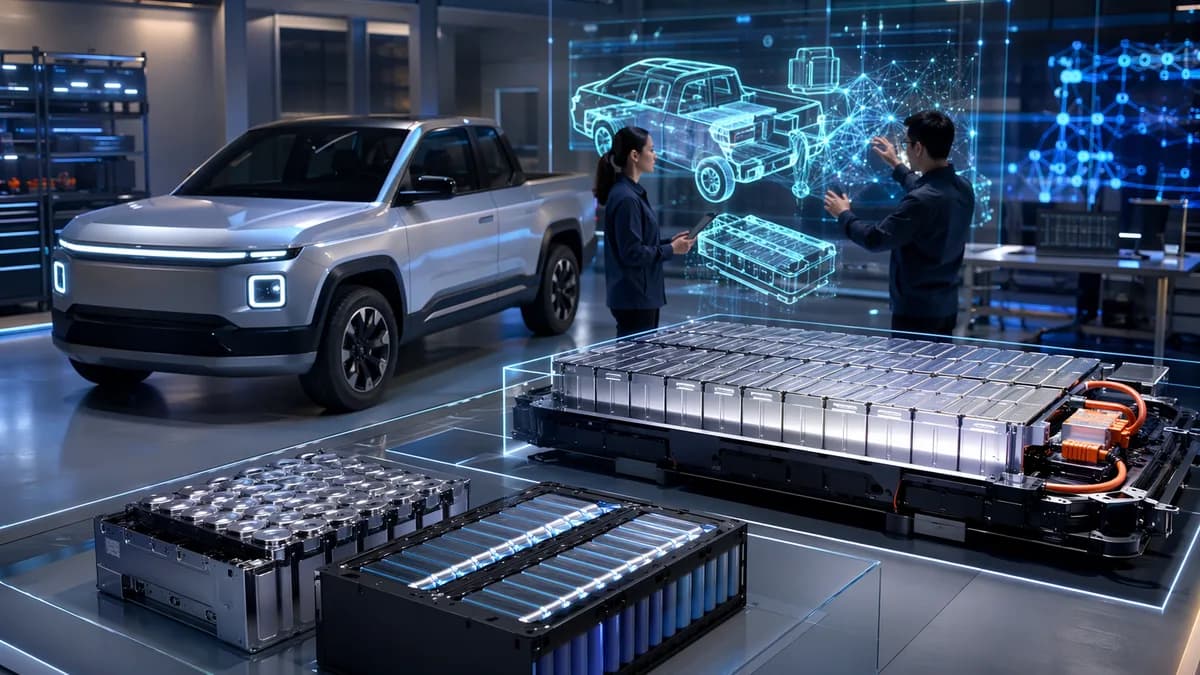
But NMC has a cost problem. TechCrunch notes that NMC is expensive mostly because of high nickel and cobalt prices. Lithium-iron-phosphate, or LFP, goes in the other direction. It uses lower-cost ingredients, including iron as a main cathode material, replacing nickel and cobalt. TechCrunch says LFP battery packs are cheaper by about 40%.
That tradeoff is exactly where Slate lives. The company is not selling a luxury EV truck with a giant pack and a long options sheet. It is selling a stripped-down pickup that has to make its price credible before buyers even get to the configurator.
The tension is simple. LFP is less energy dense than NMC, but it can make an entry-level EV more economically defensible. For Slate, the surprise is that the cheaper chemistry no longer means accepting a 150-mile standard range. The new standard target is 205 miles.
$24,950 forces the Slate EV truck battery to beat the spec sheet
A cheap EV truck has less room for battery indulgence. Every extra kilowatt-hour has to justify itself against the starting price, the vehicle’s size, and the buyer’s actual use case.
TechCrunch’s core battery comparison looks like this:
| Battery choice | Source-supported strengths | Source-supported drawbacks | Slate implication |
|---|---|---|---|
| NMC | Higher energy density, widely used in autos | More expensive due to nickel and cobalt | Helps range, but strains a low-price strategy |
| LFP | About 40% cheaper, lower-cost ingredients, can be charged to 100% with fewer degradation concerns | Lower energy density, supply chain concentrated in China | Better fit for a simple, low-cost truck if range remains usable |
The important part is not that LFP magically solves EV affordability. It doesn’t. It changes the engineering budget. Slate still has to manage pack size, weight, range, charging behavior, and customer expectations. But LFP gives the company a chemistry that aligns with a vehicle designed around restraint.
There is also a practical ownership angle. TechCrunch says LFP cells can be charged to 100% with fewer concerns about degradation than NMC. For a truck with a 205-mile standard pack, that matters. A buyer who can comfortably use the full pack daily may care less about a bigger headline range.
That is a different sales pitch from the early EV era. It says: here is enough range, at a price that doesn’t collapse the vehicle’s reason to exist.
150 miles became 205 miles because pack architecture changed too
Slate did not just swap chemistry. It is also using cell-to-pack construction, which helps explain how the company can improve the standard range while moving to a less energy-dense chemistry.
Older EV packs often placed cells into modules, then loaded those modules into the pack. TechCrunch notes that this approach allowed automakers to use pouch cells, which are cheaper and lighter, but the module structure eventually canceled out some of those savings.
Cell-to-pack takes a more direct route. Rigid batteries, either prismatic or cylindrical, are loaded directly into the pack. That cuts manufacturing steps and improves volumetric energy density. For a small EV like the Slate truck, that packaging gain is not a footnote. It is how the vehicle can use cheaper cells without giving up the entire range proposition.
This is where the Slate EV truck battery decision becomes more interesting than a chemistry swap. LFP’s lower cell-level energy density is partly offset by pack-level design. The truck loses the optional 240-mile pack, but the base version becomes more useful.
That trade may frustrate buyers who wanted the bigger pack. It also clarifies Slate’s target. A low-cost truck with 205 miles of standard range is a cleaner product than a cheap-looking truck whose affordability depends on steering customers away from the expensive version.
Tax-credit math flipped from constraint to non-issue
The policy backdrop changed fast.
Before last summer, TechCrunch says EVs using LFP would not qualify for the $7,500 tax credit under the Inflation Reduction Act if the battery materials did not meet domestic or free trade sourcing rules. Since LFP supply chains are concentrated in China, that was a major obstacle.
That explains why Slate originally leaned toward NMC. In prior InsideEVs reporting included in the source material, Slate CEO Chris Barman framed the earlier NMC choice around U.S. supply and tax-credit compliance:
“We've gone with more of what's in the mainstream right now and that many others in the industry are using. So we're using more of what's been scaled within the U.S.,” she said. “For LFP, most of those materials would come out of China or elsewhere.”
Then the calculation changed. TechCrunch reports that when the One Big Beautiful Bill Act axed the tax credits, those sourcing concerns “evaporated” as well. Chinese manufacturers were back in consideration.
Slate is now working with Gotion, a Hefei-based battery company, to source the cells, which will be built at a factory in Illinois, according to InsideEVs as cited by TechCrunch.
That is the policy irony. Tax-credit rules once pushed Slate toward a more expensive chemistry. Removing the credit opened the door to the cheaper one.
A123 to Gotion shows how America lost and then re-imported the LFP playbook
LFP’s U.S. story is messier than “China invented cheap batteries.” TechCrunch notes that early U.S. battery startup A123 Systems was founded to commercialize the technology. After missteps, A123 went bankrupt and was bought in 2013 by a Chinese auto parts company.
Since then, Chinese battery companies have embraced LFP and dominated production. That matters because Slate is trying to build an American low-cost EV truck using a battery chemistry where China holds the strongest industrial position.
The Gotion connection shows the current compromise. Slate wants the cost structure associated with LFP, but the cells are slated to be built in Illinois. That does not erase China’s advantage in the chemistry, but it does show how U.S. EV affordability may depend on importing manufacturing know-how and supply relationships into domestic plants.
This is the deeper market signal beneath Slate’s move. The U.S. wants affordable EVs and domestic battery manufacturing. LFP is one of the clearest routes to lower pack cost. But the strongest LFP supply base was built elsewhere.
Ford, GM, Rivian and Tesla make Slate’s choice less strange
Slate is not alone in moving toward LFP. TechCrunch says Ford, GM, Rivian, and Tesla all offer models that use LFP cells.
That matters for investor and buyer perception. LFP no longer looks like a cheap experiment reserved for fringe vehicles. It is now accepted enough that a startup can use it without having to educate the entire market from scratch.
The broader shift is also tied to changing range expectations. TechCrunch says U.S. automakers have historically prioritized range, and vehicles that travel more than 300 miles on a charge tend to be pricey. That is the opposite of Slate’s goal.
Charging networks have also grown in size, reach, and speed, according to TechCrunch, and range anxiety is gradually waning. The source does not claim range concerns are gone. They aren’t. But the market no longer forces every EV to justify itself with maximum range.
That is why Slate’s decision connects to the larger cheap EV debate we covered in $24,950 Slate Truck Rips Luxury Bloat Out of New EVs. The company is not trying to prove an EV truck can be premium. It is trying to prove one can be simple enough to sell cheaply.
Buyers, suppliers and investors will price the same battery change differently
For consumers, the LFP shift sends mixed but mostly practical signals. The upside is a lower-cost chemistry, a 205-mile standard range instead of 150 miles, and daily charging to 100% with fewer degradation concerns than NMC. The downside is the loss of the optional 240-mile pack.
Cold-weather performance, final charging curves, warranty terms, pack size, and real-world range remain open questions based on the supplied source material. Slate will need to answer those with production specs, not slogans.
For suppliers, the decision highlights the value of U.S.-based LFP capacity. Slate’s cells are tied to Gotion and an Illinois factory, according to the TechCrunch report. If low-cost EVs need LFP, then domestic manufacturing capacity for that chemistry becomes more strategically important, even after consumer tax credits disappear.
For investors, XOOMAR’s read is straightforward: Slate is prioritizing manufacturability and margin discipline over splashy specs. That is the right instinct for a capital-heavy EV startup. A 240-mile option may have looked better in marketing, but a simpler 205-mile standard pack may be easier to build, price, and explain.
For established automakers, Slate’s warning is sharper. A low-cost EV truck may not come from adding a cheaper trim to an expensive platform. It may come from deleting complexity at the vehicle level, the options level, and now the battery level.
Smaller packs, tougher pricing, and the evidence Slate still owes the market
The Slate EV truck battery pivot points toward a more disciplined EV market: smaller packs where possible, cheaper chemistries where acceptable, and vehicle designs built around realistic daily use rather than maximum advertised range.
That does not mean LFP takes over everything. TechCrunch explicitly says it won’t, and notes that automakers like GM are betting on an entirely different chemistry. NMC still has a role where energy density matters most. But for entry-level EVs, standard-range trims, and work vehicles with predictable daily use, LFP’s cost advantage is hard to ignore.
The next proof points are concrete. Slate has to hold the $24,950 starting price before destination, taxes, and other fees. It has to deliver the 205-mile standard pack without making the truck feel compromised. It has to execute the Gotion supply plan and Illinois cell production pathway described in the source. And it has to show buyers that losing the 240-mile option is a simplification, not a retreat.
Evidence that would strengthen the thesis: stable pricing, clear pack specs, credible production timing, and real-world range close to the new standard target. Evidence that would weaken it: price creep, supply delays, disappointing charging behavior, or buyers treating 205 miles as too narrow for a truck.
Slate’s battery change is not a technical footnote. It is a sign that the next EV winners may be the companies ruthless enough to design for cost from day one.
The Bottom Line
- Slate’s battery switch shows how EV startups are prioritizing affordability over maximum range.
- A 40% battery cost gap could be crucial to making a $24,950 electric truck financially viable.
- The move reflects a broader industry shift toward LFP batteries for lower-cost EVs.
Slate EV battery strategy: NMC vs LFP
| Factor | NMC cells | LFP cells |
|---|---|---|
| Role in Slate plan | Originally planned | Now selected |
| Main advantage | Higher energy density for more range in limited space | Lower cost and better fit for a budget truck |
| Key materials | Nickel, manganese, and cobalt | Lithium, iron, and phosphate |
| Cost profile | More expensive due to nickel and cobalt prices | About 40% cheaper, according to TechCrunch |
Slate EV truck battery range changes
Original standard pack
miles150
New standard pack
miles205
Dropped optional pack
miles240
Sources

Written by
XOOMAR Insights Team
Research and Editorial Desk
The XOOMAR Insights Team pairs automated research with human editorial judgment. We track hundreds of sources across technology, fintech, trading, SaaS, and cybersecurity, cross-check the facts, and explain what happened, why it matters, and what to watch next. We do not just rewrite headlines. Every article is fact-checked and scored for reliability before it goes live, and we link back to the original sources so you can verify anything yourself.
Explore More Topics
Related Articles
 Technology
Honda's Profit Doubles After Worst Annual Loss Ever
Honda's quarterly profit more than doubled to $2.9 billion in a dramatic recovery, just months after posting its first-ever annual loss, driven by vehicle sales
Aug 9, 20264 min
 Technology
Amazon's Gas Plant Permits 33 Million Tons of CO2
Amazon's planned Texas data center, powered by a dedicated natural gas plant, has a permit to emit 33 million tons of CO2 annually, potentially making it the la
Aug 8, 20267 min
 Technology
Apply for a Prime TechCrunch Disrupt Side Event
You can host a free, focused side event at TechCrunch Disrupt 2026 to directly connect with over 10,000 high-value founders and investors in San Francisco.
Aug 7, 20267 min
 Technology
TechCrunch Disrupt 2026 Tests Endurance Over AI Hype
TechCrunch Disrupt 2026 pivots from startup hype to operational durability, following founders who landed massive investor interest and oversubscribed rounds fr
Aug 7, 20266 min
 Technology
The Brutal ROI on a $12,500 TechCrunch Disrupt Booth
Paying $12,500 for a Disrupt booth isn't an investment, it's a test. This guide shows how to turn that table into qualified leads and meetings.
Aug 6, 20266 min
 Trading
Stocks Ignore Record Job Losses as Fed Pledge Trumps Payrolls
The Dow Jones Industrial Average showed no fear after July's shocking job losses, as investors bet weak labor data will keep the Federal Reserve from raising ra
Aug 10, 20266 min
 Fintech
CPI Print Holds Key to Crypto Rally or Ruin
Crypto's fate this week balances on a knife edge, with the July CPI report poised to dictate Fed policy and market risk appetite, while earnings reveal which co
Aug 10, 20266 min
 Global Trends
Oil Plunges 2% on Secret Iran Peace Deal Hints
Crude oil prices dropped 2% on unconfirmed reports that a ceasefire deal between the U.S. and Iran could reopen the Strait of Hormuz, despite ongoing attacks on
Aug 10, 20267 min
 Fintech
Erebor Quadruples Deposits In 100 Days For $8B Valuation
Startup-focused Erebor Bank has quadrupled deposits in three months and is now raising $1.5 billion at an $8 billion valuation, a giant bet on its post-SVB nich
Aug 10, 20265 min
 Fintech
DOJ Charges 455 Providers for $6.5B in Healthcare Fraud
The Department of Justice has replaced traditional fraud investigations with AI-driven analytics, charging 455 defendants in a $6.5 billion scheme and forcing p
Aug 10, 20267 min
Don't miss the signal
Get our weekly roundup of the stories that matter across tech, fintech, and trading. No noise, just signal.
Free forever. No spam. Unsubscribe anytime.