
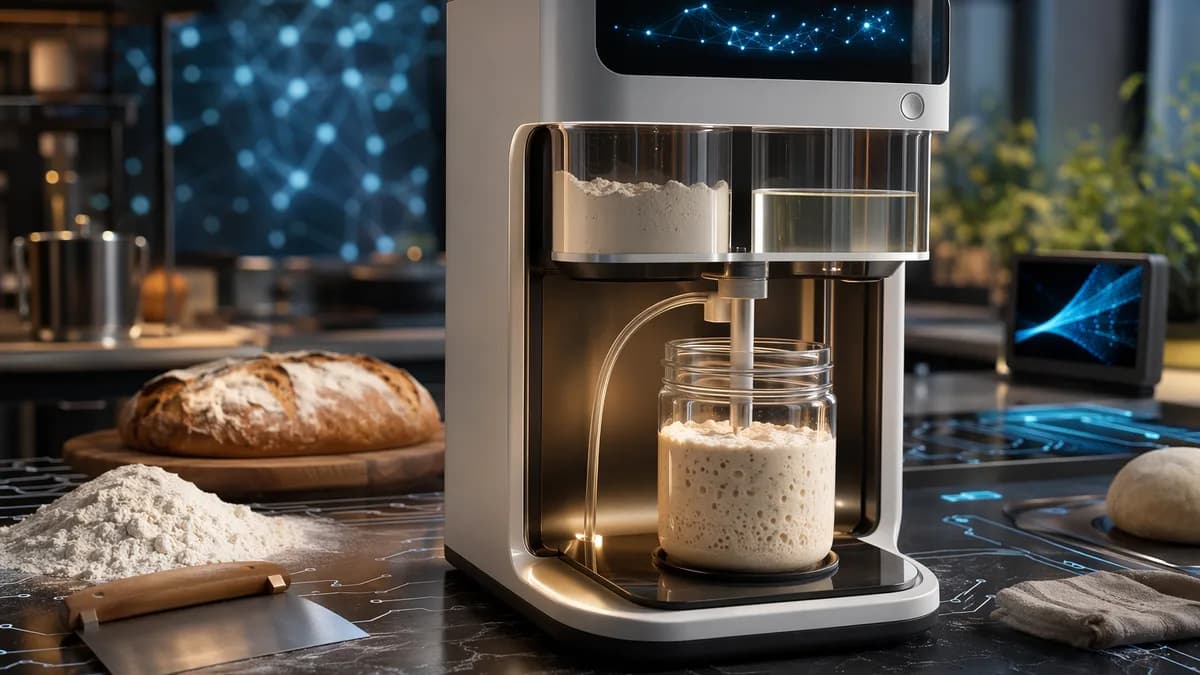
Sourdough was supposed to be the anti-gadget hobby, but the Sourdough Sidekick is now selling a $180 machine that automates starter feeding, the dullest and most failure-prone part of the process. Codeveloped with King Arthur Baking Company and FirstBuild, the GE Appliances innovation hub behind the Opal ice maker, the device is now available after a March 2025 crowdfunding launch, according to The Verge.
TechnologyJuly 5, 2026· 7 min read· By XOOMAR Insights Team
$180 Sourdough Sidekick Rescues Starters from Neglect
Updated on July 5, 2026
XOOMAR Intelligence
Analyst Take
69/ 100
4 sources analyzedMedium confidenceTrend10Freshness100Source Trust88Factual Grounding91Signal Cluster20
The pitch is narrow by design: the Sourdough Sidekick doesn’t knead dough, shape loaves, score crusts, or bake bread. It dispenses flour and water on a schedule so a starter is active when the baker wants to use it.
Sourdough Sidekick brings King Arthur-backed automation to starter feeding
The Sourdough Sidekick takes aim at the chore that makes sourdough feel less romantic after the first week: keeping a starter alive, fed, and ready. In Auto mode, users add 15g of existing starter, fill separate dispensers with flour and water, then set a target date, time, and starter weight.
The machine then feeds and mixes the starter on a dynamic schedule that accounts for local temperature. The goal is simple: build the right amount of active starter at the right moment.
That matters because sourdough depends on timing. A starter that peaks while you’re asleep or at work can throw off the rest of the bake. The Sidekick tries to move that timing problem from the baker’s head into a countertop appliance.
King Arthur’s role gives the device more credibility than the usual one-task kitchen gadget. The company’s logo sits on the front, and King Arthur’s own product page describes the device this way:
“It feeds your starter, so you don’t have to!”
That promise is attractive because starter care is both routine and unforgiving. Miss feedings and the culture weakens. Feed too much and you create excess discard. Time it badly and the bake starts from a compromised base.
The Verge reviewer Dominic Preston found the core Auto mode worked well with simple white bread flour. He said he set a bake several days out, left the device alone, and returned to a strong starter that produced “a pretty decent white loaf.” His bread even came out overproofed, suggesting the machine produced a more active starter than his usual manual process.
That’s the strongest case for the Sidekick. It isn’t trying to make sourdough less handmade. It’s trying to remove the repetitive prep step that keeps people from baking regularly.
Automated starter care targets the most tedious part of sourdough baking
Starter management is the part of sourdough that looks simple until it owns your schedule. The Sourdough Sidekick narrows the job to repeatable mechanics: dispense flour, dispense water, mix, wait, repeat.
The device offers three modes:
| Mode | What it does | Main limitation from The Verge review |
|---|---|---|
| Auto | Sets starter readiness by date, time, and target weight | Requires 15g starter seed and can force larger batches |
| Ratio | Uses preset feeding ratios and user-set frequency | Doesn’t allow unequal flour and water amounts |
| Custom | Lets users set seed amount, feed frequency, flour, and water | Doesn’t adjust for ambient temperature |
Auto mode is the obvious beginner setting. It handles feeding math and aims to reduce the daily discard cycle for up to a week, according to King Arthur’s product listing.
The catch is that Auto mode isn’t as flexible as experienced bakers may want. The Verge found that if a bake is set a few days out, the Sidekick can make as little as 150g of starter. If the target is four days or longer, it requires at least 400g, which was more than the reviewer usually needed for one loaf.
That can create the very discard problem the product is meant to ease.
There’s also no Auto maintenance mode. Users have to set a bake day, and that bake day has to be within the next week. If they don’t know when they’ll bake, they either set an arbitrary target and accept discard, or remove the crock and put the starter in the fridge.
The flour story is mostly positive, with caveats. The Sidekick handled most whole wheat and rye flours in The Verge’s testing, but users must recalibrate when switching flour types because densities differ. An especially coarse-milled rye flour from British miller Landrace produced starter that was too thick for the machine to mix properly, leaving dry clumps and thin patches.
Custom mode fixed that by letting the reviewer make a looser starter. That’s the mode serious bakers will likely care about most, because it allows fine-tuning hydration rather than forcing a standard 1:1:1 feed.
The basic before-and-after is blunt:
- Before: Manual starter feeding, timing guesswork, fridge pauses, and discard decisions.
- After: Scheduled feeding and mixing, but only within the machine’s mode limits.
- Best fit: Bakers who know when they’ll bake and do it often.
- Worst fit: Occasional bakers with small kitchens and irregular schedules.
XOOMAR analysis: this is the same usability test that shows up across consumer automation products. Novelty doesn’t carry the device. Repeat use does. That’s the thread behind our coverage of 3 ChatGPT prompts that can rescue your gaming backlog fast and Meta Pocket sneaking AI game making into social feeds: automation has to remove a real task, not just add another interface.
Single-purpose kitchen gadget status will decide Sourdough Sidekick’s appeal
The Sidekick’s biggest weakness may be physical, not technical. It’s another single-purpose appliance asking for money, counter space, cleaning time, and tolerance for noise.
The Verge gave it a 6 review score and said the strongest recommendation depends on baking frequency:
“But I’d only recommend it if you bake at least a loaf a week, and ideally more.”
That line frames the whole product. If someone bakes twice a week, starter automation can save attention and reduce friction. If they bake once a week or less, the machine may spend too much time idle while the starter still goes in and out of the fridge.
Cleaning also cuts against the “set it and forget it” pitch. FirstBuild recommends cleaning the glass crock, lid, and paddle between every feeding cycle to prevent buildup. The crock and lid are not dishwasher-safe, so users have to wash them by hand. The water tank and flour hopper can go in the dishwasher, but they need cleaning less often.
Then there’s the sound. By default, the Sidekick stirs every two hours for 30 seconds. The Verge called the whirring loud enough that it could irritate people in smaller spaces, especially studio apartments.
The app doesn’t change the calculation much. The Sidekick has Wi-Fi and a mobile app, but The Verge found little reason to use it. The app can send alerts when starter is ready or discard needs removal, and it can show current settings. It can’t change those settings remotely.
For now, the practical takeaway is clear. The Sourdough Sidekick looks useful for frequent bakers who already know they want fresh sourdough on a schedule and dislike starter upkeep. It looks much harder to justify for casual bakers, cramped kitchens, or anyone who wants a low-maintenance appliance that cleans itself.
The next test is durability in real kitchens: whether the Sidekick can keep producing bake-ready starter across different flours, hydration preferences, and irregular schedules without creating extra discard or cleanup. If it passes that test, King Arthur and FirstBuild have a credible niche device. If it doesn’t, the Sidekick risks becoming exactly what sourdough purists expect: another appliance solving one problem while leaving three new chores behind.
Key Takeaways
- The $180 Sourdough Sidekick targets one of sourdough baking’s most common failure points: starter maintenance.
- King Arthur Baking Company’s involvement gives the single-purpose appliance added credibility.
- The device could make sourdough more approachable for bakers who struggle with feeding schedules and timing.
Sourdough Sidekick vs. Manual Starter Feeding
| Task | Sourdough Sidekick | Manual Feeding |
|---|---|---|
| Starter feeding | Automates flour and water dispensing on a schedule | Requires the baker to feed by hand |
| Timing | Sets feeding around a target date, time, and starter weight | Depends on the baker tracking peak activity |
| Temperature adjustment | Accounts for local temperature | Requires baker judgment |
| Bread making | Does not knead, shape, score, or bake | Still handled by the baker |
Sources

Written by
XOOMAR Insights Team
Research and Editorial Desk
The XOOMAR Insights Team pairs automated research with human editorial judgment. We track hundreds of sources across technology, fintech, trading, SaaS, and cybersecurity, cross-check the facts, and explain what happened, why it matters, and what to watch next. We do not just rewrite headlines. Every article is fact-checked and scored for reliability before it goes live, and we link back to the original sources so you can verify anything yourself.
Explore More Topics
Related Articles
 Technology
Tiny Fan Rescues Qi2 Chargers From Their Heat Trap
The Kuxiu D5 shows fan-cooled Qi2 chargers aren't a gimmick. They're a practical fix for wireless charging's heat problem.
Jul 4, 20267 min
 Technology
Old Android Phone Rescues Your Home Router From Outages
An old Android phone can keep your home router online, so every device stays on your normal Wi-Fi during broadband outages.
Jun 29, 20268 min
 Technology
Heatwave Win Turns Saatva Memory Foam Hybrid Into a Steal
Saatva's Memory Foam Hybrid stayed cool in a heatwave, and a $400 discount makes its premium perks harder to dismiss.
Jul 5, 20268 min
 Trading
Weak NFP Sends GBP/USD Flying as Fed Hike Bets Crack
GBP/USD hit a 10-day high after a weak NFP print crushed Fed hike bets and knocked the Dollar lower.
Jul 5, 20265 min
 Global Trends
China Ethnic Unity Law Turns Minority Identity into a Test
China's new ethnic unity law widens Beijing's power over language, religion and speech, stoking fears of forced assimilation.
Jul 5, 20267 min
 Trading
STRC Selloff Flashes Crypto Bottom as Strategy Fears Fade
Bitwise says STRC’s plunge is a late-cycle crypto washout, not proof Strategy is cracking.
Jul 5, 20267 min
 Technology
No Disc in GTA VI Preorder Boxes, Where to Buy It Safely
GTA VI preorders come down to platform, edition, and storefront, with no discs in physical boxes and preload starting November 12, 2026.
Jul 5, 20268 min
 Technology
From Just $13, 5 Desk Gadgets Kill Workday Friction
The best desk gadgets here don't reinvent work. From $13 up, they erase small annoyances that drain focus.
Jul 5, 20268 min
 Trading
Warsh Sends Bitcoin Past $60,000 as Crypto Snaps Back
Bitcoin reclaimed $60,000 after Kevin Warsh's softer inflation comments, pulling major altcoins higher despite no clear Fed pivot.
Jul 5, 20266 min
 Global Trends
Felony Charge Snares Olympian in Reflecting Pool Vandalism
Ex-Olympian Davey Hearn faces a felony over alleged Reflecting Pool vandalism, a $1,000 case now tangled in Trump restoration politics.
Jul 5, 20266 min
Don't miss the signal
Get our weekly roundup of the stories that matter across tech, fintech, and trading. No noise, just signal.
Free forever. No spam. Unsubscribe anytime.