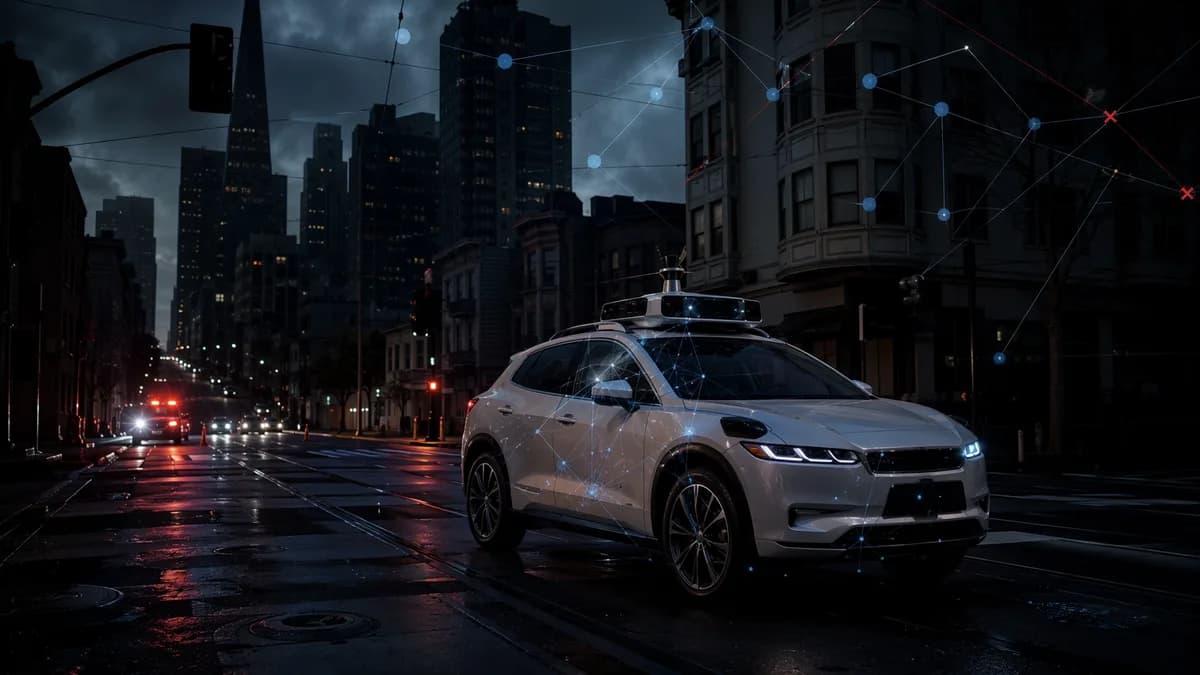
About 7,000 PG&E customers were reportedly affected by the outage behind the latest Waymo San Francisco power outage disruption, a much smaller footprint than the December blackout that still managed to expose the same hard question: how autonomous is a robotaxi network when the city around it loses power?
XOOMAR Intelligence
Analyst Take
Waymo told riders that service was “temporarily paused” and that “freeway routes are unavailable,” according to a screenshot posted on social media and reported by TechCrunch. The Alphabet-owned company told TechCrunch it was making “temporary adjustments” while monitoring local conditions.
“We are making temporary adjustments to our service while we monitor local conditions. We know riders depend on us, and we will return to normal operations as soon as possible.”
A 7,000-customer outage turned Waymo San Francisco power outage risk into the real story
The headline is not that Waymo’s robotaxi service appeared to pause. The sharper point is that a driverless service can still be deeply dependent on non-driver infrastructure.
TechCrunch reports that the outage appeared to affect around 7,000 PG&E customers in San Francisco. That is not citywide paralysis. Yet Waymo still made service changes, at least according to its own statement and the customer screenshot TechCrunch cited.
That makes the Waymo San Francisco power outage episode a useful stress test. A robotaxi can perform well under normal operating conditions and still face difficult risk decisions when utility service, road conditions, rider demand, and city operations become less predictable.
XOOMAR analysis: the central test is no longer simply whether Waymo’s vehicles can drive. It is whether the commercial network can fail gracefully when the city is degraded. In transportation, reliability is not a side feature. It is the product.
The July service pause is not the same as a vehicle failure
TechCrunch does not report that Waymo vehicles stalled during the July 18 outage. It does not confirm dark traffic lights, blocked intersections, charging problems, app failures, or remote assistance overload during this specific incident.
That distinction matters.
A vehicle-level failure would mean the robotaxi itself could not handle a condition in front of it. A network-level pause can mean the operator chose to narrow or halt service because the surrounding operating environment became harder to manage safely.
Those are different problems, with different implications.
| Question | What the July 18 source confirms | What remains unconfirmed |
|---|---|---|
| Outage scale | Around 7,000 PG&E customers appeared affected | Which neighborhoods were affected |
| Waymo service status | Customer screenshot said service was “temporarily paused” | How long the pause lasted |
| Routing limits | Screenshot said “freeway routes are unavailable” | Whether all non-freeway trips were blocked |
| Vehicle behavior | Waymo said it made “temporary adjustments” | Whether vehicles stalled or blocked traffic |
| Operations impact | Waymo said it was monitoring local conditions | Whether charging, dispatch, or remote assistance was affected |
A cautious pause can be the right call. It may prevent stranded riders, confusing routing, or conflicts with emergency activity. But repeated pauses during outages would weaken the claim that robotaxis can serve as dependable urban mobility, especially in a city where power and traffic disruptions are not theoretical.
The numbers Waymo has not disclosed matter more than the screenshot
The available numbers are thin, but they point to the metrics that should define the next phase of scrutiny.
For the July 18 incident, readers should watch for:
- Duration: How long was San Francisco service paused or limited?
- Coverage: Which parts of the service area were unavailable?
- Fleet exposure: How many Waymo vehicles were active nearby?
- Customer impact: Were trips canceled, delayed, or rerouted?
- Recovery: Did service return all at once, or in staged zones?
- Freeway access: Why were “freeway routes” unavailable, and for how long?
XOOMAR analysis: autonomy should be judged by uptime as much as by driving competence. A passenger does not experience a disengagement rate. They experience whether a car arrives, whether it completes the trip, and whether the app gives a clear answer when conditions change.
This is also where physical infrastructure collides with AI deployment. XOOMAR has tracked that tension in other contexts, including energy-intensive AI infrastructure in $6B Valuation Thrusts Valar Atomics Into AI Power Race and reliability failures at the customer interface in AI Customer Service Chatbots Trap $2,000 Ebike Buyer. Waymo is a different product, but the lesson rhymes: AI systems are judged hardest where software meets messy real-world operations.
The December blackout gives this outage a heavier shadow
This is not Waymo’s first power-related problem in San Francisco.
TechCrunch notes that a number of Waymo vehicles stalled on city streets during a blackout in December, and that a similar incident paralyzed traffic during a Golden Gate Bridge fireworks show on the Fourth of July. The December event was much larger. According to AP reporting carried by NBC Bay Area, that outage affected 130,000 homes and businesses in San Francisco, nearly one-third of PG&E customers served in the city, and was caused by a fire at a power substation.
During that December outage, AP reported that some Waymo vehicles stopped with hazard lights blinking, while others stopped in intersections and forced other cars to move around them. Waymo said its vehicles are designed to treat nonfunctioning traffic signals as four-way stops, but said the scale of the outage created unusual conditions.
“While the failure of the utility infrastructure was significant, we are committed to ensuring our technology adjusts to traffic flow during such events,” a Waymo spokesperson said in the AP report. “Throughout the outage, we closely coordinated with San Francisco city officials.”
That history changes how the July 18 pause reads. If Waymo limited service before a visible street problem emerged, that may show a more conservative operating posture. If the pause followed recurring outage concerns, it also gives regulators and city officials more evidence to demand clearer plans.
San Francisco Mayor Daniel Lurie has already called for tougher state regulations to “adequately address how autonomous vehicles operate during major incidents, planned or not,” according to TechCrunch.
Riders, city officials, and Waymo will read the same pause differently
Waymo’s view is straightforward. A temporary service adjustment during unstable local conditions can signal discipline. It is better to pause than to create avoidable risk.
Riders may see it differently. A robotaxi that vanishes during an outage may feel less dependable than a human-driven ride option, especially if the app does not explain where service is available or when trips will resume. TechCrunch’s report says customers were told service was “temporarily paused,” but it does not report how many riders saw that message or how many trips were affected.
City officials and emergency responders have the hardest standard. Outages already create pressure on intersections, public transit, roads, and emergency response. Their concern is not whether a single robotaxi behaves correctly in isolation. It is whether hundreds of autonomous vehicles can avoid adding blocked lanes, stalled curb space, or confusion during an incident.
For operators and investors, the signal is operational rather than dramatic. Frequent interruptions could pressure utilization assumptions and expansion timelines. But the source material does not provide revenue impact, downtime, or fleet counts for July 18, so those remain questions, not conclusions.
Power resilience is now part of the robotaxi safety case
The Waymo San Francisco power outage report points to a practical requirement for autonomous ride-hailing: outage planning has to be treated as core infrastructure.
That does not mean Waymo must operate through every incident. It means customers and cities will expect clearer rules. If service is paused, the app should say where, why, and what happens to active trips. If freeway routes are unavailable, riders should know whether surface-street trips remain possible. If vehicles are being pulled back, the public should not have to infer that from social media screenshots.
XOOMAR analysis: the next credible safety case for robotaxi operators will include more than sensors, maps, and driving policy. It will include backup operating procedures, utility coordination, service-boundary controls, and playbooks for degraded city conditions.
The key evidence to watch is simple: whether Waymo publishes clearer post-incident explanations, whether San Francisco or state regulators ask for outage response plans, and whether future pauses become rarer, shorter, and less confusing.
The winners in autonomous ride-hailing will not be the companies that never pause. They will be the ones that make pauses rare, clear, safe, and boring.
Impact Analysis
- The pause shows robotaxi reliability depends on city infrastructure, not just vehicle autonomy.
- Even a limited outage can force service changes that affect rider trust and availability.
- Waymo’s response highlights the need for autonomous networks to fail safely during disrupted conditions.
Waymo San Francisco outage context
| Event | Reported scope | Waymo response |
|---|---|---|
| Latest San Francisco outage | About 7,000 PG&E customers affected | Service temporarily paused and freeway routes unavailable |
| December blackout | Larger than the latest outage, according to the summary | Raised similar questions about robotaxi network resilience |
Reported PG&E Customers Affected
Primary Sources & Disclosures

Written by
XOOMAR Insights Team
Research and Editorial Desk
The XOOMAR Insights Team pairs automated research with human editorial judgment. We track hundreds of sources across technology, fintech, trading, SaaS, and cybersecurity, cross-check the facts, and explain what happened, why it matters, and what to watch next. We do not just rewrite headlines. Every article is fact-checked and scored for reliability before it goes live, and we link back to the original sources so you can verify anything yourself.