
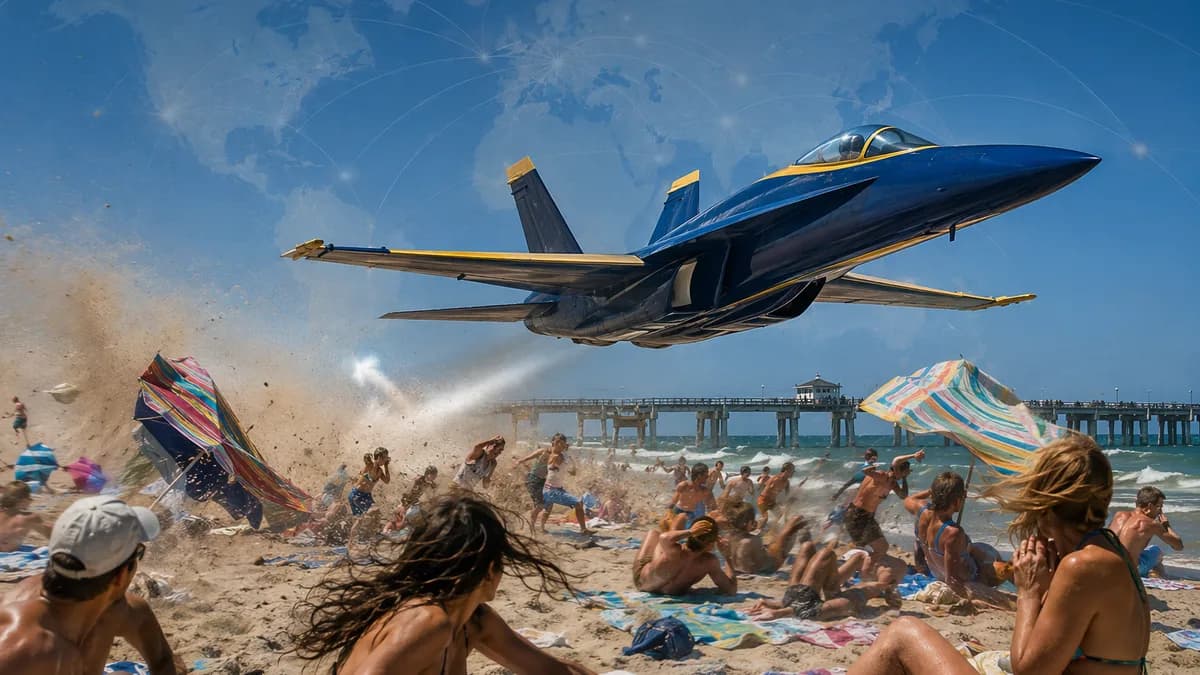
No injuries were reported after a US Navy Blue Angels low flypast over Pensacola Beach, Florida, on Wednesday, but beach umbrellas, chairs, and other loose items were thrown into the air as the jet passed over a packed crowd.
Global TrendsJuly 18, 2026· 7 min read· By XOOMAR Insights Team
Blue Angels Low Flypast Sends Pensacola Beach Gear Flying
Updated on July 18, 2026
XOOMAR Intelligence
Analyst Take
57/ 100
4 sources analyzedLow confidenceTrend10Freshness95Source Trust92Factual Grounding88Signal Cluster20
That tension is the story. The flyby delivered the spectacle people came to see, then immediately raised the question every modern airshow operator has to answer: how close is too close when the audience is sitting on sand, filming from every angle, and surrounded by loose gear? Beachgoers captured the moment on video, according to BBC World, and the clip quickly became less about awe alone and more about safety judgment.
A Blue Angels low flypast became a beach-safety stress test
The Blue Angels are built around precision. That’s why the Pensacola Beach clip landed with such force. It wasn’t a random private aircraft buzzing a shoreline. It was an aircraft from an elite US Navy flight demonstration squadron, flying in front of a crowd that expected controlled danger, not flying beach furniture.
Officials said they are reviewing the incident after the aircraft flew below the expected profile.
"an aircraft flew lower than standard profiles, resulting in a disturbance on the beach that affected civilian chairs and umbrellas"
That statement matters because it narrows the issue. The question isn’t whether the crowd enjoyed it. Some clearly did. The question is whether the maneuver matched the profile the team expected to fly.
One attendee told US media it was an "amazing" experience. Another, quoted by Yahoo from local reporting, said: "I've been coming for 10 years and I've never seen a pass like that in my life." That split reaction is exactly why the incident is hard to dismiss. Thrill and concern came from the same few seconds.
The visible evidence was scattered umbrellas, not reported injuries
The most important fact remains simple: no injuries were reported. That keeps the incident in the category of a reviewable disturbance rather than a tragedy.
Still, loose beach objects are not irrelevant. In a setting like Pensacola Beach, umbrellas, tents, chairs, towels, and coolers become the easiest visible signal of how people on the ground experienced the pass. If gear moves, spectators know the aircraft’s effect reached them.
The official wording also points to the variables investigators will care about, even if they haven’t released measurements: altitude, position relative to the crowd, the intended arrival maneuver, and whether the aircraft stayed within the approved standard profile.
Yahoo reported a fuller official statement from Naval Air Station Pensacola:
"The safety of our hometown community, spectators, and our pilots is our highest priority"
The same statement said team leadership is reviewing the circumstances and conducting a safety review to ensure operations follow Navy and Federal Aviation Administration safety standards. That gives the review two audiences: internal military leadership and a public that has already seen the clip.
Pensacola Beach and the Blue Angels share a powerful, complicated brand
Pensacola is not just another stop for the Blue Angels. The Yahoo report describes the event as the annual "Breakfast with the Blues" in Pensacola Beach, and the squadron’s own identity is tied to public demonstration, Navy pride, and local attention.
The team was formed in 1946, according to the Yahoo report, and is described there as the second-oldest formal aerobatic team in the world. It is made up of six Navy pilots and one Marine Corps pilot, flying Boeing F/A-18E/F Super Hornets and Lockheed Martin C-130J Super Hercules aircraft.
That history raises the stakes. A Blue Angels show is not just entertainment. It is a public-facing military performance built around trust. The audience is supposed to feel close to the power without doubting the control behind it.
Pensacola Beach intensifies that balance. A beach crowd is not seated in a stadium. People bring shade tents, umbrellas, bags, and chairs. They spread out. They react unevenly. That makes the setting visually spectacular, but harder to read from a safety and crowd-management standpoint.
Spectators and officials are reading the same clip in different ways
For spectators, the flypast may be remembered as a once-in-a-decade moment. Ashley Korn told WEAR, according to Yahoo: "I literally thought we were going to be taken out by Blue Angels, but it was amazing."
That quote captures the contradiction. The fear was part of the thrill. But official reviewers can’t treat that as the end of the matter.
A safety-focused reading starts elsewhere: an aircraft flew lower than standard profiles, and civilian property was disturbed. Even without injuries, that is enough to justify asking whether crowd messaging, beach setup, or flight profiles need adjustment before the next event.
The Navy and pilots face a different pressure. Demonstration flying depends on discipline, repetition, and public confidence. A viral clip can compress all of that into one replayed angle, often before the full review is complete.
This is not unique to aviation. Public narratives increasingly form around short, shareable records, whether the subject is politics, security, or technology. XOOMAR has seen that dynamic in very different contexts, including Live TV Fractures Over Trump Election Speech Claims and Steam Malware Hidden in Games Stole $220K, Feds Say. The lesson for the Blue Angels is narrower but sharp: when evidence is visual, institutions have less time to explain what happened.
The unresolved question is whether the profile failed or the setting amplified it
The official review has not yet answered the key operational question: why did the aircraft fly lower than standard profiles?
There are several possibilities, but only the review can establish which one applies. The maneuver may have deviated from expectations. The standard profile may need different safeguards in a beach setting. Or the ground-level video may have made the pass look more alarming than it appeared from an operational perspective while still documenting real disturbance on the sand.
XOOMAR analysis: the most useful way to read this incident is not as a referendum on the Blue Angels’ skill. It is a test of how elite demonstration teams adapt to public events where the audience is close, informal, and recording everything.
For fans, the practical takeaway is direct: secure loose items, follow official viewing guidance, and don’t assume an informal beach vantage point is risk-free just because the event is familiar.
For organizers, the next pressure point is communication. If future beach shows include low passes near crowded sand, spectators will expect clearer guidance about loose gear, crowd positioning, and what areas are safest for viewing.
Future Pensacola flypasts will be judged by safety discipline as much as spectacle
The Blue Angels low flypast in Pensacola Beach will likely be remembered by many attendees as thrilling. It will also sit in official files as a moment that triggered a safety review after beach gear was disturbed.
That dual legacy is the real story. The Blue Angels’ bond with Pensacola can survive one viral clip. But the next beach event will draw sharper attention to visible discipline: where the aircraft flies, how the crowd is prepared, and whether the show looks controlled from the sand as well as from the cockpit.
The evidence that would calm the story is straightforward: a transparent review, clear findings, and any needed adjustments before the next public beach flypast. The evidence that would deepen concern would be repeated low-profile disturbances, especially if officials offer little detail beyond saying safety is the priority.
Impact Analysis
- The incident raises safety questions about how low military demonstration jets should fly over crowded public beaches.
- No injuries were reported, but airborne umbrellas and chairs show how quickly loose objects can become hazards.
- Officials reviewing whether the aircraft flew below standard profiles could influence future airshow procedures.
Sources

Written by
XOOMAR Insights Team
Research and Editorial Desk
The XOOMAR Insights Team pairs automated research with human editorial judgment. We track hundreds of sources across technology, fintech, trading, SaaS, and cybersecurity, cross-check the facts, and explain what happened, why it matters, and what to watch next. We do not just rewrite headlines. Every article is fact-checked and scored for reliability before it goes live, and we link back to the original sources so you can verify anything yourself.
Explore More Topics
Related Articles
 Global Trends
858 Canadian Wildfires Choke Chicago, Detroit and NYC
858 Canadian wildfires are sending hazardous smoke into major US cities, turning a remote fire season into a cross-border health crisis.
Jul 18, 20268 min
 Global Trends
Iran Attacks US Allies as Hormuz War Risk Spreads Fast
Iran widened the war by hitting US allies, dragging Kuwait, Jordan and Bahrain into a fight circling the Strait of Hormuz.
Jul 18, 20267 min
 Global Trends
US Aid Workers Turn Kenya Ebola Quarantine Into Flashpoint
Seven asymptomatic US aid workers are quarantining in Kenya, turning Ebola controls into a fight over risk, consent, and sovereignty.
Jul 18, 20267 min
 Global Trends
Speech Snub Has Trump Threatening TV Network Licenses
Trump turned NBC and ABC's skipped live airing into a license threat, raising a fight over federal power and press freedom.
Jul 18, 20269 min
 Global Trends
Trump Turns Wildfire Smoke Into Canada Tariffs Fight
Trump is threatening Canada with tariffs over wildfire smoke, turning a real air-quality crisis into a border fight.
Jul 18, 20268 min
 Technology
DOJ Cracks Open TikTok Federal Device Ban for Feds
DOJ says TikTok’s restructured U.S. app no longer triggers the federal device ban, letting agencies allow it on work phones.
Jul 18, 20267 min
 Fintech
Alpaca Grabs $135M as Tokenized Stocks Need Plumbing
Alpaca raised $135M to scale the custody, clearing and API rails behind tokenized U.S. stocks.
Jul 18, 20266 min
 Technology
Apple Tax-Free Shopping Dangles Savings in 8 States
Apple buyers in 8 states can skip sales tax from July 17, but product rules and price caps can wipe out the savings.
Jul 18, 20269 min
 Global Trends
EU Entry Exit System Pushes UK Passport Waits to 20 Minutes
Rome says EES has pushed UK passport checks from 7 to 20 minutes, raising the risk of wider summer airport queues.
Jul 19, 20269 min
 Global Trends
Bluey Indigenous Language Episodes Bring Yolngu Matha Home
Bluey’s Yolngu Matha episodes turn language preservation into something kids can hear, repeat and share at home.
Jul 19, 20268 min
Don't miss the signal
Get our weekly roundup of the stories that matter across tech, fintech, and trading. No noise, just signal.
Free forever. No spam. Unsubscribe anytime.