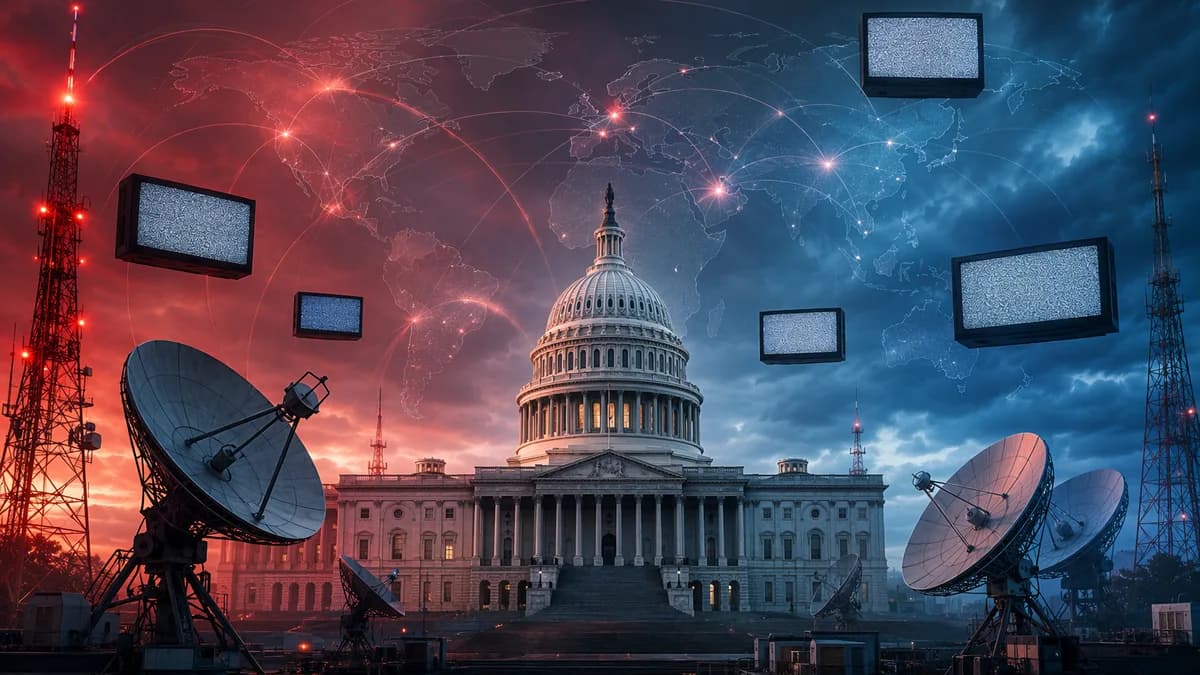
Trump’s broadcast-license threat signals a shift from attacking press coverage to invoking state power against outlets that make editorial calls he dislikes. President Donald Trump used his Thursday night election security address to accuse NBC and ABC of joining a “plot” because they did not carry the speech live on their main broadcast channels, according to Time.
XOOMAR Intelligence
Analyst Take
The immediate trigger was narrow. NBC and ABC did not air the 25-minute address live on their primary networks, though Time reported both carried Trump’s remarks on their streaming channels. Other networks, including CBS, MS NOW, and Fox News, broadcast part or all of the speech. The President treated that programming decision as evidence of deception.
“Fraud like this should mean a revocation of their licenses.”
That line is the center of the dispute. Presidents routinely complain about coverage. Trump has made that a signature move. But the broadcast-license fight is different because it ties negative or insufficient coverage to punishment through federal broadcast authority.
There is also an important legal distinction. In U.S. broadcast law, FCC licenses generally attach to individual broadcast stations, not to national networks as editorial entities. ABC and NBC are network brands whose programming reaches viewers through owned stations, affiliates, and digital platforms. Cable and streaming outlets, including CNN, do not hold broadcast licenses in the same way. Trump used broad “licenses” language, but the law is more specific than the rhetoric.
For readers tracking the same speech and the split-screen TV response, this analysis focuses on the pressure mechanism behind Trump’s demand, not just the airtime decision.
Trump’s broadcast-license threat turns a programming call into a power test
Trump framed the networks’ decision as intentional suppression, not editorial judgment. During the address, he said:
“In a rare move, NBC and ABC ‘Fake' News have both said that they would not cover this speech. They knew what it was about.”
He then escalated. As he made allegations about foreign interference in U.S. elections, Trump said major TV networks “are part of a plot, they want to continue this fraud, for whatever reason.” The White House’s Rapid Response social media account also criticized CNN for not carrying the speech live.
The strongest counterpoint is simple: NBC and ABC did not fully black out the remarks. Time says both carried the speech on streaming channels. Yahoo also reported that both networks aired special reports summarizing Trump’s remarks after he concluded. That weakens any claim that the public had no route to see what he said.
But XOOMAR’s analysis is that the factual availability of the speech may not be the real point. The pressure works through escalation. A live-broadcast decision becomes “fraud.” “Fraud” becomes a threat aimed at broadcast licenses. That threat can then sit over future newsroom choices, even if no station license is actually revoked.
The FCC argument runs into a First Amendment wall
Legal experts cited by USA TODAY said the Federal Communications Commission cannot punish broadcasters simply because they declined to air a President’s speech live. Robert Corn-Revere, chief counsel at the Foundation for Individual Rights and Expression, put it bluntly:
“The First Amendment doesn’t permit the president to demand coverage by royal decree.”
David Keating, president of the Institute for Free Speech, made the editorial-control point just as directly:
“The government is not in charge of deciding what is newsworthy and what isn’t newsworthy, what needs to be carried live and what doesn’t.”
That does not mean the FCC is irrelevant. USA TODAY reported that the FCC has limited power to revoke broadcast licenses, and that experts said an attempt to pull licenses over editorial decision-making is possible, even if unlikely to survive. Keating said such a move “certainly wouldn’t surprise me” if FCC Chairman Brendan Carr tried it, but added: “I don’t think it would be successful in the end.”
The legal question, then, is not whether the President can complain. He can. The harder question is whether federal authority can be invoked against coverage decisions without becoming retaliation. On the supplied record, experts say that bar is constitutionally high.
The distinction between stations and networks matters here, too. The FCC’s broadcast licensing authority is not a general power to discipline national news brands for editorial choices. Any actual license fight would have to move through the law governing particular broadcast licensees, not through the broader political shorthand Trump used.
NBC, ABC, CNN, CBS, MS NOW, and Fox made different calls on the same speech
The programming split matters because Trump treated non-live carriage as misconduct, while the networks’ actual choices were more varied.
| Outlet | Reported handling of Trump’s speech |
|---|---|
| NBC | Did not carry live on main broadcast, carried remarks on streaming channel |
| ABC | Did not carry live on main broadcast, carried remarks on streaming channel |
| CNN | Did not carry live, White House Rapid Response criticized the decision |
| CBS | Broadcast part or all of the speech, according to Time |
| MS NOW | Broadcast part or all of the speech, according to Time |
| Fox News | Broadcast part or all of the speech, according to Time |
Time also notes that TV networks are not required to provide live coverage of Presidential speeches. Some have declined to air addresses from former Presidents, including Joe Biden’s 2022 speech on threats to democracy.
That comparison matters because it cuts against the idea that a network declining live carriage is automatically extraordinary or fraudulent. The counterpoint for Trump is that he argued this speech concerned election security, a topic he presented as urgent. But urgency does not erase editorial discretion.
It also does not convert every platform into the same kind of license holder. NBC and ABC’s broadcast programming is connected to licensed stations, while CNN’s distribution model is different. That makes the President’s political complaint broader than the FCC’s direct licensing framework.
Fox’s $787.5 million settlement hangs over live election claims
There is another reason networks may hesitate before carrying election-related claims live. Time points to Fox News’ $787.5 million defamation settlement over false claims related to the 2020 election as a backdrop for broadcaster caution.
That figure is not incidental. It is the clearest supplied data point explaining why live, unfiltered election allegations create risk for media companies. The decision not to air something live does not necessarily mean burying it. It can mean choosing to verify, contextualize, or summarize claims after they are made.
Trump’s accusation flips that logic. In his framing, caution becomes concealment. In newsroom logic, caution after a major defamation settlement can be a risk-control decision. Both sides are talking about trust, but they define the danger differently.
That difference is especially sharp with election claims. Live television leaves little room for immediate verification. Delayed summaries, streaming carriage, or edited segments can be editorial methods for reducing legal and factual risk. Trump’s criticism treats those methods as evidence of political hostility.
Carr’s FCC investigations make the license rhetoric harder to dismiss
Trump’s latest remarks did not appear in isolation. Time describes broader tension around Trump’s attacks on media outlets and the role of Brendan Carr, a Trump ally who chairs the FCC. Deadline also framed the remarks as part of a larger confrontation between Trump and major broadcasters.
That context matters, but it should not be overstated. The supplied record supports concern about regulatory pressure, not a conclusion that the FCC can simply revoke a national network’s status as punishment for declining live coverage. The legal structure remains narrower: broadcast licenses generally belong to individual stations, and any attempt to target editorial decisions would face serious First Amendment objections.
This is where the license rhetoric becomes more than a rhetorical flare-up, even if it remains legally imprecise. A President is calling for revocation in response to a programming decision, while the communications regulator is led by an ally who has publicly been part of the broader media-pressure landscape. That does not prove coordination or predetermine an outcome. It does show why broadcasters, lawyers, and investors would read the threat as part of a broader pressure cycle.
The practical worry is not only whether a revocation attempt would succeed. It is whether the possibility of investigations, public attacks, legal costs, or license uncertainty could influence editorial decisions before any formal case begins.
Late-night fights turned entertainment programming into regulatory anxiety
Trump’s feud with television programming adds another layer to the same pressure question. The broader issue is not limited to hard-news broadcasts. Entertainment shows, late-night monologues, interviews, and political commentary can all become targets when a President treats unfavorable coverage as something regulators should examine.
The supplied record is strongest on the election-speech dispute itself, so the late-night context should be read as background rather than proof of any specific regulatory outcome. The pattern still matters analytically: when political criticism of media companies is paired with references to federal power, executives may begin to view ordinary programming choices through a legal and regulatory lens.
That is the chilling-effect question. A network does not need to lose a license for pressure to matter. Producers may ask whether a joke, interview, live segment, or fact-check will trigger a public attack. Lawyers may advise more caution. Managers may decide that a fight is not worth the cost, even if the First Amendment argument is strong.
The same legal distinction remains important here. Late-night programs air across different platforms and through different distribution arrangements. Treating them all as if a national network itself holds one revocable license oversimplifies the law. But Trump’s political language can still create pressure because broadcasters and their parent companies operate in a regulated environment.
The real test is whether threats change newsroom behavior before any license fight begins
The strongest legal reading from the supplied sources is that actual license revocation over an editorial decision would face steep First Amendment barriers. Anna Gomez, an FCC commissioner appointed by Joe Biden in 2023, called Trump’s demand “ridiculous” in a statement to USA TODAY and said the FCC “has no authority to punish a station for refusing to air a blatantly political speech.”
That wording is important because it names the proper legal unit: a station. Trump’s criticism was aimed at NBC and ABC as national brands, but FCC broadcast licenses are not a general permission slip for a network’s editorial identity. Any real enforcement theory would have to fit within station-based licensing rules and constitutional limits.
But the practical effect does not require a successful revocation. It can come from legal cost, management caution, FCC uncertainty, public attacks, and internal debates over whether airing, editing, delaying, or fact-checking Trump creates less risk.
Evidence that would strengthen XOOMAR’s thesis would include more FCC activity tied directly to political coverage decisions, more public threats from Trump naming specific broadcasters or stations, or network executives changing programming after those threats. Evidence that would weaken it would be clear FCC restraint, consistent treatment across political parties, and networks continuing to make live-coverage calls without visible retreat.
The next phase of the broadcast-license fight will not be measured only in court filings. It will be measured in editorial rooms, where the question becomes whether independent coverage still feels like a protected judgment, or a regulated risk.
Impact Analysis
- Trump’s threat shifts the dispute from media criticism to potential use of federal broadcast authority.
- FCC licenses apply to individual broadcast stations, not national networks as a whole, making the legal issue more complex than the rhetoric.
- The clash raises broader concerns about whether editorial programming decisions could face political punishment.
How Networks Handled Trump’s Election Security Address
| Outlet | How It Handled the Speech |
|---|---|
| NBC | Did not air the 25-minute address live on its main broadcast channel; carried remarks on streaming |
| ABC | Did not air the 25-minute address live on its main broadcast channel; carried remarks on streaming |
| CBS | Broadcast part or all of the speech |
| MS NOW | Broadcast part or all of the speech |
| Fox News | Broadcast part or all of the speech |
Primary Sources & Disclosures

Written by
XOOMAR Insights Team
Research and Editorial Desk
The XOOMAR Insights Team pairs automated research with human editorial judgment. We track hundreds of sources across technology, fintech, trading, SaaS, and cybersecurity, cross-check the facts, and explain what happened, why it matters, and what to watch next. We do not just rewrite headlines. Every article is fact-checked and scored for reliability before it goes live, and we link back to the original sources so you can verify anything yourself.