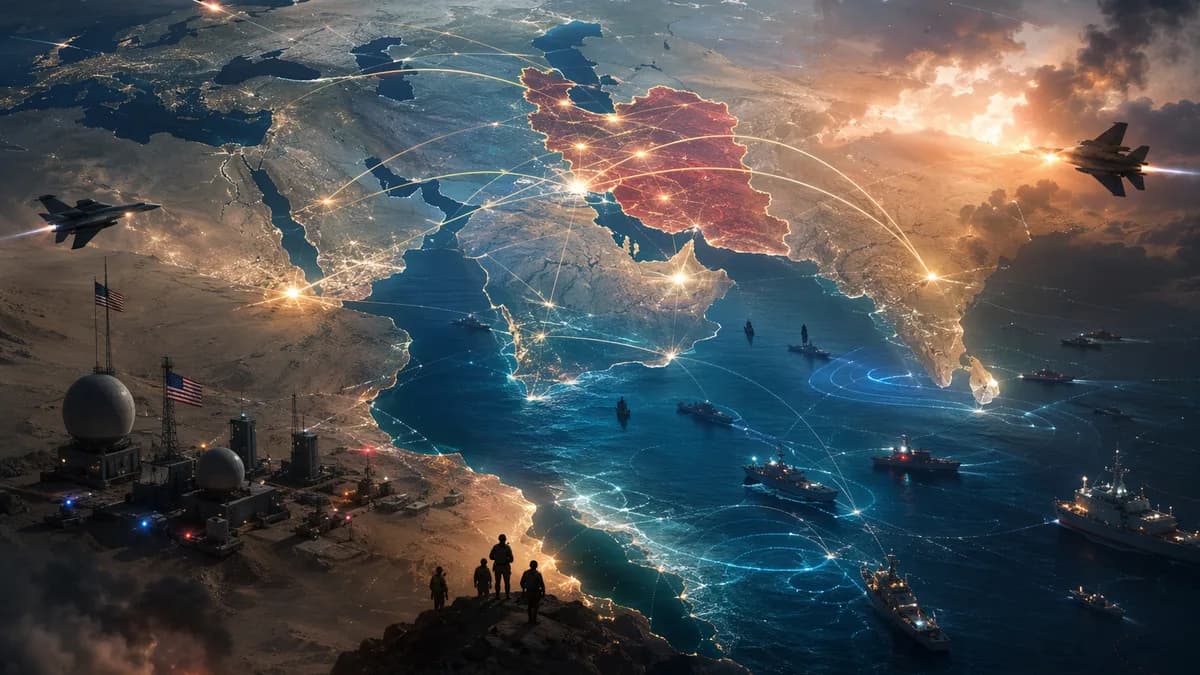
The renewed US-Iran conflict is no longer a two-sided exchange: Iran attacks US allies across the Middle East as American strikes on Iran enter a second week and fighting intensifies around the Strait of Hormuz.
XOOMAR Intelligence
Analyst Take
Kuwait accused Iran of targeting civilian sites and vital infrastructure, Jordan said its air defenses downed Iranian missiles, and Bahrain activated air sirens after detecting possible incoming drones or missiles, according to Guardian World.
Iran strikes Kuwait, Jordan and Bahrain after the war spills past Tehran and Washington
The latest escalation followed a seventh consecutive night of US strikes on Iran. US Central Command said its overnight attacks hit Iranian “surveillance sites, military logistics infrastructure, underground weapons storage, and maritime capabilities.”
Iran’s response widened the battlefield. Kuwait said it intercepted Iranian missiles and drones, while Jordan’s state-run Petra news agency said the kingdom’s air defense systems had downed Iranian missiles.
Bahrain’s warning was less definitive but still serious. Authorities sounded sirens on Saturday and told residents to shelter after detecting possible incoming drones or missiles.
The fighting is now wrapped around the Strait of Hormuz, the waterway that has become the center of the military and energy risk. For more context on that pressure point, see XOOMAR’s Strait of Hormuz trade route fears, Strait of Hormuz Erupts as Trump’s New Iran War Lever and Seventh Night of US Iran Strikes Rattles Hormuz Route.
Iran’s Revolutionary Guard Corps said it struck a US military support center at Camp Arifjan in Kuwait and destroyed a US radar facility at Ali Al Salem airbase. It also claimed attacks on US-linked targets in Bahrain and Jordan, including aircraft.
Those Iranian claims have not been confirmed by US officials in the supplied material. The US military also rejected a separate IRGC claim that two oil tankers had exploded after hitting mines in the Strait of Hormuz, saying the claim was false.
Before Saturday’s barrage, the war was already escalating. After it, the map changed.
- Before: The core exchange was US strikes on Iranian targets and Iranian retaliation against US interests.
- After: Kuwait, Bahrain and Jordan are now publicly inside the strike zone.
- Before: Hormuz was the main maritime flashpoint.
- After: Civilian infrastructure and Gulf air defenses are part of the immediate crisis.
- Before: Gulf states faced spillover risk.
- After: Kuwait says it was directly targeted.
Kuwait desalination plant claim turns infrastructure into the central danger
Kuwait’s allegation cuts deeper than a military-base strike. The country said Iran targeted civilian sites and vital infrastructure, including a power and water desalination plant.
That matters because Kuwait is extremely arid and relies on desalinated water for about 90% of its drinking water. A strike on that system, even if limited, can quickly move from military escalation to a civilian emergency.
Kuwait said several firefighters and a worker were injured while responding to blazes sparked by Iranian strikes. The Kuwait Petroleum Corporation also said an oil facility was targeted, causing injuries and “significant material losses.”
The country briefly closed its airspace while intercepting Iranian missiles and drones. USA Today’s supplied reporting also said Kuwait International Airport operations were suspended because of repeated missile and drone threats.
Kuwait’s foreign ministry framed the attacks as systematic, not accidental.
“The repeated targeting of these vital facilities reveals a systematic hostile approach targeting civilian sites and vital infrastructure that endangers the lives and safety of civilians,” the foreign ministry of Kuwait said.
The Gulf Cooperation Council went further. Secretary-general Jasem Mohamed al-Budaiwi said attacks on civilian infrastructure amounted to “war crimes.”
“Iran’s actions constitute a highly dangerous escalation, a grave violation of international law and the United Nations (UN) Charter, as well as war crimes requiring international accountability and prosecution, given the deliberate targeting of infrastructure and civilian facilities,” al-Budaiwi said.
Iran says its attacks are a response to US strikes on civilian infrastructure, including bridges and power facilities. Iranian media reported explosions or strikes in Sirik, Ahvaz and Yazd, while Iran’s health ministry said US strikes have killed 50 people and wounded more than 500 since hostilities resumed.
The Iranian energy ministry acknowledged successful US “attacks on power infrastructure” for the first time on Friday. It urged people in southern provinces facing extreme heat to use less power, but did not specify what had been hit.
Strait of Hormuz escalation puts Gulf defenses and oil markets on alert
The Strait of Hormuz is now doing two things at once: absorbing military pressure and transmitting market anxiety. Supplied reporting says the waterway carries about one-fifth of the world’s oil supply.
That is why each claim involving tankers, mines, airbases or oil infrastructure carries weight beyond the battlefield. The IRGC said two oil tankers tied to “deceptive American intelligence agencies” exploded after hitting mines in the strait. The US military said that was false.
Iran also said it had “stopped” four ships trying to transit the waterway. Separately, related source material said only eight ships passed through the strait on Thursday, compared with more than 130 ships a day before the war.
Oil prices climbed more than 4% on Friday to their highest level in more than a month, according to supplied Reuters-linked reporting. Traders now have to price more than missile salvos. They have to price airspace closures, tanker movement, insurance costs and the chance that a commercial route becomes a military bargaining chip.
This is the gap that matters: Washington says it is degrading Iranian military capability, while Tehran is signaling that US-aligned states can pay a direct cost for hosting or supporting American military activity.
The risk is not a single strike. It is the compounding effect of interceptions, misread radar tracks, damaged energy sites and claims that outpace verification.
A useful comparison:
| Flashpoint | Reported development | Immediate risk |
|---|---|---|
| Kuwait | Missiles and drones intercepted, civilian infrastructure allegedly targeted | Water, power and oil facilities exposed |
| Jordan | Air defenses reportedly downed Iranian missiles | Wider regional missile defense activation |
| Bahrain | Sirens sounded after possible incoming drones or missiles | US-linked military sites under threat |
| Strait of Hormuz | Tanker and ship claims disputed by US | Shipping disruption and market volatility |
Washington’s next move will decide whether this stays contained or spreads
The next phase depends on whether the US keeps its strikes at the current tempo, expands the target list, or shifts pressure toward diplomacy. US Central Command says the campaign is meant to “continue degrading Iranian military capabilities.”
Iran is threatening to move beyond proportional retaliation. Maj Gen Mohsen Rezaee, a senior military adviser to Iran’s supreme leader, said Tehran will resume “full-scale offensive operations” if US strikes continue for another two or three days.
“Iran will no longer limit itself to retaliatory, like-for-like responses … and no political border will be safe,” Rezaee said, according to IRIB.
Iran’s supreme leader, Mojtaba Khamenei, also warned of “unforgettable lessons” if the US continues attacks. The statement attributed to him was read on state television, and Guardian World reported he has not been seen since the war began.
For Gulf governments, the immediate tasks are blunt: confirm casualties, assess damage, harden missile defenses, reopen airspace safely where possible, and decide how publicly to pressure Washington and Tehran.
For markets, the watch items are just as clear: tanker traffic through Hormuz, verified damage to oil or desalination infrastructure, and any formal move by Gulf states toward emergency consultations or UN action.
The conflict has moved from direct US-Iran strikes into a regional test of alliances, infrastructure resilience and deterrence. The next few days will show whether Saturday’s attacks were a warning shot to US allies, or the start of a broader campaign against the systems that keep Gulf economies running.
Impact Analysis
- The conflict is expanding beyond direct US-Iran strikes into allied countries across the region.
- Fighting near the Strait of Hormuz raises major risks for global energy flows and shipping security.
- Attacks on US-linked facilities increase the chance of deeper American and regional military involvement.
Iranian Attacks and Responses Across US Allies
| Country | Reported Threat | Response or Claim |
|---|---|---|
| Kuwait | Missiles and drones targeting civilian sites, infrastructure, and US-linked facilities | Said it intercepted Iranian missiles and drones; Iran claimed strikes on Camp Arifjan and Ali Al Salem airbase |
| Jordan | Iranian missiles and alleged US-linked targets | Said air defenses downed Iranian missiles |
| Bahrain | Possible incoming drones or missiles and alleged US-linked targets | Activated air sirens and told residents to shelter |
Primary Sources & Disclosures

Written by
XOOMAR Insights Team
Research and Editorial Desk
The XOOMAR Insights Team pairs automated research with human editorial judgment. We track hundreds of sources across technology, fintech, trading, SaaS, and cybersecurity, cross-check the facts, and explain what happened, why it matters, and what to watch next. We do not just rewrite headlines. Every article is fact-checked and scored for reliability before it goes live, and we link back to the original sources so you can verify anything yourself.