
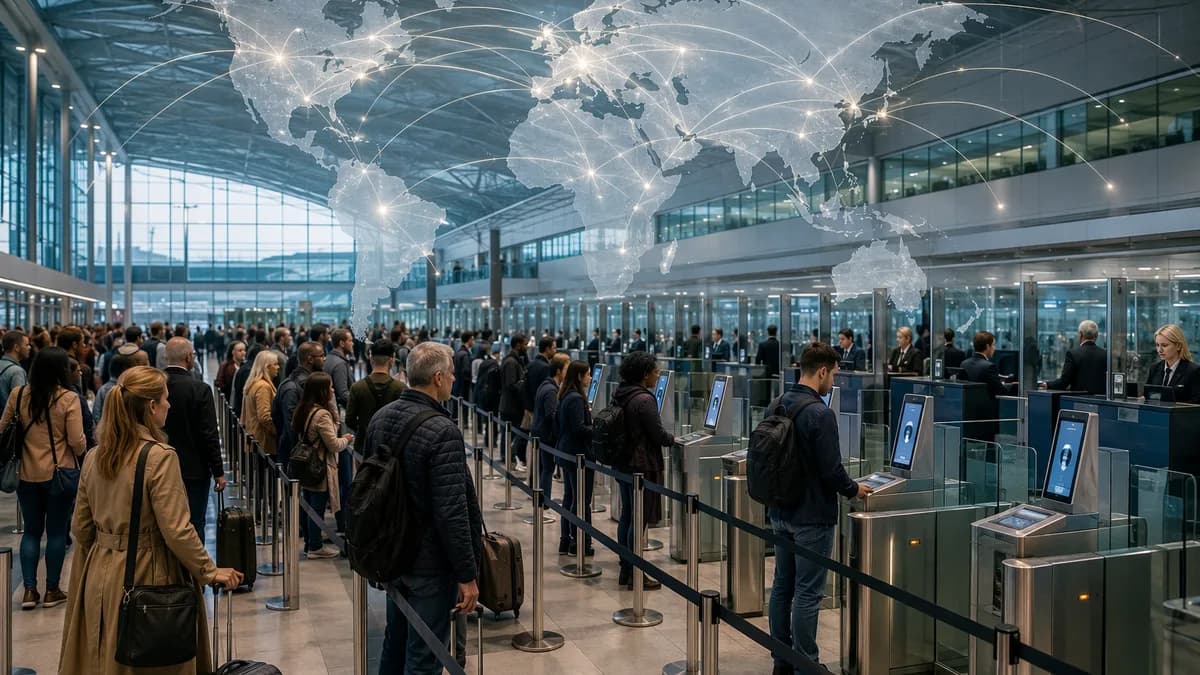
The EU Entry Exit System is already pushing UK passport control times at Rome Fiumicino from seven minutes to 20 minutes, even after airport fixes, according to the airport’s Chief Aviation Officer.
Global TrendsJuly 19, 2026· 9 min read· By XOOMAR Insights Team
EU Entry Exit System Pushes UK Passport Waits to 20 Minutes
Updated on July 19, 2026
XOOMAR Intelligence
Analyst Take
58/ 100
4 sources analyzedLow confidenceTrend10Freshness97Source Trust92Factual Grounding90Signal Cluster20
That warning comes from Ivan Bassato, who told BBC World that Rome’s main airport has improved the process by linking biometric registration to e-gates, but still hasn’t restored the speed passengers had before the new checks. Ryanair is now telling UK passengers heading to Europe this summer to “allow extra time for their journey and be prepared for extended waits at passport control.”
The practical problem is simple. A border process that used to be a passport check now includes biometric registration for many non-EU travellers entering the Schengen area. At scale, that changes everything.
Why could EU passport queues get much longer for UK travellers this summer?
UK travellers face longer waits because the Entry Exit System, or EES, adds a digital registration step at the border for non-EU citizens entering the Schengen area, which the BBC says is made up of 29 European countries.
The system requires travellers to register fingerprints and a photo when they arrive. That information is then checked when they leave. The checks are often handled through standalone automated machines known as kiosks, though some passengers go through border officers instead.
Families are especially exposed. At Rome Fiumicino, children under 12 cannot use the e-gates and must go to a border officer. In Portugal, children under 16 go to border police staff to have their biometric information recorded.
Ryanair said “the failed EES rollout” was causing unnecessary delays and long queues.
The issue is not only that one person takes longer. It is that planes land in waves. If several full flights arrive close together, a few extra minutes per passenger can turn a manageable queue into a hall full of tired travellers.
That is why this story matters beyond Rome. It is a technology rollout hitting real-world infrastructure at peak travel time. XOOMAR has tracked similar stress points in public systems, from accountability after the Genoa bridge disaster verdict to transport disruption after US strikes on Iran hit airports, bridges and rail. Border technology is less visible, until it stops moving people.
What is the EU Entry Exit System replacing passport stamps?
The EU Entry Exit System is a digital border process for non-EU citizens entering and leaving the Schengen area. It replaces parts of the older routine where border officers checked passports manually and stamped documents.
Under the system described by the BBC, eligible non-EU travellers register fingerprints and a photo when they arrive. That data is checked when they leave. The new process has been phased in since October.
The core change is biometric. A passenger is no longer only presenting a passport. They are being enrolled into a digital process that links their identity to fingerprints and a facial image.
| Old passport-control routine | Entry Exit System routine |
|---|---|
| Passport presented to border officer | Passport presented plus biometric registration |
| Manual passport stamp | Fingerprints and photo recorded for eligible travellers |
| Short interaction in many cases | Extra kiosk, e-gate, or officer step |
| Children processed with family at officer desk | Some children must go to border officers for biometric recording |
Rome’s experience shows the tension. Fiumicino spent €12m ($13.7m, £10.2m) on self-service kiosks, but the airport found it impractical to have large volumes of passengers using those machines. It then shifted UK nationals and others toward passport e-gates for fingerprint and photo registration.
That helped, but it did not solve the problem.
Bassato said integration with e-gates “improved things significantly”.
Yet the average time for UK nationals to get through the border still rose from seven minutes to 20 minutes.
How do biometric checks change the airport routine?
The new airport routine depends on the terminal and the passenger, but the BBC reporting gives the broad shape: non-EU travellers register fingerprints and a photo, usually through kiosks or e-gates, and some groups are handled by border officers.
That creates three operational choke points:
- Machines: Kiosks and e-gates need to work quickly and in enough volume.
- People: Border officers still handle children and cases that machines cannot process.
- Space: Queues need somewhere to go when arrivals bunch together.
At Rome Fiumicino, the airport tried to improve flow by moving UK nationals into e-gates for biometric registration. At Faro airport in Portugal, Superintendent Pedro Oliveira told the BBC that automated machines were generally the quickest way through the border.
But the technology is not always stable.
“[EES] makes us very dependent on the technology…. servers often are intertwined and connected, so sometimes something that happens in Warsaw affects our system here.”
Oliveira added:
“At times, there are just complications with the server of the European Union. Sometimes crashes happen in all member states at the same time, and we need a few minutes to reboot everything.”
He said this was happening less often. More border officers have also been recruited to help in Portugal.
Why are airport bosses saying passport control can nearly triple?
Bassato’s numbers explain the pressure better than any abstract warning. At Fiumicino, UK nationals went from seven minutes at the border to 20 minutes after EES, even after improvements.
That is close to a tripling of time. In a quiet terminal, that may feel irritating. During peak arrivals, it becomes a queue-management problem.
A border hall works like any constrained processing system. If passengers arrive faster than booths, kiosks, or e-gates can clear them, the queue does not grow politely. It backs up. It spills into corridors. It makes onward plans fragile.
The BBC found examples across Europe:
- Rome: Carl, travelling from Yorkshire with his family, said, “It was two hours queuing, from getting off the plane to getting through with children. I knew it was going to be bad, but not as bad as that.”
- Rome: David, visiting from the US with his wife Marlo, said the queue took about an hour. “We actually missed our car, our driver.”
- Barcelona: Barry, from Bracknell, said passport control took 45-50 minutes because some machines were not working.
- Barcelona: Sarah said passport control took nearly as long as the flight. “The queue was huge, nearly an hour… it was just slow”.
The European Commission’s position is more measured. It said disruption is limited in most EU airports and that it will keep supporting member states during implementation.
“This support will continue to the fullest extent possible.”
That leaves a gap between policy confidence and airport-floor reality. The system may be workable in most places, but the failures are concentrated exactly where travellers notice them: busy terminals, peak flights, families, and broken machines.
What would a long EU border queue look like for a family flying to Spain?
Take a UK family landing at a busy Spanish airport on a Saturday morning, alongside several other flights from Britain. The old routine may have meant passports, a brief check, and a stamp. Under the Entry Exit System, eligible travellers may need biometric registration instead.
If machines are available and working, the family may move through kiosks or e-gates. If children are too young for automated gates, they may need to see a border officer. If several planes have landed at once, that officer queue can become the slowest part of the process.
The human cost is obvious. Children get restless. Parents are watching the time. A rental car desk, hotel transfer, coach departure, cruise connection, or onward domestic flight becomes a source of pressure.
This is where the BBC’s Rome examples matter. Carl’s family waited two hours after landing. David and Marlo missed their driver after about an hour in the queue. Those are not catastrophic delays, but they are enough to wreck the first day of a trip.
For travellers, the lesson is not panic. It is planning. If your journey depends on a tight transfer after passport control, EES adds a new uncertainty you cannot control.
How should UK travellers prepare for EU Entry Exit System delays?
UK travellers heading into the Schengen area this summer should assume the EU Entry Exit System may add time at passport control, especially at busy airports and during peak arrival periods.
Ryanair’s advice is blunt: allow extra time and prepare for extended waits. That is the safest operating assumption until the system proves consistent.
Practical steps:
- Check airline guidance: Ryanair has already warned passengers about longer waits.
- Check airport updates: Conditions vary by airport, terminal, staffing, and machine performance.
- Avoid tight onward plans: Leave more time for transfers, rental cars, trains, coaches, cruises, or separate flights.
- Keep documents ready: Slow queues get worse when passengers arrive unprepared.
- Expect family processing to take longer: Children may need border officer handling rather than e-gates.
Airports and airlines have pressed the European Commission to let countries suspend EES proactively before especially busy periods. The BBC says a meeting earlier this month did not lead to a change. Countries involved can suspend EES under exceptional circumstances, but the question is whether that flexibility will be used before queues become severe.
Bassato wants duplication removed from the process and wants more countries using the EU’s pre-registration app. Only Sweden and Portugal are currently doing so, according to the BBC.
The watch item now is narrow but important: whether e-gate integration, software fixes, more border officers, and wider pre-registration can cut queues before the busiest summer flows hit. Until then, UK travellers should treat passport control as part of the journey that can no longer be timed from memory.
Impact Analysis
- UK travellers to the Schengen area may face significantly longer airport queues this summer.
- The new biometric checks can create delays when several full flights arrive close together.
- Families may be hit harder because some children must be processed by border officers instead of e-gates.
UK Passport Control at Rome Fiumicino: Before vs After EES
| Before EES | After EES |
|---|---|
| Passport check took about 7 minutes | Passport control now takes about 20 minutes |
| Standard passport processing | Biometric registration with fingerprints and photo |
| Children could move through normal controls more easily | Children under 12 cannot use e-gates at Rome Fiumicino |
Passport Control Time at Rome Fiumicino
Before EES
minutes7
After EES
minutes20
Sources

Written by
XOOMAR Insights Team
Research and Editorial Desk
The XOOMAR Insights Team pairs automated research with human editorial judgment. We track hundreds of sources across technology, fintech, trading, SaaS, and cybersecurity, cross-check the facts, and explain what happened, why it matters, and what to watch next. We do not just rewrite headlines. Every article is fact-checked and scored for reliability before it goes live, and we link back to the original sources so you can verify anything yourself.
Explore More Topics
Related Articles
 Global Trends
Spanish Wildfire Traps Britons as Holiday Turns Deadly
A British family escaped a Bedar wildfire that killed 12, including four Britons, with 23 still missing.
Jul 11, 20268 min
 Global Trends
Shattered Window Pulls Ryanair Passenger Toward Danger
A Ryanair flight returned to Greece after a passenger window dislodged, with local reports describing a terrifying midair rescue.
Jul 13, 20267 min
 Global Trends
Miami Arrest Puts Tate Brothers in UK Rape Crosshairs
Andrew and Tristan Tate were arrested in Miami as the UK seeks extradition on rape and trafficking charges.
Jul 19, 20268 min
 Global Trends
Pauline Hanson Exports Grievance at London CPAC Stage
Hanson used London CPAC to turn British culture-war fears into a warning for Australia, exposing One Nation's imported grievance playbook.
Jul 18, 20267 min
 Global Trends
Andy Burnham Courts Labour Left before No 10 Reality Bites
Burnham’s leftward pitch sets the tone, but cabinet picks and Treasury limits will show whether Labour really breaks with Starmer.
Jul 17, 20268 min
 Technology
Spotify Parent-Managed Accounts Break Free-Tier Wall
Spotify is pushing parent-managed accounts into its free tier, turning child safety into a mass-market growth play.
Jul 19, 20269 min
 Technology
Trillion-Dollar AWS Billing Glitch Rattles Cloud Trust
AWS showed customers bills up to $1.5tn after a global glitch, turning a pricing error into a cloud trust problem.
Jul 17, 20268 min
 Trading
UK Power Gap Knocks GBP/USD Price Forecast Toward 1.34
GBP/USD slid to 1.3427 as the UK leadership handover put Sterling back under pressure before Monday's formal transfer.
Jul 17, 20265 min
 Cybersecurity
Windows Bind Link Attacks Trick EDR Into Clean Scans
Bitdefender says Windows bind links can split file views, letting malware trick EDR into scanning clean files while hostile code runs.
Jul 19, 20268 min
 Technology
Approval Fail Sinks ChatGPT Work, Claude Cowork Wins
ChatGPT Work organized 447 PDFs but ignored approval controls. Claude Cowork looks safer for file agents right now.
Jul 19, 20268 min
Don't miss the signal
Get our weekly roundup of the stories that matter across tech, fintech, and trading. No noise, just signal.
Free forever. No spam. Unsubscribe anytime.