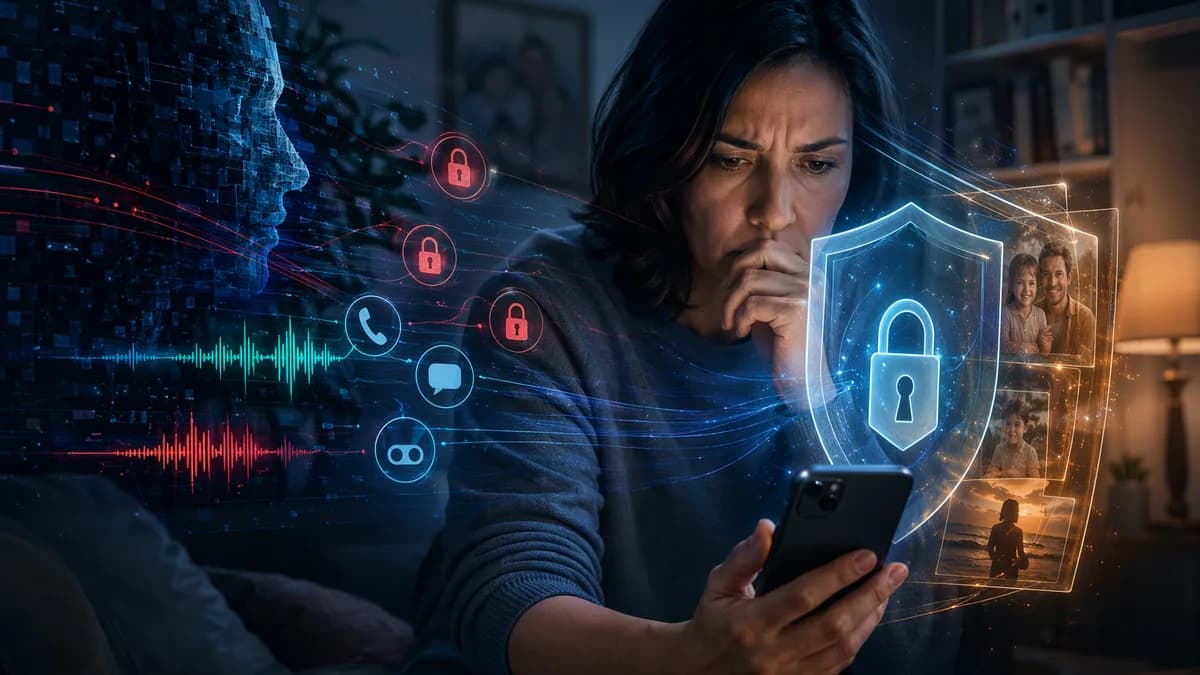
On Tuesday, Savi is launching a Savi AI scam app for iPhone and Android that can screen texts, voicemails and live calls for scams that impersonate loved ones. The consumer security startup also raised $7 million in seed funding, according to TechCrunch.
XOOMAR Intelligence
Analyst Take
Savi was founded by brothers Patrick Coughlin and Ryan Coughlin, and TechCrunch frames the launch around a family incident that exposed how realistic AI-driven impersonation scams have become.
Tuesday: Savi launches an AI scam app built for family panic moments
The Savi AI scam app is aimed at the kind of fraud that no longer looks like a sloppy phishing text. It is built for calls and messages that sound personal, urgent, and plausible.
Savi’s paid app screens texts, voicemails, and incoming calls. Its standout feature is live call monitoring: during a suspicious call, a user can add Savi’s live agent as a silent listener, and the app looks for behavioral signals that suggest a scam while the conversation is still happening.
Savi charges $8/month, discounted to $63/year, for a family plan with no cap on users, according to TechCrunch. Savi’s own site presents that annual pricing as starting at $5.25/mo and says the app is available on iOS and Android, with Text Protection listed as iOS-only.
| Savi feature | What it does | Platform note from source material |
|---|---|---|
| Voicemail | Takes messages from unknown callers, identifies callers, filters junk | iPhone and Android |
| On-Call | Joins a live call silently and flags scams in real time | iPhone and Android |
| Text Protection | Filters scam and spam texts | iOS only |
| Scamwise | Checks suspicious messages, images, websites, or situations | Free tool, web and app |
Before the app launch, Savi tested its model through Scam Wise, a free website that lets users upload suspicious texts, photos, or emails without registration. Patrick Coughlin told TechCrunch the tool launched about four months ago and has received 50,000 submissions, now growing by about 10,000 submissions or more each week.
That matters because Savi is not building in a lab vacuum. Scam Wise gave the startup real-world scam examples to train its detection model.
Two years after a fake kidnapping call, Savi turns a family incident into a product
The company’s origin story is grim. About two years ago, Patrick Coughlin’s mother called him in distress after receiving a call that appeared to come from his sister’s phone number.
The caller claimed he had kidnapped Coughlin’s sister. The scammer spoofed the number, used a voice that sounded like her, and referenced a Walmart location she frequented.
“she thinks she hears my sister's voice saying, ‘Mom, they've got me.’ There’s a blood-curdling scream, and then my sister says, ‘You’ve got to do what they tell you.’ And then a man comes on the phone and says, ‘If you don't pay us $1,200 right now, we're going to kill your daughter in the parking lot of the local Walmart,’”
Coughlin’s mother avoided paying. She called her daughter and confirmed she was safe. The kidnapping was an AI-generated scam.
The attack hit Patrick Coughlin differently because of his job. At the time, he was senior vice president of security products at Cisco, after Splunk had acquired his cloud security startup TruSTAR for a reported $82 million in May 2021. Cisco later bought Splunk in 2024.
“What I was thinking, after calming my mom down is: What has fundamentally changed in the underlying cybercriminal economy that we are now able to lever the same kind of sophistication that I had seen pointed at government agencies, and then later at Fortune 500 companies? And now we're deploying that sophistication at the consumer?”
His answer is cheap generative AI. In Coughlin’s telling, fraudsters no longer need expensive tools or deep research to make a scam feel intimate. He told TechCrunch that a voice can be cloned from three seconds of audio taken from a public social media post.
The broader scam landscape supports the urgency without relying on exotic hypotheticals. The case Coughlin describes shows how impersonation can combine spoofed numbers, cloned voices, and familiar location details to push a target into acting before they can verify what is real.
XOOMAR analysis: Savi’s pitch is that scam detection has to move from after-the-fact cleanup to in-the-moment interruption. Bad grammar and strange sender addresses are weak defenses when the attack uses a familiar voice, a spoofed number, and a parent’s fear.
For readers tracking adjacent cybersecurity risks, see XOOMAR’s coverage of 3.8 Million Caught in Medtronic Data Breach Fallout and Opera Paste Protect Stops ClickFix Attacks at the Brink. Savi sits on the consumer protection side of the same broad problem: stopping harm before a user makes the irreversible click, call, or payment.
After the $7 million seed round, Savi has to win trust before the scam call arrives
Savi is currently mostly using Google Gemini, according to TechCrunch. The company has built its software on an AI gateway, which lets it tap other AI models when needed, including models built for voice detection.
That architecture gives Savi flexibility. It also creates the next set of questions.
Product test: Can the Savi AI scam app spot a convincing live-call scam quickly enough to matter?
Trust test: Will families install and configure the app before someone is targeted?
Privacy test: What data does Savi collect during live call monitoring, voicemail handling, and text filtering?
Behavior test: Will users obey a warning when a caller is screaming for money and claiming a loved one is in danger?
Those details will decide whether Savi becomes a useful consumer security layer or another app people download after the worst moment has passed. The company’s family pricing helps its case, because the same plan can cover kids, spouses, parents, and other relatives without a user cap.
The watch item now is adoption under stress. AI scams are getting more believable because they attack speed, emotion, and identity at once. Savi’s app will be judged on whether it can cut through that pressure in real time, with a warning clear enough to stop someone before they send money.
Key Takeaways
- AI impersonation scams are becoming more realistic, especially in urgent family-related situations.
- Savi’s live call monitoring targets scams while conversations are still happening, not just after messages arrive.
- The $7 million seed round signals investor interest in consumer tools that fight AI-enabled fraud.
Savi AI Scam App Features
| Feature | What it does | Platform note |
|---|---|---|
| Voicemail | Takes messages from unknown callers, identifies callers, filters junk | iPhone and Android |
| On-Call | Joins a live call silently and flags scams in real time | iPhone and Android |
| Text Protection | Filters scam and spam texts | iOS only |
| Scamwise | Checks suspicious messages, images, websites, or situations | Free tool, web and app |
Savi Pricing
Primary Sources & Disclosures

Written by
XOOMAR Insights Team
Research and Editorial Desk
The XOOMAR Insights Team pairs automated research with human editorial judgment. We track hundreds of sources across technology, fintech, trading, SaaS, and cybersecurity, cross-check the facts, and explain what happened, why it matters, and what to watch next. We do not just rewrite headlines. Every article is fact-checked and scored for reliability before it goes live, and we link back to the original sources so you can verify anything yourself.