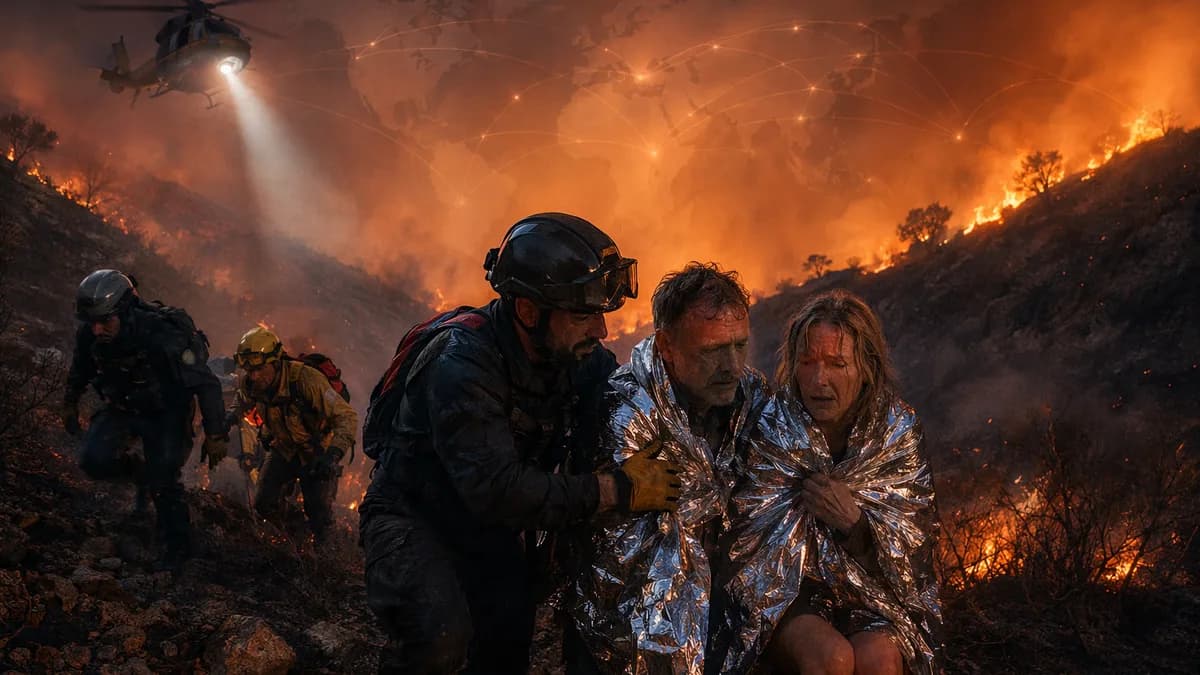
How did a British couple, burned across 40% of their bodies and semi-conscious in an Almería ravine, manage to call loudly enough for rescuers to find them?
XOOMAR Intelligence
Analyst Take
The pair, who were on holiday in Spain and were believed to have been hiking, were found by Guardia Civil officers searching for survivors near Bédar, one of the worst-hit areas in the Almería wildfires, according to Guardian World. They were airlifted to hospital after a two-hour rescue operation and remain in intensive care.
How did the British couple survive long enough to be found in the ravine?
The couple were discovered in a critical condition in a ravine after the wildfire swept through part of Almería province. Local media reports cited by the Guardian said they were badly burned and semi-conscious when officers reached them.
Their identities, ages, hometown and precise route have not been confirmed in the supplied reports. Authorities have not said how long they had been trapped before the search team heard them.
“As you gain more experience, something inside you tells you: ‘Look again, try one more time.’ We’ll never forget that look of surprise and emotion on their faces.”
That account came from Sgt Pedro Barre, one of three officers involved in the search operation, speaking to Spain’s TVE state broadcaster. Barre said officers first heard a sound in the distance but thought it might have been an echo.
Another officer involved, Rafael Zea, said the couple’s ability to call out was extraordinary given their injuries.
“Being able to call out in the condition they were in was a titanic effort.”
The rescue underscores the danger facing emergency teams in terrain where smoke, burned ground and ravines can hide survivors from view. The supplied reports do not say whether the couple had received any warning before they were caught by the fire.
XOOMAR analysis: the known facts point to a rescue that depended less on technology than persistence. Officers were already searching for survivors or trapped people, but the decisive moment came when they chose not to dismiss a distant sound.
How far have the Almería wildfires spread around Bédar and Los Gallardos?
The Almería wildfires have killed 12 people, burned more than 6,000 hectares (14,800 acres) and left at least 23 people missing, according to the Guardian report. At least 1,400 people have been evacuated from their homes.
More than 500 firefighters and emergency workers have been involved in the response. The fire has affected communities including Bédar and areas around Los Gallardos, where emergency crews worked to keep flames from advancing toward more populated zones.
The casualty picture remains incomplete. Most of those killed are thought to be British and Belgian nationals, along with one Spaniard, but the identities of the dead have not yet been officially confirmed in the supplied reporting.
Forensic scientists in Madrid are using samples from the victims’ bodies and DNA samples from families of missing people to identify the dead. That process matters because the missing-person figure remains high and families may be waiting outside Spain for official confirmation.
Related XOOMAR coverage includes 12 Dead, 23 Missing as Los Gallardos Wildfire Races and Spanish Wildfire Traps Britons as Holiday Turns Deadly, which track the reported death toll and the impact on foreign visitors in the affected area.
Why did the fire become so dangerous so quickly?
High winds were a central problem. Firefighters were only able to start gaining control on Saturday afternoon after those winds eased, according to the supplied source material.
On Sunday, Juan Manuel Moreno Bonilla, the head of Andalusia’s regional government, said the fire had been contained and its perimeter secured. That does not erase the danger for people still missing, or for emergency crews working through burned areas.
Bonilla said dry weather, high winds and several heatwaves fuelled by the climate crisis had made the area a “ticking timebomb” for wildfire.
That description fits the reported sequence: a fast-moving blaze, difficult terrain, evacuations, missing people and a rescue where two injured hikers were only found because officers kept searching after dark.
XOOMAR analysis: visitors are exposed in a different way from residents. The reports say the rescued couple were on holiday and believed to be hiking. That means they may have been away from fixed addresses, familiar escape routes or local community warnings when the fire moved. The reports do not establish whether that happened in this case, but it is the obvious operational risk raised by the rescue.
Why are the missing-person searches and victim identifications still unresolved?
The immediate firefighting picture improved after the perimeter was secured, but the human toll is still being counted. At least 23 people remain missing in the supplied reports, and forensic teams are still working to identify bodies.
The condition of the terrain appears to be a major factor. Guardia Civil officers were searching a charred area for survivors when they found the British couple. That indicates emergency teams are still dealing with places where people may be trapped, injured or hard to locate.
The Civil Guard has also warned people to obey evacuation orders and access restrictions. In related supplied reporting, the force said failing to comply puts both residents and emergency crews at risk.
For British visitors and families trying to trace relatives, the practical lesson is narrow but urgent:
- Avoid restricted zones: Police cordons and access limits are there because the area remains dangerous.
- Follow local instructions: Evacuation orders can change as fire lines shift.
- Report missing relatives quickly: DNA identification efforts depend on family samples where victims cannot be identified visually.
- Do not return early: The supplied reports include arrests of two people accused of returning to homes against police instructions after evacuation from a high-risk zone.
What happens next in Almería?
The next phase is not a victory lap over containment. It is a search, identification and hospital-care operation.
Emergency crews are expected to keep checking affected areas while firefighters deal with remaining risks inside the secured perimeter. Hospitals will determine whether the rescued British couple survive their severe burns, but no further medical detail has been released in the supplied reports.
The unanswered questions are stark: how the couple entered the danger zone, whether warnings reached them, how many missing people are still alive, and when families will receive official identification of the dead.
For now, the Almería wildfires have shifted from a fast-moving firefight to a slower accounting of who made it out, who did not, and whether anyone else is still waiting to be heard.
The Stakes
- The rescue highlights the extreme danger wildfires pose to tourists and hikers in unfamiliar terrain.
- Emergency crews face major challenges finding survivors in smoke-filled ravines and burned landscapes.
- The couple’s survival underscores how quickly wildfire conditions can become life-threatening.
Primary Sources & Disclosures

Written by
XOOMAR Insights Team
Research and Editorial Desk
The XOOMAR Insights Team pairs automated research with human editorial judgment. We track hundreds of sources across technology, fintech, trading, SaaS, and cybersecurity, cross-check the facts, and explain what happened, why it matters, and what to watch next. We do not just rewrite headlines. Every article is fact-checked and scored for reliability before it goes live, and we link back to the original sources so you can verify anything yourself.