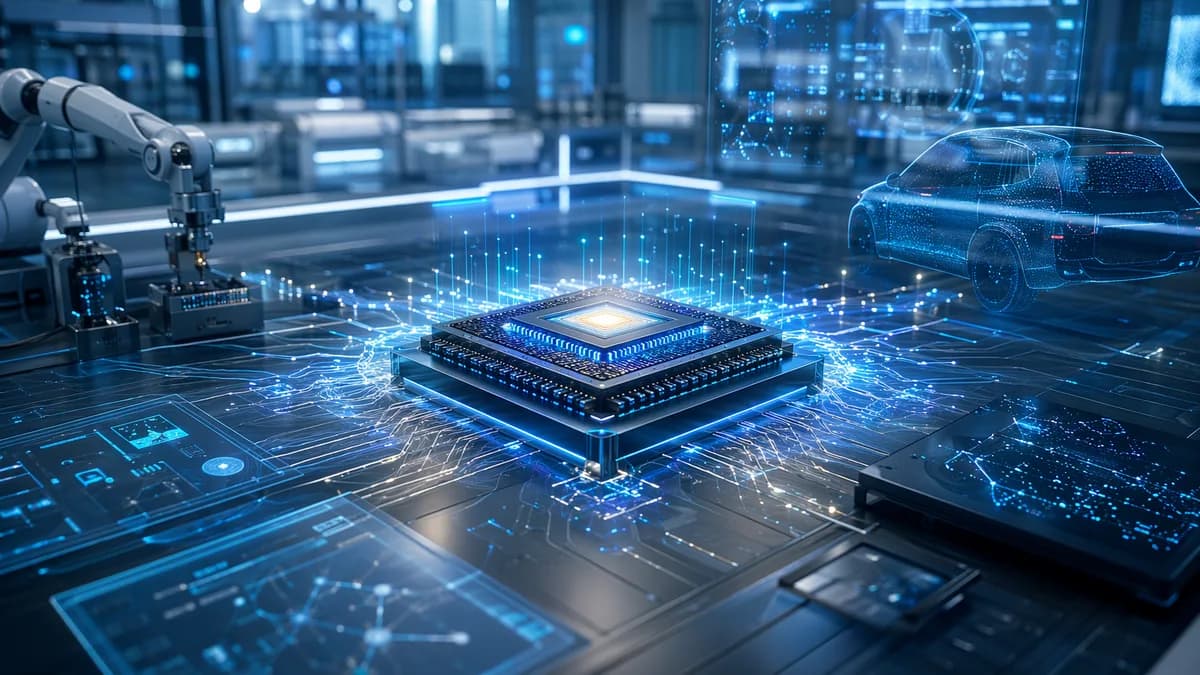
On Jul 12, 2026, the most revealing Apple AI story was not about a chatbot, it was that the failed car program may have helped create the Apple Neural Engine, the silicon layer now carrying the company’s on-device AI strategy.
XOOMAR Intelligence
Analyst Take
That’s the sharper read from new reporting by The Verge, which cites Mark Gurman’s latest Power On newsletter: Apple’s self-driving car processor never shipped, but the project helped lead to the Neural Engine, which debuted with the iPhone X and A11 Bionic.
XOOMAR analysis: Project Titan still looks like a commercial failure. Apple spent years chasing a vehicle that never reached customers. But if the car effort pushed Apple to build better local AI silicon, its afterlife may matter more than the abandoned vehicle itself.
Jul 12, 2026: Apple’s car failure now looks like an AI chip origin story
The new reporting reframes Apple’s self-driving car program as an internal stress test for AI hardware. A self-driving platform would need heavy on-device processing because a car can’t wait on distant servers to interpret the road around it. The Verge says Apple realized early in the self-driving work that it needed powerful on-device AI processing.
That matters because Apple’s current AI posture leans heavily on local computation. The Verge notes that this hardware foundation has helped Apple promote privacy, since less data needs to be sent to the cloud.
The key tension is simple:
| Apple project | What happened | What survived |
|---|---|---|
| Self-driving car program | The processor was never finished | On-device AI priorities |
| Neural Engine | Debuted with iPhone X and A11 Bionic | Became Apple’s AI hardware backbone |
| M7 Ultra | Reportedly in accelerated development | Could support up to 1.5TB of RAM |
The car never arrived. The chip ideas did.
That’s not a clean victory. It’s a salvage operation. But in Apple’s world, salvage can still become platform strategy.
iPhone X and A11 Bionic: the car problem fed the Apple Neural Engine
The reported chain starts with autonomous driving. Apple’s team, working on a self-driving platform, concluded that the company needed much stronger AI processing on the device itself. The unfinished car processor did not have to ship to shape Apple’s future chips.
The Apple Neural Engine first appeared with the iPhone X and A11 Bionic. In that early phase, The Verge says it mainly powered computer vision features, including Face ID, Animoji, and augmented reality features.
That list now reads differently. At launch, those features looked like consumer-facing iPhone upgrades. In hindsight, they were also proof that Apple could put specialized machine learning acceleration inside mass-market devices.
XOOMAR analysis: the car program likely changed the scale of the problem Apple was trying to solve. A phone chip roadmap can optimize for camera tricks, authentication, and interface features. A self-driving system pushes toward continuous perception, fast decision support, and local processing. The source does not detail the exact internal transfer of teams or designs, so it would be too strong to say Project Titan directly became the Neural Engine. The supported claim is narrower and still important: the car effort helped lead Apple toward the Neural Engine.
That is enough to change how the failure should be judged.
2027’s M7 Ultra plan shows the Neural Engine is no longer a side block
The most concrete forward-looking detail in the report is Apple’s chip roadmap. According to The Verge’s summary of Gurman’s reporting, Apple is skipping the Pro, Max, and Ultra versions of its upcoming M6 chip. Instead, it is accelerating development of the M7, expected in the first half of 2027, with major Neural Engine upgrades.
The biggest number is attached to the server side: the M7 Ultra is expected to underpin a new Apple server product and support up to 1.5TB of RAM.
That figure matters because it points beyond iPhone features. Apple has long pushed local AI on consumer devices, but a server product based on M7 Ultra would suggest a broader Apple-controlled AI hardware stack, from device-side inference to Apple-run infrastructure.
The Verge does not provide Neural Engine throughput numbers for these chips. That omission matters. AI chip performance is not captured by a single headline metric anyway. Memory capacity, thermals, software support, and model design all shape what users actually experience.
Still, the roadmap signal is clear: Apple is treating AI hardware as a core strategic layer, not a decorative accelerator added to sell spec sheets.
From Face ID to privacy claims: Apple’s AI software still has to catch up
The Neural Engine’s first public era was visible and narrow. Face ID unlocked the phone. Animoji showed off facial tracking. Augmented reality features made the hardware feel playful.
The current role is more strategic. The Verge says Apple’s AI software efforts have lagged behind the rest of the industry, while its hardware has remained impressive. That split is now the central Apple AI question.
Hardware gives Apple room to argue that it can run more intelligence locally. It also supports the company’s privacy pitch, because less user data needs to leave the device. But silicon alone does not make an AI product feel useful. If the software layer underdelivers, faster Neural Engines become latent capacity rather than a clear consumer advantage.
This is also where Apple’s broader AI push intersects with legal and talent pressure. We’ve covered that tension in Apple Sues OpenAI, Says Hardware Push Stole Secrets and 400 Apple Defectors Ignite OpenAI Lawsuit Over ChatGPT. Those disputes sit outside The Verge’s chip report, but they underscore the same point: Apple’s AI race is not only about models. It is also about chips, people, infrastructure, and control.
“we’re focusing on autonomous systems, and clearly one purpose of autonomous systems is self-driving cars. There are others. And we sort of see it as the mother of all AI projects.”
That 2017 Tim Cook quote, included in related reporting supplied with the brief, aged well in one respect. The car disappeared, but the “AI project” part did not.
Project Titan’s afterlife now runs through chips, servers, and CarPlay
Apple’s auto ambitions did not vanish entirely with Project Titan. Related reporting supplied with the brief notes that Apple has continued pushing into vehicle software through CarPlay 2, which expands Apple’s role across in-car displays and controls. For readers focused on the consumer side of that strategy, our guide to Messy CarPlay Apps Hide an iPhone Fix Drivers Miss tracks the practical interface layer Apple still owns.
But the deeper legacy now appears to sit in silicon.
The Verge report says Apple is making AI hardware a cornerstone of its strategy. The move to accelerate M7 development, skip higher-end M6 variants, and prepare an M7 Ultra server product suggests Apple wants tighter control over the hardware that runs its AI features.
XOOMAR analysis: that fits Apple’s strongest pattern. The company tends to prefer owning the critical layers: chip, operating system, device, and services. A failed car project may have strengthened one of those layers by pushing Apple toward specialized AI processing earlier than a normal iPhone roadmap might have required.
The risk is equally clear. If Apple’s AI software continues to trail, the hardware story won’t carry the narrative forever. The next evidence to watch is specific: whether the M7 arrives in the first half of 2027 with meaningful Neural Engine gains, whether the reported M7 Ultra server product materializes, and whether users see AI features that justify Apple’s heavy bet on local processing.
Project Titan won’t be remembered only as Apple’s abandoned car if its chip legacy becomes the engine behind the next wave of Apple devices.
The Bottom Line
- Apple’s canceled car project may have helped shape the AI chips now central to its device strategy.
- The Neural Engine strengthens Apple’s privacy pitch by enabling more AI processing on-device.
- Project Titan remains a commercial failure, but its hardware legacy could still influence future Apple products.
Apple AI Hardware Legacy
| Apple project | What happened | What survived |
|---|---|---|
| Self-driving car program | Processor never shipped | On-device AI priorities |
| Neural Engine | Debuted with iPhone X and A11 Bionic | Became Apple’s AI hardware backbone |
| M7 Ultra | Reportedly in accelerated development | Could support up to 1.5TB of RAM |
Primary Sources & Disclosures

Written by
XOOMAR Insights Team
Research and Editorial Desk
The XOOMAR Insights Team pairs automated research with human editorial judgment. We track hundreds of sources across technology, fintech, trading, SaaS, and cybersecurity, cross-check the facts, and explain what happened, why it matters, and what to watch next. We do not just rewrite headlines. Every article is fact-checked and scored for reliability before it goes live, and we link back to the original sources so you can verify anything yourself.