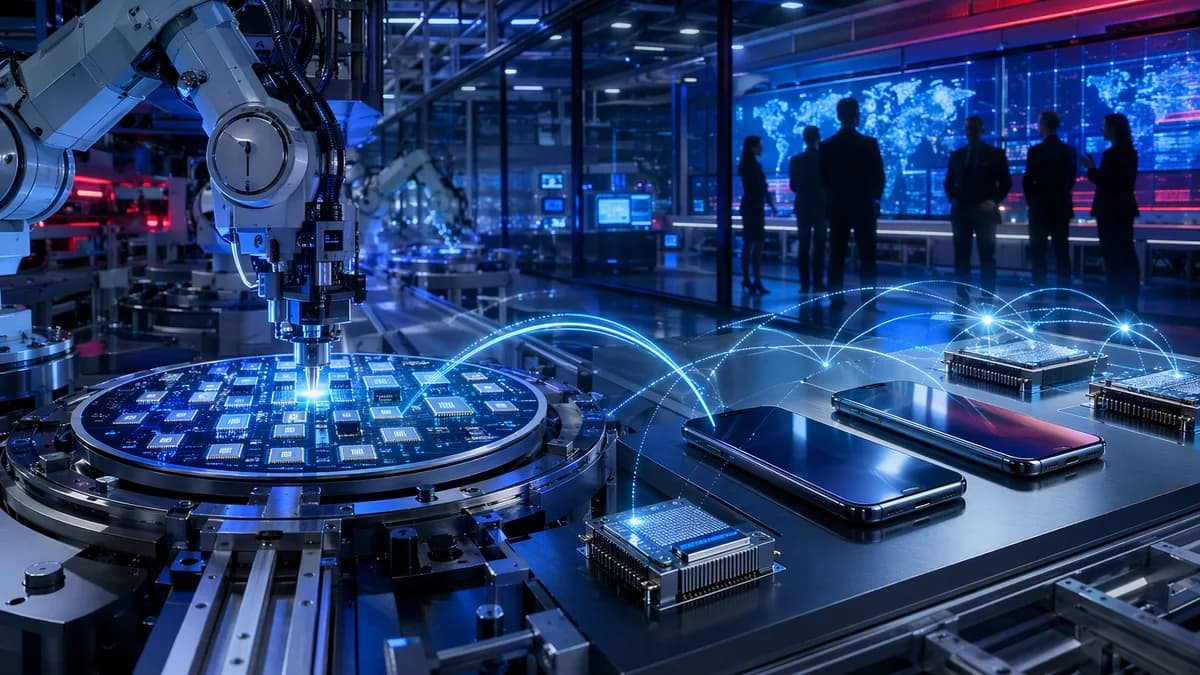
Apple is turning a supplier contract into political insurance, manufacturing optionality, and tighter control over a critical slice of its hardware stack. The Apple Broadcom deal is expected to exceed $30 billion and cover more than 15 billion U.S.-made custom wireless connectivity chips for Apple products, according to TechCrunch.
XOOMAR Intelligence
Analyst Take
That’s the headline. The deeper signal is sharper: Apple wants more U.S. production for high-value components without moving full iPhone assembly home. The company is putting $1.5 billion into capital expenditure investment tied to Broadcom’s facility in Fort Collins, Colorado, while keeping its broader manufacturing model intact.
The Apple Broadcom deal turns wireless chips into a U.S. manufacturing hedge
The agreement covers custom silicon components and wireless connectivity technologies across a “wide range of Apple products,” Apple said in its own announcement. TechCrunch describes Broadcom as Apple’s primary hardware supplier for wireless components, so this is less a new relationship than a major expansion of an existing one.
Apple’s stated goal is domestic production. The company says the deal will produce more than 15 billion U.S.-made chips and support “hundreds of American jobs.” That job figure is modest next to the dollar amount, which makes the strategic value clearer. This is not mainly a mass hiring story. It’s a capacity, control, and politics story.
“Apple and Broadcom have a long history together, and this new phase of our partnership further accelerates our commitment to American manufacturing and innovation,” said Tim Cook, Apple’s CEO.
The phrase that matters is “this new phase.” Apple is not saying it will make every critical component in America. It is choosing one narrow but important area, wireless connectivity, and anchoring more of it inside a U.S. supplier footprint.
The numbers say scale, but the job count says specialization
The Apple Broadcom deal has three hard figures that define the story:
| Measure | Source-backed detail | XOOMAR read |
|---|---|---|
| Agreement size | Expected to exceed $30 billion | A long-term commitment, not a trial order |
| Chip volume | More than 15 billion U.S.-made chips | Apple is planning around repeatable, high-volume component supply |
| Facility investment | $1.5 billion for Fort Collins expansion and modernization | The deal targets specialized production capacity |
| Jobs impact | “Hundreds of American jobs” | High-value manufacturing, not labor-heavy device assembly |
Broadcom will produce advanced radio frequency components, including FBAR filters, and advanced wireless connectivity technologies at the Fort Collins facility. The sources do not detail the chips’ exact specifications, product placement, or production schedule.
That matters. Wireless components sit inside the user experience, but Apple hasn’t tied this announcement to a specific iPhone feature, Mac upgrade, Watch improvement, or Vision product change. Readers looking for product-level Apple signals can compare this upstream supply move with XOOMAR’s device coverage, including Leaked iPhone 18 Pro Max Battery Breaks Apple’s Pattern and Messy CarPlay Apps Hide an iPhone Fix Drivers Miss. This Broadcom agreement does not confirm anything in those areas. It tells us where Apple wants more component certainty.
Apple is localizing the parts it can, not rebuilding the iPhone supply chain
The political backdrop is explicit in the source material. TechCrunch reports that the deal is part of Apple’s commitment to invest $600 billion in the U.S. economy over the next four years, a pledge made after pressure from the Trump administration. TechCrunch also reports that Trump previously threatened new tariffs on Apple products unless the company moved core iPhone manufacturing to the U.S., then later reversed the policy.
That sequence explains the shape of this deal. iPhone assembly has remained overseas, according to TechCrunch. Apple is instead shifting more production of selected components to the United States.
This is a pragmatic move. Full device assembly is one problem. Specialized wireless component production is another. Apple can point to U.S.-made chips, U.S. supplier investment, and hundreds of American jobs while avoiding the far more disruptive step of moving core iPhone assembly.
The company is also placing the agreement inside its American Manufacturing Program, or AMP, which Apple says launched last year to accelerate U.S. manufacturing. Apple calls this Broadcom commitment its largest AMP commitment to date.
Broadcom gets an anchor, Apple gets a cleaner supply story
For Broadcom, the upside is direct: a massive customer, a multiyear commitment, and funding tied to modernization in Fort Collins. Hock Tan, Broadcom’s president and CEO, framed the expansion around the companies’ long relationship.
“Broadcom is proud to continue to work with Apple after decades of success together, and we share a strong commitment to American innovation,” said Hock Tan.
For Apple, the benefits are more layered.
Supply planning: A multiyear agreement for more than 15 billion chips gives Apple and Broadcom a clearer production runway.
Political positioning: The company can show a concrete U.S. investment tied to advanced components, not just offices or services hiring.
Component focus: Wireless connectivity is a core hardware layer across Apple’s product lineup, including products that depend on Wi-Fi, Bluetooth, radio frequency components, and other networking semiconductors.
Manufacturing selectivity: Apple can localize key parts without claiming its entire hardware chain is domestic.
XOOMAR analysis: this is how Apple threads the needle. It gives Washington a visible manufacturing win, gives Broadcom a larger U.S. role, and gives Apple more say over a component category that appears across its devices. But the announcement does not prove lower costs, better margins, or near-term consumer-facing upgrades. The sources don’t support those claims.
The “Made in America” label has limits Apple is not hiding
The phrase U.S.-made chips will carry the marketing and political weight here. Still, the supplied material does not say the full supply chain becomes American. It says Broadcom will expand and modernize its Fort Collins manufacturing facilities and produce named wireless components there.
That distinction matters because Apple’s hardware supply chain remains broader than one component category. TechCrunch specifically says iPhone assembly has remained overseas. Apple’s announcement says it has been working with the administration and U.S. businesses to help create an “end-to-end silicon supply chain in America,” but this deal advances that effort rather than completing it.
So the accurate read is narrow and strong: Apple is moving more wireless component production into the United States through Broadcom. It is not announcing a fully domestic iPhone.
The next proof point is whether Fort Collins becomes a repeatable Apple template
The Apple Broadcom deal should be judged by execution, not ceremony. The watch item is whether Apple turns this into a repeatable model for other critical components: long-term commitments, named U.S. facilities, large capital expenditure, and enough volume to justify specialized capacity.
Evidence that would support the thesis: Apple announces more AMP deals with similar scale, Broadcom’s Fort Collins expansion stays tied to Apple product demand, and future Apple disclosures keep emphasizing U.S.-made custom silicon components.
Evidence that would weaken it: the agreement remains a one-off political showcase, Apple stops short of naming further domestic component commitments, or the “hundreds of American jobs” headline becomes the main measurable result.
For now, the clearest read is this: Apple is not bringing the iPhone home. It is bringing more of the iPhone’s invisible infrastructure closer to home, one high-value component layer at a time.
Impact Analysis
- Apple is expanding U.S. production for critical wireless components without reshoring full iPhone assembly.
- The deal gives Apple more control over a key part of its hardware supply chain.
- The investment strengthens Apple’s domestic manufacturing story amid political pressure over U.S. jobs and production.
Apple's U.S. Manufacturing Strategy
| Approach | What Apple Is Doing | Strategic Purpose |
|---|---|---|
| U.S.-made wireless chips | Producing more than 15 billion custom wireless connectivity chips with Broadcom | Adds domestic capacity, supplier control, and political protection |
| Full iPhone assembly in the U.S. | Not part of the announced plan | Keeps Apple’s broader global manufacturing model intact |
Apple-Broadcom Deal and Related Investment
Primary Sources & Disclosures

Written by
XOOMAR Insights Team
Research and Editorial Desk
The XOOMAR Insights Team pairs automated research with human editorial judgment. We track hundreds of sources across technology, fintech, trading, SaaS, and cybersecurity, cross-check the facts, and explain what happened, why it matters, and what to watch next. We do not just rewrite headlines. Every article is fact-checked and scored for reliability before it goes live, and we link back to the original sources so you can verify anything yourself.