Updated: This article has been refreshed to clarify the timeline, correct an incomplete paragraph, add legal context around the charges, and sharpen the distinction between the knife attack under investigation and the racist public disorder that followed.
XOOMAR Intelligence
Analyst Take
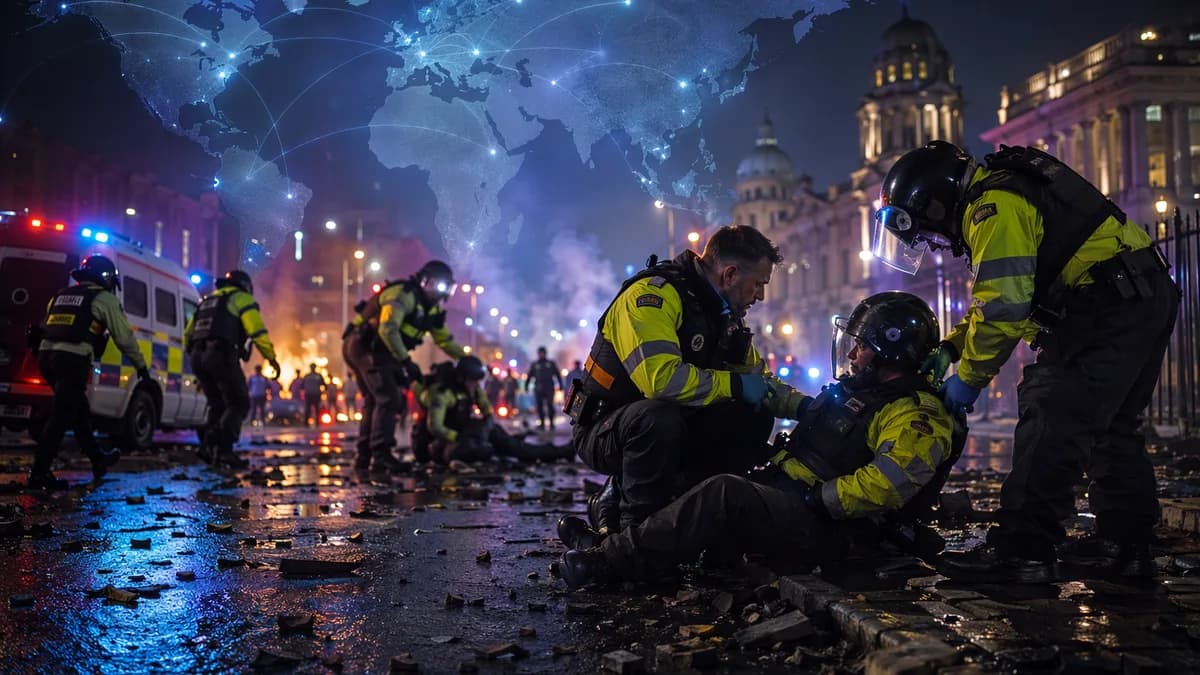
Twelve police officers were injured and 16 arrests were made after a second night of unrest in and around Belfast, where Northern Ireland secretary Hilary Benn condemned the violence as “racist thuggery.”
The disorder followed a knife attack and spread into nearby Newtownabbey, with police using water cannon against rioters who burned a truck and threw bricks and petrol bombs, according to Guardian World.
Police and political leaders said the violence was not a legitimate protest but serious public disorder that left officers hurt, property damaged and ethnic minority communities frightened. The Police Service of Northern Ireland said officers faced sustained attacks, including missiles and petrol bombs, as they tried to restore order.
Hilary Benn brands Belfast riots “racist thuggery” after 12 police officers are injured
Benn’s language was blunt because the reported targets were not random. He said ethnic minority people in Northern Ireland were fearful after reports of people being stopped in cars and asked about their nationality while going to work.
Asked on Sky News whether the unrest should be described as racist riots rather than protests, Benn said:
“Well, if you are targeting people on the basis of the colour of their skin how else can you describe them? That is racist thuggery, there’s no question about it at all.”
The immediate trigger was a knife attack on Monday. Hadi Alodid was charged with the attempted murder of Stephen Ogilvie. He was also charged with threats to kill an NHS radiographer and possession of a knife.
Ogilvie remains in hospital after losing his left eye in the attack. His family condemned the violent protests and appealed for calm, making clear that violence against communities or police could not be justified by what happened to him.
The court case and the riots are separate matters. The charges against Alodid will be dealt with through the criminal justice system, while the disorder that followed is being investigated as public violence, including suspected hate-related offences. Police urged people not to use speculation, rumours or online claims to inflame tensions.
Riots spread beyond Belfast into Newtownabbey
The unrest began in Belfast before spreading into nearby areas, including Newtownabbey, where police said officers came under attack. A truck was set alight, bricks were thrown, and petrol bombs were used as disorder continued into a second night.
The PSNI deployed water cannon as part of its response, a sign of the severity of the violence. Water cannon are rarely used and are generally reserved for situations where police believe there is a serious risk to public safety or officers on the ground.
The injury toll among police underlined how quickly the situation escalated. Twelve officers being hurt in one night of disorder places significant pressure on an already stretched policing operation, especially when unrest moves across multiple locations.
The 16 arrests announced after the violence covered suspected offences connected to the disorder. Police also indicated that further investigative work would continue, including reviewing footage, identifying people involved and assessing whether specific attacks should be treated as racially motivated.
Ethnic minority communities report fear after targeted intimidation
The most serious concern raised by Benn and community leaders was that ethnic minority residents were being targeted because of their race, nationality or perceived immigration status.
Reports that people were stopped in cars and asked about their nationality intensified fears that the unrest had moved beyond anger over a criminal incident and into organised or opportunistic racist intimidation.
Community groups warned that such incidents can have a chilling effect well beyond the immediate scenes of disorder. People may avoid work, school, public transport or local shops if they believe they could be singled out on the street.
Benn said there was “no question” that targeting people because of the colour of their skin was racist. His comments reflected a broader political response across Northern Ireland and Westminster: leaders framed the violence as criminality rather than protest.
Political pressure grows for a firm response
The Belfast and Newtownabbey disorder has increased pressure on police, local councils and political leaders to respond quickly on two fronts: restoring public order and reassuring vulnerable communities.
Public order policing is only one part of the response. Authorities are also expected to work with community representatives, local businesses, schools and faith groups to reduce tension and prevent retaliatory violence or copycat incidents.
The episode comes amid a wider pattern seen across parts of the UK and Ireland, where violent incidents involving migrants or ethnic minority suspects have sometimes been seized upon by far-right activists or online agitators to stir anti-immigrant unrest.
That wider context matters because police and ministers have repeatedly warned that false claims, edited videos and inflammatory posts can spread quickly during public order incidents. Once a local criminal case becomes a flashpoint for racist mobilisation, misinformation can accelerate the risk of violence.
Impact Analysis
- The violence has heightened fears among ethnic minority communities in and around Belfast, particularly after reports of people being stopped and questioned about their nationality.
- Police injuries and arrests show the unrest escalated beyond protest into serious public disorder involving missiles, petrol bombs and damage to property.
- Political leaders are framing the riots as racist violence, increasing pressure for a firm security response and visible support for targeted communities.
- The criminal case connected to the knife attack remains separate from the riots, and authorities have urged the public not to use the incident to justify attacks on people or police.
- The disorder has renewed concern about how quickly local incidents can be amplified into racist mobilisation through rumours, intimidation and online misinformation.
Belfast unrest: reported incident figures
Primary Sources & Disclosures

Written by
XOOMAR
Data desk
XOOMAR is a capital markets software and data company. Every brief on this site starts from a dataset the company collects itself from primary sources (CFTC, SEC EDGAR, FINRA, the Federal Reserve, exchange APIs) and names the numbers it is built on, with a link to the data page so you can check them. Briefs are reviewed before they go out and corrected in place when the data is revised.