
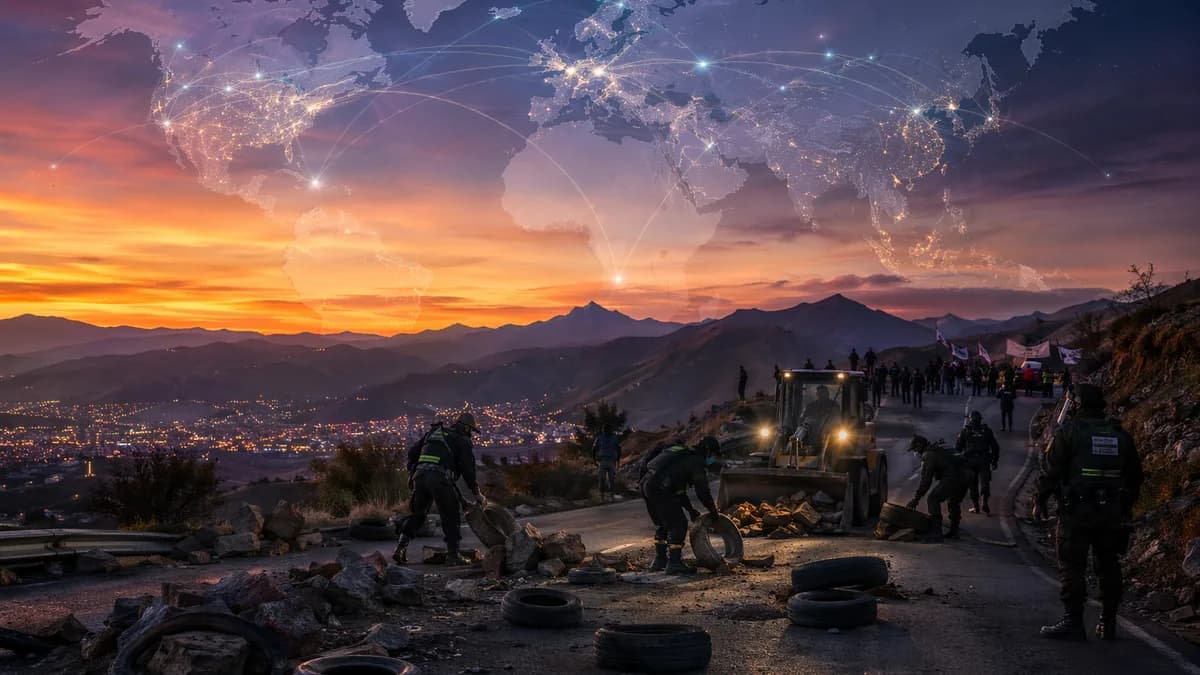
On Sunday, June 21, 2026, Bolivia roadblocks were still being cleared around La Paz and other cities after President Rodrigo Paz declared a 90-day state of emergency, while a patrol aircraft monitoring a blocked highway crashed and killed six people, according to ABC International.
Global TrendsJune 21, 2026· 7 min read· By XOOMAR Insights Team
Fatal Crash Shadows Paz's Bolivia Roadblocks Crackdown
Updated on June 21, 2026
XOOMAR Intelligence
Analyst Take
58/ 100
4 sources analyzedLow confidenceTrend10Freshness99Source Trust85Factual Grounding94Signal Cluster20
The timing matters because the decree has moved Bolivia from political standoff to coercive state action. Roads that had stranded trucks, choked fuel and food supplies, and isolated urban centers are now being reopened by security forces. But the hardest blockade remains political: Paz can clear highways faster than he can settle the legitimacy fight with unions, coca growers, and factions aligned with former President Evo Morales.
June 21: Bolivia roadblocks become a test of state power after the decree
The immediate signal from La Paz is control. The government declared an emergency on Saturday, parliament overwhelmingly ratified it, and by Sunday security forces were still clearing highways. One of the largest rural unions behind the blockades called for a pause and told protesters to withdraw until next week to assess the situation.
That is not surrender. It is a tactical pause.
XOOMAR analysis: The decree may reopen the main corridors in the short term, but it does not remove the political incentive that made Bolivia roadblocks effective in the first place. Blockades force the state into a visible choice: tolerate disruption and look weak, or send security forces and risk escalation. Paz has chosen the second path.
The crash of the light aircraft sharpened the stakes. The aircraft had been conducting aerial patrols over sections of the highway linking La Paz and Cochabamba. Bolivia’s Air Force said an investigative board has been activated to determine the cause. The source does not establish any link between the crash and protest violence, so the event should be treated as a deadly operational incident, not as evidence of sabotage.
Saturday’s emergency order targeted the supply choke points first
The blockade strategy worked because it hit the basics. During the conflict, hundreds of trucks were stranded on highways. Truck drivers were able to return home on Saturday. Business groups estimate losses at more than $2 billion, while cities were left short of fuel and food.
Related reporting cited in the supplied material said the number of blocked roads fell from 50 to 28 as of Sunday. Fuel trucks started moving toward and into La Paz and nearby El Alto after roads were cleared in the Altiplano. Security forces also worked to reopen a road between La Paz and Oruro, described as important for bringing in fuel from neighboring Chile.
Those details show why Bolivia roadblocks bite harder than ordinary demonstrations:
- Fuel: Blocked fuel trucks quickly turn political protest into a citywide operating crisis.
- Food: Supply disruptions empty markets and raise household pressure.
- Hospitals: Related reporting said hospitals faced shortages, including oxygen.
- Transport: Stranded drivers become both victims of the blockade and pressure points on the government.
- Public patience: Support for grievances can erode when families cannot move, work, refuel, or get medical care.
For markets readers, the useful lens is logistics stress. When chokepoints dictate outcomes, political risk becomes operational risk. That same discipline matters in other XOOMAR coverage, from currency pressure in DXY Spike Pins EUR/USD Below 1.15 After Hawkish Fed to corporate cost pressure in Hundreds Axed in Rivian Layoffs After R2 SUV Debut.
Paz’s decree restores movement, but the Morales front remains open
The decree gives the government room to use the armed forces in support of police to reopen roads and protect the population, according to related reporting in the supplied material. The government said the state of emergency will last 90 days, but could end earlier if the threat level falls.
The state of emergency could be lifted earlier if “violence and threats against the population come to an end,” the government said.
The most important unresolved area is Chapare, Morales’ coca-growing stronghold. Security forces have been clearing highways since Saturday, but they had not entered Chapare as of Sunday. Road blockades remained there, led by coca growers’ unions allied with Morales.
The government’s allegation is direct. Presidential spokesman José Luis Gálvez said the administration accuses Morales of encouraging the protests to destabilize the government. The government also accuses Morales of instigating and financing demonstrations to secure impunity from a judicial investigation into the alleged abuse of a minor while he was president. Morales has been entrenched in Chapare since 2024 and has refused to appear before the courts, according to the source material.
XOOMAR analysis: This is the core political risk. Paz can reopen roads outside Chapare and claim progress, but leaving Chapare untouched shows the limits of state reach. Entering it could trigger a larger confrontation. Not entering it preserves a pocket of defiance.
Drivers, vendors, protesters, police, and the palace are fighting different crises
The same highway means different things depending on where you stand.
| Stakeholder | What the roadblock means now |
|---|---|
| Urban residents | Fuel, food, medicine, and mobility |
| Truck drivers | Stranded income and personal safety |
| Businesses | Supply losses estimated by business groups at more than $2 billion |
| Protesters | Leverage against a government they reject |
| Police and military | A test of discipline, force, and public legitimacy |
| Paz government | A fight to prove it can govern |
Related reporting said protests had demanded Paz resign over austerity measures, including cancellation of fuel subsidies, and other issues. It also cited at least 365 arrests and 37 injuries, according to authorities, and at least 17 deaths, most linked to lack of medical care caused by transport disruption, according to Bolivia’s ombudsman’s office.
The protest argument should not be flattened into disorder. Groups that distrust institutions often choose roads because roads produce immediate leverage. Courts, elections, and negotiations can feel slow or closed to them. A highway blockade gets a response.
But the pressure cuts both ways. Once shortages hit households, the political cost of continuing the blockade rises. That is why the rural union’s pause matters. It suggests at least part of the protest coalition sees risk in pushing too far after the decree.
The post-Morales rivalry is now playing out on highways
The source material does not provide enough verified historical detail to compare this crisis with earlier Bolivian upheavals such as the Gas War or the 2019 crisis. What it does show is a current fracture around Morales and the coca growers’ unions aligned with him.
Morales governed from 2006 to 2019. Now, according to the government, allies in his coca-growing base are sustaining blockades in parts of Cochabamba, while one major rural union has stepped back temporarily. That split matters. A protest movement that pauses in one region but holds in another is harder to negotiate with and harder to defeat cleanly.
XOOMAR analysis: Paz’s best-case outcome is not total submission from protesters. It is fragmentation. If unions peel away, roads reopen, trucks move, and Chapare becomes isolated politically, the government gains leverage. If security operations create new outrage, the coalition can harden again.
Three paths after the first roads reopen
The next decision point is next week, when at least one major rural union plans to reassess after calling for protesters to withdraw.
Three scenarios now define the risk:
- Corridors reopen, shortages ease: The government clears main routes, fuel reaches cities, and protest momentum weakens. Paz gets a short negotiating window.
- Clashes reshape the story: Heavy-handed operations turn the decree into a symbol of overreach and help protest leaders rebuild support.
- Partial reopening becomes routine: Main roads open and close intermittently, while Chapare remains outside full government control and blockades stay available as political leverage.
The evidence to watch is concrete: the number of blocked roads, whether fuel and food supplies normalize in La Paz and El Alto, whether security forces enter Chapare, and whether protest leaders remain split.
XOOMAR analysis: Unless road clearances are paired with enforceable negotiations and visible relief on shortages, Bolivia is more likely to see recurring blockades than a clean return to calm. The decree can move trucks. It cannot, by itself, settle the fight over who has the authority to make the country stop.
Impact Analysis
- The emergency decree shifts Bolivia’s crisis from political standoff to direct state enforcement.
- Clearing roadblocks may restore fuel, food, and transport flows but risks escalating tensions with protest groups.
- The aircraft crash that killed six people adds urgency and uncertainty to an already volatile security response.
Bolivia Crisis: Government vs. Protest Movement
| Side | Position | Immediate Move |
|---|---|---|
| President Rodrigo Paz’s government | Restore state control and reopen blocked highways | Declared a 90-day state of emergency and deployed security forces |
| Unions, coca growers, and Morales-aligned factions | Challenge the government’s legitimacy and pressure it through disruption | Paused some blockades and told protesters to withdraw until next week |
Sources

Written by
XOOMAR Insights Team
Research and Editorial Desk
The XOOMAR Insights Team pairs automated research with human editorial judgment. We track hundreds of sources across technology, fintech, trading, SaaS, and cybersecurity, cross-check the facts, and explain what happened, why it matters, and what to watch next. We do not just rewrite headlines. Every article is fact-checked and scored for reliability before it goes live, and we link back to the original sources so you can verify anything yourself.
Explore More Topics
Related Articles
 Global Trends
Smoke From Los Angeles Warehouse Fire Forces Emergency
Smoke from the Boyle Heights warehouse fire pushed Los Angeles into emergency mode, with residents facing days of fumes and health questions.
Jun 21, 20266 min
 Global Trends
Sharp Turn Shadows B-52 Bomber Crash Probe After 8 Die
Eight died in a B-52 crash at Edwards, and officials say the investigation could take six months.
Jun 16, 20265 min
 Technology
8K Loses Out in DJI Osmo Pocket 4P's Fast 4K Fight
DJI skipped 8K on the Osmo Pocket 4P, betting 4K at 240fps and smarter tracking can beat Insta360's resolution pitch.
Jun 22, 20267 min
 Global Trends
Makerfield Tactical Voting Crushes Reform’s Labour Raid
Labour turned Green and Lib Dem tactical votes into a 55% Makerfield win while Reform and Restore split the right.
Jun 22, 202611 min
 Trading
Autumn Exit Calms GBP as Starmer Resignation Bites
A Monday timetable may cool GBP's leadership panic, but markets still have to price an Andy Burnham fiscal agenda.
Jun 22, 20267 min
 Global Trends
Labour Revolt Pushes Keir Starmer Resignation to Brink
Starmer may outline an exit plan Monday after Burnham's return to Parliament turned Labour pressure into a governing crisis.
Jun 21, 20266 min
 Technology
Buried Apple Intelligence Features Rescue iPhone AI
Apple Intelligence gets useful when you stop chasing demos and use five buried tools in Notes, Screenshots, Shortcuts and Reminders.
Jun 21, 20269 min
 Technology
Trump Lets Anthropic Shed AI Security Threat Label
Anthropic got its threat label softened after quick White House compliance, showing AI risk can now turn on access controls and politics.
Jun 21, 20269 min
 Fintech
Fake Betting Videos Drag Polymarket Into Trust Crisis
Reported fake betting videos put Polymarket’s trust problem front and center, raising doubts about whether its market signals reflect real conviction.
Jun 21, 20268 min
 Global Trends
Dancing Girl Textbook Censorship Forces NCERT U-Turn
NCERT restored the Dancing Girl image after a shaded torso sparked backlash over textbook censorship and ancient art.
Jun 21, 202612 min
Don't miss the signal
Get our weekly roundup of the stories that matter across tech, fintech, and trading. No noise, just signal.
Free forever. No spam. Unsubscribe anytime.