
If the China Green Great Wall has reduced desertified land every year since 2000, why are scientists still warning that the fight is nowhere near over?
Global TrendsJuly 13, 2026· 9 min read· By XOOMAR Insights Team
China Green Great Wall Battles a Costly Desert Comeback
Updated on July 13, 2026
XOOMAR Intelligence
Analyst Take
59/ 100
4 sources analyzedLow confidenceTrend20Freshness97Source Trust82Factual Grounding90Signal Cluster20
That tension is the real story. China’s half-century desert campaign has produced visible gains: sand dunes stabilized, forests planted, and communities that once lived behind walls of dust now seeing roads and green cover again. But the same reporting shows a harder truth: the Three-North Protective Forest Program still depends on labor, water, monitoring, and political commitment that may need to last for decades more, according to Independent World.
The China Green Great Wall is not a simple victory lap. It is a test of whether a state can keep paying, organizing, and adapting long after the photo-op phase of restoration ends.
Can straw grids really hold back a moving desert?
Yes, but only up to a point.
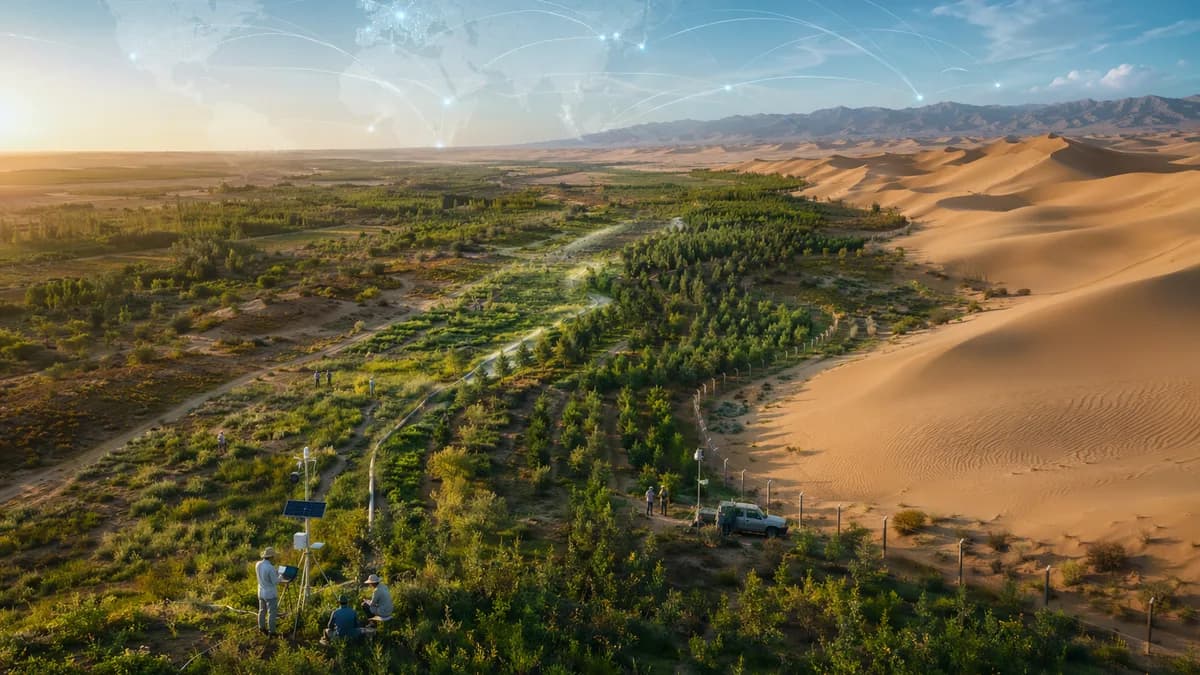
For half a century, workers across northern China have pushed forearm-length sticks into shifting sand, first in rows, then in intersecting lines. The result is a lattice across the dunes. Saplings are planted inside the squares and supported by irrigation. The method, known as straw checkerboards, slows wind across the sand and gives plants a better chance to take root.
That low-tech design matters. It can be repeated across remote desert margins without waiting for heavy infrastructure. It also creates fast, visible proof that sand is being fixed in place.
But the method is not self-executing. Yin Yuzhen, a 60-year-old sand-control worker, still works from dawn to noon with her husband, tending trees and fixing or replacing checkerboards. Their children and local volunteers sometimes join them. That detail cuts through the grand language around the Green Great Wall. This is not a wall that was built once. It is a system that has to be maintained.
“Even the passing of a bird across the sky made me happy,” Yin said, recalling her early days working near the Mu Us desert.
Her account also shows why the work matters locally. Four decades ago, she said, sand blew so thick that it was hard to see a short distance.
“But now we can see the sun. We can see the green in the distance. We can see the road,” said Yin.
XOOMAR analysis: straw checkerboards solve a physical problem first, moving sand. They do not, by themselves, solve the deeper ecological problem: whether vegetation can survive over time under changing rainfall, water limits, soil conditions, and human land use.
Do the numbers prove the China Green Great Wall is working?
They prove progress. They do not prove permanence.
The Chinese government says the program launched in 1978 and helped shift vast regions covering nearly half of China from “the desertification advancing and people retreating” to “greenery advancing and the desertification retreating.” Forests planted by the program now cover a cumulative 500,000 square kilometers (200,000 square miles).
State media data says desertified land in northern China peaked in 2000 and has since been reduced by more than 1,000 square kilometers (400 square miles) each year. Zhu Jiaojun, a scientist at the Institute of Applied Ecology, Chinese Academy of Sciences, said long-term monitoring by his team shows China’s desertified land has shrunk by around 10% overall since 2000. Areas of severely or extremely desertified land have fallen by more than 40%.
Forest cover in the program area rose from around 5% in 1978 to 14% in 2022.
| Metric | Reported figure | Why it matters |
|---|---|---|
| Program launch | 1978 | Shows the campaign’s unusually long political runway |
| Planted forest coverage | 500,000 sq km | Indicates the scale of state-backed restoration |
| Annual reduction since 2000 | Over 1,000 sq km | Shows measurable retreat of desertified land |
| Overall shrinkage since 2000 | Around 10% | Suggests gains beyond isolated demonstration zones |
| Severe or extreme desertification | Down more than 40% | Points to improvement in the worst-hit areas |
| Forest cover in program area | 5% in 1978 to 14% in 2022 | Shows long-term land-cover change |
| Labor involved | Over 300 million rural laborers | Reveals the human scale behind the statistics |
Zhu’s own framing is more cautious than the headline numbers.
“The achievement of desertification combat is due to people’s hard work and a bit of luck with climate,” he said.
That line matters. Increased rainfall in some areas has made vegetation restoration easier, Zhu said. If part of the success rests on favorable climate conditions, the durability of the China Green Great Wall depends on whether those conditions persist.
Is this an engineering project, or a political endurance test?
It is both, and that is why the program has lasted this long.
Barron Joseph Orr, chief scientist for the U.N. Convention to Combat Desertification, pointed to the state’s staying power as the core lesson.
“The broad significance of the Three-North Program is not only the scale of restoration, but the long-term political commitment behind it,” Orr said.
His point is not that China found a magic anti-desertification formula. It is that reversal becomes possible when restoration is folded into long-term development strategy.
That separates China’s campaign from some other large restoration efforts. The African Union’s Great Green Wall, launched in 2007, aimed to create a 5000-mile wall of trees across 11 countries: Chad, Mali, Niger, Burkina Faso, Mauritania, Nigeria, Sudan, Ethiopia, Eritrea, Djibouti and Senegal. The United Nations described it as “a green wall to promote peace and restore nature in Africa’s Sahel region” and expected it to provide 10 million job opportunities by 2030.
But the project stalled after setbacks. Issa Garba, an environmental activist from Niger, told Independent Arabia in 2023:
“The Sahel countries have not allocated any spending in their budgets for this project. They are only waiting on funding from abroad, whether from the European Union, the African Union, or others.”
He added:
“This project will persist despite its faltering and setbacks. However, completing it within the 2030 deadline remains an unattainable goal”.
XOOMAR analysis: the comparison is not about which region “cares more.” It is about governance. Restoration at this scale requires financing, local labor, enforcement, and monitoring across decades. China’s centralized capacity has helped it keep going. The warning now is that even centralized capacity cannot remove ecological limits.
For wider China risk context, XOOMAR has also tracked climate-linked regional disruption in 15 Dead as Typhoon Bavi Barrels Toward Taiwan, China and state-scale technical ambition in Sea Net Catches China’s First Reusable Rocket Booster. The Green Great Wall belongs in that broader file: China can mobilize at scale, but execution does not end the moment infrastructure appears.
Who benefits if desert control holds, and who carries the burden?
Local communities gain first when sand retreats.
Yin’s testimony is plain. Visibility improved. Green appeared. Roads became visible. Those are not abstract environmental benefits. They affect mobility, settlement, and daily work.
Zhu estimated that more than 300 million rural laborers have been involved in the program, mostly on a paid, part-time basis. That means the China Green Great Wall has also functioned as a rural labor project, not only a land restoration campaign.
But the burden sits close to the ground. Workers still repair checkerboards. Farmers and herders still need restoration to match livelihoods. The environmental advocacy group Green Camel Bell in Gansu province works with farmers and herders to explain desertification risks, plant trees in dryland areas, and help restore and sustain vegetation.
Its founder, Zhao Zhong, put the policy challenge directly:
“Efforts to combat desertification and restore forests should be linked to local livelihoods, so communities do not see economic development and ecological protection as an either-or choice,” said Zhao Zhong.
Orr agreed that restoration has a much greater chance of succeeding if communities benefit economically.
XOOMAR analysis: this is where the next phase gets harder. If local people see conservation as lost income or restricted land use, maintenance weakens. If they see it as tied to jobs, safer land, and viable livelihoods, the project has a better chance of surviving beyond state campaigns.
Why is water now the hardest question for the China Green Great Wall?
Because restored drylands can become more self-sustaining, but they do not become maintenance-free.
Orr said restored dryland ecosystems may become increasingly self-sustaining over time, yet still require careful management and long-term monitoring. Success depends on factors including water availability and soil health.
That is the hinge. The first era of the Green Great Wall was about stopping visible sand. The next era is about sustaining living systems in dry places. Planting is the easier metric. Survival is the real one.
Zhu framed the biggest unresolved risk as a funding and intervention question:
“This is what we are very concerned with and this is also the biggest challenge,” he said, referring to how conservation can be sustained if the scale of human intervention and investment is reduced.
The forward test is clear. Evidence that would strengthen the China Green Great Wall thesis includes continued declines in severe desertification, rising vegetation survival without heavier irrigation, and local income models that keep communities engaged. Evidence that would weaken it would be rising maintenance dependence, restoration sites that fail when investment drops, or gains that rely too heavily on favorable rainfall.
The warning is not that straw checkerboards have stopped working. The warning is that desertification is no longer just a sand-control problem. It is a water, soil, labor, and governance problem that will punish any program judged only by planted area.
Impact Analysis
- China’s desert-control campaign shows that ecological restoration can deliver real gains but may require generations of upkeep.
- The reliance on labor, irrigation, and monitoring raises questions about whether large-scale climate adaptation projects can remain sustainable over time.
- The story highlights the gap between visible environmental success and the deeper systems needed to keep deserts from advancing again.
China Green Great Wall: Progress vs. Remaining Challenges
| Visible Gains | Ongoing Challenges |
|---|---|
| Desertified land has reportedly declined every year since 2000. | Scientists warn the desert-control effort is still far from complete. |
| Straw checkerboards and saplings have stabilized dunes in some areas. | The system requires constant maintenance, irrigation, and monitoring. |
| Some communities have seen roads, green cover, and reduced dust impacts return. | Long-term success depends on decades of labor, funding, water, and political commitment. |
Sources
- [1] Independent World
- [2] China’s 'Green Great Wall' tames desert growth, but scientists warn the fight is not over
- [3] China’s 'Green Great Wall' tames desert growth, but scientists warn the fight is not over
- [4] Why China’s ‘Great Green Wall’ Might Not Be The Ecological Victory It Seems—A Biologist Explains

Written by
XOOMAR Insights Team
Research and Editorial Desk
The XOOMAR Insights Team pairs automated research with human editorial judgment. We track hundreds of sources across technology, fintech, trading, SaaS, and cybersecurity, cross-check the facts, and explain what happened, why it matters, and what to watch next. We do not just rewrite headlines. Every article is fact-checked and scored for reliability before it goes live, and we link back to the original sources so you can verify anything yourself.
Explore More Topics
Related Articles
 Global Trends
15 Dead as Typhoon Bavi Barrels Toward Taiwan, China
Typhoon Bavi has already killed 15 in Philippine landslides and now threatens Taiwan and China with devastating rain.
Jul 10, 20265 min
 Global Trends
China Ethnic Unity Law Turns Minority Identity into a Test
China's new ethnic unity law widens Beijing's power over language, religion and speech, stoking fears of forced assimilation.
Jul 5, 20267 min
 Global Trends
Volkswagen Job Cuts Could Gut 100,000 German Roles
A reported 100,000-role cut would mark VW’s deepest challenge yet to its Germany-led export model.
Jul 6, 20268 min
 Global Trends
China Pacific Missile Test Triggers Wong's Beijing Warning
Penny Wong will confront Beijing over China's Pacific missile test, warning the launch risks miscalculation in a contested region.
Jul 6, 20266 min
 Global Trends
China Missile Test Rattles Australia's Pacific Shield
China's long-range missile launch raised Pacific security fears as Australia cast it as destabilising, not routine training.
Jul 6, 20268 min
 Cybersecurity
China, India-Linked Hackers Raid Balochistan Police
China and India-linked hackers separately breached Balochistan Police, turning local law enforcement data into a regional intelligence prize.
Jul 13, 202614 min
 Global Trends
EU Teen Social Media Limits May Force Apps to Prove Safety
Brussels may make social apps prove they're safe before teens can join, shifting the burden from parents to platforms.
Jul 13, 20269 min
 Trading
Crypto Week Ahead Traps Bitcoin Bulls in CPI Crossfire
Bitcoin's week may be decided by CPI, bank earnings and oil risk, not token catalysts, as traders test whether risk appetite can hold.
Jul 13, 20267 min
 Technology
Waze Gemini AI Grabs the Wheel in Voice Search Bet
Google is adding Gemini voice tools to Waze, but the update looks more like a cautious test than a full AI overhaul.
Jul 13, 20267 min
 Future Fiction
The Last Bell at Saltwater Commons
When the final traditional school in coastal Virginia is converted into a neighborhood learning commons, 14-year-old Mara Quintero arrives able to absorb calculus, Mandarin, and marine biology through neural knowledge transfer—but unable to ask a question that belongs to her. Her assigned AI tutor is precise, patient, and endlessly adaptive, yet it recruits the building’s retired custodian, Jonah Reed, to teach what the transfer cannot: curiosity, judgment, and the awkward art of learning with other people.
Jul 13, 202614 min
Don't miss the signal
Get our weekly roundup of the stories that matter across tech, fintech, and trading. No noise, just signal.
Free forever. No spam. Unsubscribe anytime.