
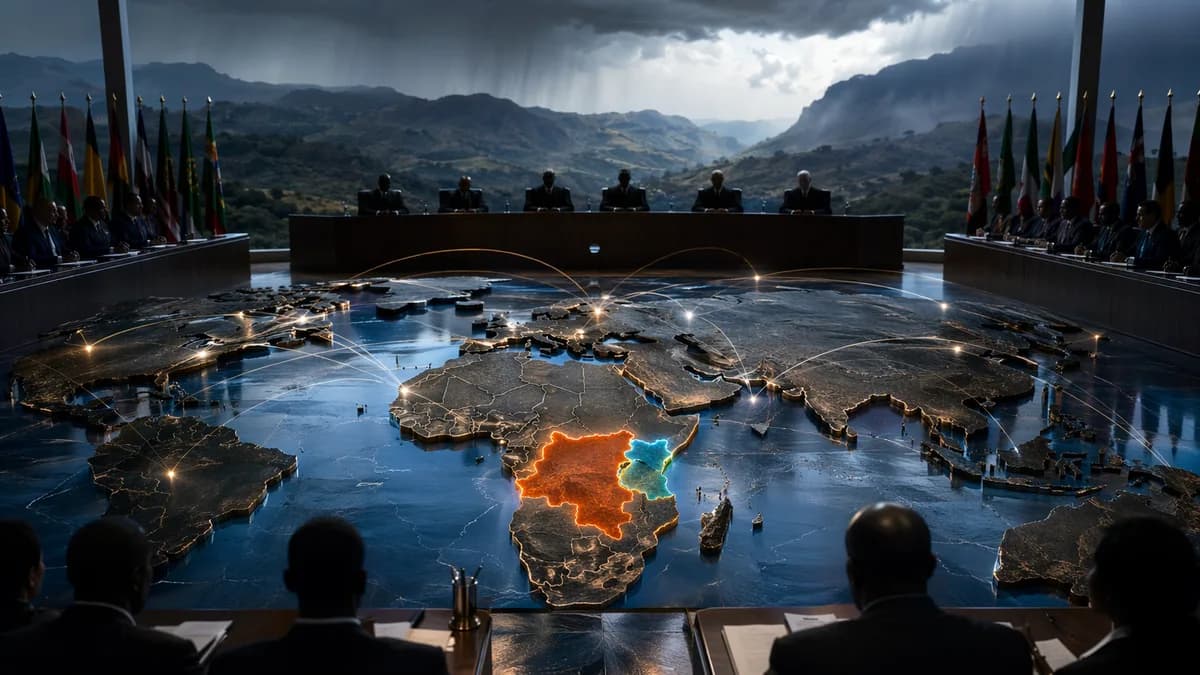
Kinshasa has pushed the DR Congo Rwanda ICJ case into The Hague, asking judges to hold Rwanda legally responsible for alleged violations tied to more than three decades of war in eastern Democratic Republic of Congo.
Global TrendsJune 26, 2026· 5 min read· By XOOMAR Insights Team
DR Congo Hauls Rwanda to ICJ in War Reparations Fight
Updated on June 26, 2026
XOOMAR Intelligence
Analyst Take
58/ 100
4 sources analyzedLow confidenceTrend20Freshness85Source Trust92Factual Grounding90Signal Cluster20
The filing at the International Court of Justice accuses Rwanda of breaching multiple international treaties after the 1994 Rwandan genocide, including conventions covering genocide prevention, racial discrimination, women’s rights and torture, according to BBC World. Rwanda has not yet responded to the latest filing, but it has long denied backing armed groups inside Congo.
DR Congo Rwanda ICJ case puts a decades-old war before UN judges
Congolese Justice Minister Guillaume Andali said Friday that Kinshasa is seeking accountability for alleged treaty breaches linked to Rwanda’s actions in eastern Congo. The Congolese application asks the ICJ to order Rwanda to stop the alleged violations and award reparations to Congolese authorities and victims.
The case marks Congo’s third attempt to bring Rwanda before the ICJ. Congolese authorities dropped an earlier case in 2001. In 2006, the court dismissed a second case, saying it could not proceed because Rwanda had not recognised its jurisdiction.
That history matters. The ICJ has confirmed it will examine the claims, but the first fight may not be over the facts on the ground. It may be over whether the court can hear the case at all.
Rwanda describes the Democratic Forces for the Liberation of Rwanda (FDLR) as a "genocidal militia" and says its continued presence in eastern Congo threatens Rwandan territory.
Kinshasa rejects Rwanda’s claims that Congolese authorities work with the FDLR. Rwanda, for its part, has long dismissed evidence that it supports rebels in Congo.
The DR Congo Rwanda ICJ case lands while fighting continues in the east despite a peace deal signed by Rwanda and DR Congo in December, spearheaded by the US, the BBC reported.
Kinshasa says Rwanda used armed groups to project force inside eastern Congo
Congo’s allegation is direct: Rwanda dispatched forces and backed armed groups to conduct unlawful military operations on Congolese territory after the 1994 genocide.
The conflict’s roots are well documented in the sources. About 800,000 people, mostly from the Tutsi community, were killed by ethnic Hutu extremists during the genocide. An estimated one million Hutus later fled across the border into what is now DR Congo, inflaming tensions in the east.
Rwanda’s army invaded DR Congo twice, saying it was pursuing some of those responsible for the genocide. It also worked with members of the Banyamulenge, a marginalised Tutsi group in eastern Congo, and other armed groups.
Kinshasa’s latest case names a broader pattern of alleged violence. The Congolese government says civilians have suffered massacres, extrajudicial killings, torture, sexual violence, forced displacement and discrimination, AP reported.
| Issue in dispute | Congo’s position | Rwanda’s position |
|---|---|---|
| M23 | Rwanda backs the rebel group and bears legal responsibility for violence in eastern Congo | Rwanda has consistently denied backing armed groups in Congo |
| FDLR | Congo denies working with the group | Rwanda says the FDLR threatens its territory |
| ICJ jurisdiction | Congo is asking the court to declare Rwanda responsible and award reparations | Rwanda has not yet responded to the latest filing |
| Conflict driver | Kinshasa points to cross-border operations and proxy groups | Kigali frames its posture around security threats from armed groups |
The M23 is central to the present crisis. UN experts and Western governments are among those who say Rwanda supports the group, which has captured large parts of eastern Congo, including the regional capital Goma, according to the BBC.
AP described eastern Congo as mineral-rich and said government forces and allied militias are fighting more than 100 armed groups. It also reported that the U.S. government has accused Rwanda of using rebels as a pretext to gain access to the region’s mineral wealth.
The U.N. has called the conflict in eastern Congo “one of the most protracted, complex, serious humanitarian crises on Earth.”
That quote captures why this filing is more than a legal maneuver. The court case is now another front in a conflict where battlefield claims, mineral wealth, ethnic history and regional diplomacy keep colliding.
The Hague fight could turn first on jurisdiction, not atrocities
The ICJ can issue binding orders between states, but it does not move quickly. Congo’s request now enters a procedural path where Rwanda’s response, jurisdiction arguments and any request for urgent measures could shape the early phase.
The 2006 dismissal is the warning sign for Kinshasa. If Rwanda challenges jurisdiction again, Congo will need to clear that threshold before judges reach the substance of the alleged violations.
Analysis: that makes the DR Congo Rwanda ICJ case a two-track fight. One track is legal, built around treaties, jurisdiction and reparations. The other is diplomatic, because even a slow-moving case can create a public record that raises pressure on governments and mediators.
For readers tracking how legal outcomes can turn on jurisdiction and remedies, XOOMAR has covered separate court battles such as Supreme Court Locks RLUIPA Damages Door for Prisoners and Supreme Court Immigration Rulings Let Trump Strip TPS. Those are domestic U.S. cases, not ICJ disputes, but the narrow lesson carries over: the forum can decide how far a claim gets before the merits are tested.
Rwanda’s next move is the immediate watch item. If Kigali participates, the case could become a formal venue for contesting years of allegations around M23, FDLR and cross-border operations. If it contests jurisdiction, the early proceedings may echo Congo’s failed 2006 attempt.
For civilians in eastern Congo, the legal calendar will feel distant. The fighting has continued despite the December peace deal, and the court’s first decisions may take time. The practical question now is whether the case changes the pressure around talks, or whether it becomes another file in a conflict that has already outlasted multiple diplomatic resets.
The Stakes
- The case could test whether international courts can address accountability for decades of conflict in eastern Congo.
- A jurisdiction fight may determine whether the ICJ ever reaches the substance of Congo’s allegations.
- The filing comes as violence continues despite diplomatic efforts to stabilize the region.
DR Congo and Rwanda Positions in the ICJ Dispute
| Issue | DR Congo | Rwanda |
|---|---|---|
| Core claim | Accuses Rwanda of treaty violations tied to conflict in eastern Congo | Has long denied backing armed groups inside Congo |
| Requested outcome | Wants the ICJ to order Rwanda to stop alleged violations and pay reparations | Has not yet responded to the latest filing |
| FDLR issue | Rejects claims that Congolese authorities work with the FDLR | Calls the FDLR a genocidal militia and a threat to Rwandan territory |
| Jurisdiction history | Making a third attempt to bring Rwanda before the ICJ | Previously avoided a 2006 case because the court said Rwanda had not recognized its jurisdiction |
Sources

Written by
XOOMAR Insights Team
Research and Editorial Desk
The XOOMAR Insights Team pairs automated research with human editorial judgment. We track hundreds of sources across technology, fintech, trading, SaaS, and cybersecurity, cross-check the facts, and explain what happened, why it matters, and what to watch next. We do not just rewrite headlines. Every article is fact-checked and scored for reliability before it goes live, and we link back to the original sources so you can verify anything yourself.
Explore More Topics
Related Articles
 Global Trends
France Ebola Case Forces Hospitals Into Alert Mode
France confirmed an imported Ebola case in a doctor back from Congo, triggering isolation, contact tracing, and hospital alerts.
Jun 24, 20265 min
 Global Trends
War Bonds Drag Burnham Into £13.5bn UK Defence Fight
No 10 wants Burnham to go beyond £13.5bn on defence, making war bonds an early test of Labour’s next economic line.
Jun 24, 20267 min
 Technology
Govee Smart Lamps Crash to Record Lows for Prime Day
Govee smart lamps have fallen to record Prime Day prices, but Matter support separates the best buys from the cheap ones.
Jun 26, 20267 min
 Global Trends
Cargo Ship Attack Triggers US Strikes on Iran Sites
US strikes hit Iranian missile, drone and radar sites after a cargo ship attack near Hormuz raised shipping and energy risks.
Jun 26, 20266 min
 Global Trends
10-2 Jury Split Jolts Palisades Fire Arson Retrial
A 10-2 jury split favored acquittal, but prosecutors will retry Jonathan Rinderknecht in the deadly Palisades Fire arson case.
Jun 26, 20268 min
 Global Trends
18 Counts Collapse Into John Bolton Guilty Plea, $2.25M Fine
John Bolton admitted illegally keeping classified defense information, cutting 18 counts to one plea with a $2.25 million fine.
Jun 26, 20265 min
 Technology
BirdBuddy Prime Day Deal Slashes $299 Feeder to $168
BirdBuddy Pro Solar fell to $168 for Prime Day, making a pricey camera bird feeder one of Amazon's surprise gadget hits.
Jun 26, 20266 min
 Technology
Level Home Layoffs Gut Smart Lock Maker as Founders Exit
Assa Abloy cut most Level Home staff, folded the smart lock maker into Kwikset, and pushed its founders out.
Jun 26, 20266 min
 Global Trends
Pickle Juice Can Calm Muscle Cramps Faster Than Water
Pickle juice may calm acute muscle cramps fast, but the effect likely comes from a nerve reflex, not sodium or instant hydration.
Jun 26, 20268 min
 Cybersecurity
Russian Hackers Turn Jaguar Land Rover Hack Into $2.5B Hit
Russian hackers were reportedly tied to a Jaguar Land Rover breach that cost the U.K. economy $2.5B and forced a bailout.
Jun 26, 20268 min
Don't miss the signal
Get our weekly roundup of the stories that matter across tech, fintech, and trading. No noise, just signal.
Free forever. No spam. Unsubscribe anytime.