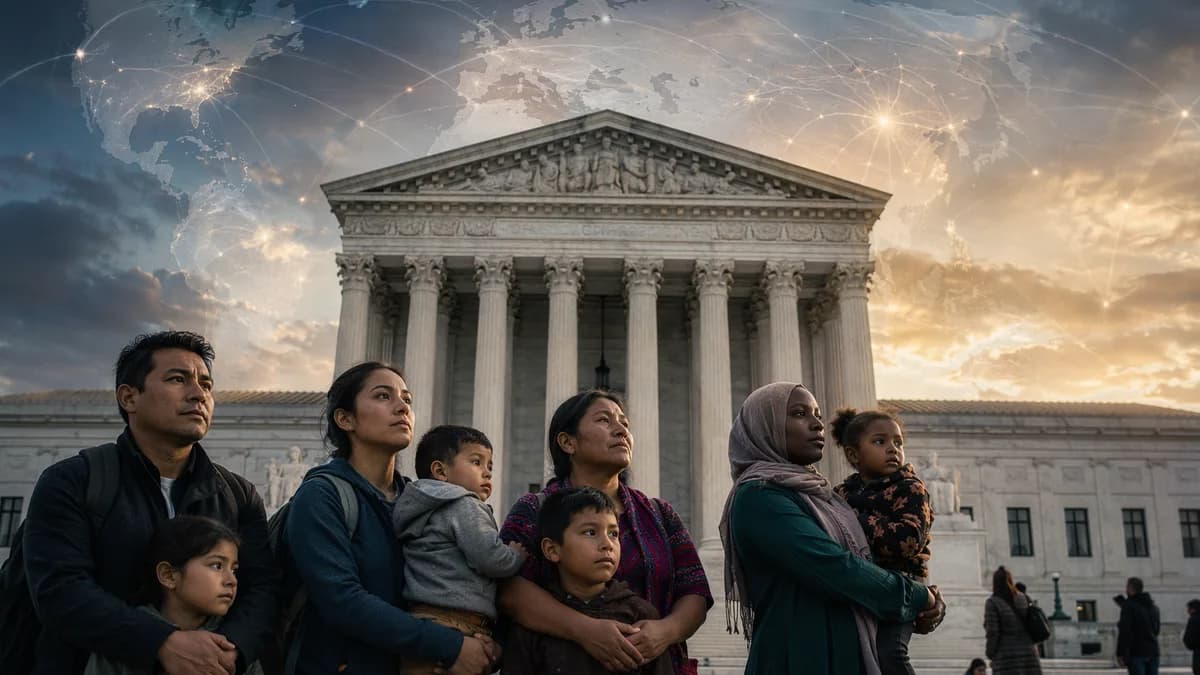
The Supreme Court immigration rulings handed Trump officials new power to strip legal protections from migrants already living in the US and to block asylum seekers before they can lodge claims at the southern border.
XOOMAR Intelligence
Analyst Take
Lawmakers and immigrant rights groups condemned the two 6-3 decisions as “disastrous” and “cruel,” while the Trump administration, Republican lawmakers and anti-immigrant groups celebrated them as victories for border control, according to Guardian World.
For the people most exposed, this is not an abstract separation-of-powers fight. It affects Haitian and Syrian TPS holders living and working legally in the US, and asylum seekers who may now be stopped before they can ask for protection.
“Today, Trump’s loyalists in the supreme court have joined forces with him to deny immigrants’ internationally recognized human rights and advance an authoritarian, white-supremacist agenda at home,” said Rep. Delia Ramirez, Democrat of Illinois.
Her accusation captures the political meaning of the rulings: critics see the court’s conservative majority as enabling a racially discriminatory immigration agenda, while Trump allies see the same decisions as long-delayed permission to tighten the border.
The Supreme Court immigration rulings give Trump officials a faster lane around protections
The core shift is procedural, but the consequences are physical: detention, removal, blocked entry, and legal status lost.
One ruling allows the Trump administration to strip Temporary Protected Status, or TPS, from hundreds of thousands of Haitians and Syrians. TPS lets immigrants from designated countries live and work in the US when conditions at home are deemed unsafe. The Guardian reported that the State Department currently warns against travel to Haiti and Syria, citing violence.
The other ruling lets US officials turn back asylum seekers at the US-Mexico border if they have not actually reached US soil. The practical question is stark: if the government can stop someone just short of the legal threshold, how meaningful is the right to seek asylum?
Immigrant rights organizations said the asylum decision revives the logic behind “metering,” a now-defunct Trump-era policy that limited how many asylum seekers could present themselves at ports of entry. The Biden administration rescinded that policy, but the current Trump administration asked the court to overturn a prior decision declaring it unlawful.
Haitian and Syrian TPS holders face removal risk, while border asylum access shrinks
The TPS ruling hits migrants who were not hiding from the government. They had permission to live and work in the US because DHS had deemed their countries unsafe for return.
Ramirez said the decision puts “more than 350,000 TPS holders at risk of deportation and countless more asylum seekers’ lives in danger.” Attorneys Geoff Pipoly and Andy Tauber, who represented Haitians before the court, described the outcome in lethal terms.
“Simply put, the supreme court’s ruling will directly result in thousands of innocent people dying violent, needless deaths,” Pipoly and Tauber said.
The asylum ruling changes the border calculus. The court said officials do not have to accept asylum claims from migrants who have not entered US soil, even if they have arrived at the border. That matters because asylum access often depends on the narrow mechanics of location, timing, screening, and whether a person can reach a lawyer before removal machinery starts moving.
XOOMAR analysis: Taken together, the rulings reduce legal friction for immigration agencies. One decision makes it easier to revoke a temporary legal status. The other narrows the moment when an asylum claim must be accepted. Different doctrines, same operational effect.
The numbers show a de-documentation fight, not a narrow docket dispute
The scale is what turns these Supreme Court immigration rulings into a national event.
The Guardian cited analysts warning that the TPS decision may open the door to further cuts across all TPS countries, potentially affecting 1.3 million holders. It also reported that the Supreme Court last year allowed the Trump administration to strip TPS for more than 300,000 Venezuelans.
Andrea Flores, an immigration expert and former director of border management on the National Security Council under the Biden administration, called Thursday’s TPS decision “the biggest delegalization moment in modern history.”
There is also an economic layer in the Guardian’s reporting. A report from earlier this year found TPS holders contribute about $29bn every year to the economy. That figure does not prove how deportations would affect specific sectors or regions, but it does show why the issue extends beyond immigration courts and campaign rhetoric.
Key numbers from the source record:
| Issue | Source-backed figure |
|---|---|
| TPS holders Ramirez said are at risk | more than 350,000 |
| Total TPS holders potentially exposed if cuts expand | 1.3 million |
| Venezuelans whose TPS was stripped after a prior Supreme Court action | more than 300,000 |
| Estimated annual economic contribution by TPS holders | $29bn |
| Vote split in both Thursday rulings | 6-3 |
The practical question is not only who wins in court. It is who loses status before another court can realistically hear them.
Advocates see racial exclusion, Trump officials see border authority
Civil rights groups and Democratic lawmakers framed the decisions as part of a broader attack on Black, brown and non-European migrants. Ramirez used the phrase “white-supremacist agenda.” Erika Pinheiro, executive director of Al Otro Lado, said the asylum ruling “violates international law” and warned it could justify other countries blocking refugees from crossing borders in search of safety.
“This decision has destroyed the United States’ position as a global leader in promoting the rights of refugees,” Pinheiro said.
Trump officials described the outcome very differently. James Percival, general counsel at the Department of Homeland Security, told Reuters that the three immigration rulings this week were “victories for the rule of law and common sense,” and said TPS “was always supposed to be temporary.” He added that the decisions give the administration “several more important tools to continue securing our borders,” according to Reuters via U.S. News.
Stephen Miller, the White House deputy chief of staff, was more blunt. Speaking to Fox News, he called Haitians with TPS “illegal” and said, “This is a victory 10 years in the making. We can finally remove these Haitian illegal migrants from the United States.”
That language is part of why advocates see something more than administrative discretion. The question for courts and Congress is whether “temporary” status can be ended in conditions the US government itself warns are dangerous.
The court's current majority has changed the immigration risk calculus
Reuters reported that since Trump returned to office in January 2025, the court has largely allowed his administration to implement immigration policies while legal challenges continue. It cited examples including deportations to countries where migrants have no ties, aggressive immigration raids, and the termination of humanitarian protections including TPS and parole.
The institutional backdrop matters. Reuters noted the court has held its current 6-3 conservative majority since October 2020, when Trump appointed Justice Amy Coney Barrett after the death of Justice Ruth Bader Ginsburg. It also contrasted the current court with the June 2020 decision that blocked Trump’s bid to end protections for Dreamers, when Chief Justice John Roberts joined the liberal justices in a 5-4 ruling.
XOOMAR analysis: the supplied record supports a narrow but important conclusion. The court is not merely deciding isolated immigration cases. It is changing the risk profile for migrants by signaling that executive enforcement choices will often survive emergency review, even when lower courts or advocacy groups raise major legal objections.
For readers tracking the court’s broader rights docket, XOOMAR has also covered separate Supreme Court disputes in Supreme Court Locks RLUIPA Damages Door for Prisoners and Supreme Court Blocks Damages Over Rastafarian Dreadlocks. Those cases are different. The common reader question is institutional: how much practical remedy remains when the court narrows routes to relief?
Migrants, lawyers and local communities now face faster consequences
For migrants, the immediate risk is loss of protection before a long-running case can be resolved. Haitians and Syrians with TPS may have pending applications for other immigration status, but the Guardian reported they are now vulnerable to deportation.
For lawyers and nonprofits, the likely effect is emergency triage. That is XOOMAR analysis, but it follows directly from the rulings: when legal status is revoked for large groups and border access is narrowed, demand shifts to urgent filings, removal defense, and last-minute intervention.
For communities, the TPS ruling carries labor and family consequences, though the source material does not break them down by industry or city. The $29bn annual contribution figure cited by the Guardian indicates that TPS holders are economically embedded. Removing legal work authorization from large groups can hit households first, then employers and local tax bases.
The public trust risk is harder to quantify but easy to understand. If migrants believe courts are unreachable or that legal status can vanish by executive decision, they may avoid government systems altogether. That can make abuse, exploitation and community safety problems harder to surface.
The next cases will test whether any guardrails remain
The next phase will likely turn on how aggressively the Trump administration uses the authority these decisions preserve.
If the administration moves to cut TPS for more countries, revive border turn-backs, or press other asylum limits, that would strengthen the thesis that the Supreme Court immigration rulings are part of a wider executive strategy rather than a pair of technical wins. If lower courts retain room to block specific abuses, or if the Supreme Court later draws clearer limits, that would weaken it.
Litigation will continue. But the field has changed. Future challenges may face a court that has already shown, in these cases, a willingness to let Trump officials move first and litigate later.
That is the structural watch item: whether US immigration policy is becoming less a system of statutory rights enforced by courts, and more an executive enforcement program insulated from meaningful judicial review until after lives have already been upended.
Impact Analysis
- The rulings could expose Haitian and Syrian TPS holders to detention, removal, or loss of legal work status.
- Asylum seekers may now be blocked before they can formally ask the US for protection.
- The decisions intensify the political fight over whether the court is enabling Trump’s immigration agenda.
Two Supreme Court Immigration Rulings
| Ruling | Who is affected | Effect |
|---|---|---|
| Temporary Protected Status | Haitian and Syrian TPS holders | Allows Trump officials to strip legal protections from migrants living and working legally in the US |
| Asylum access at southern border | Asylum seekers | Lets US officials turn people back before they can lodge protection claims |
Vote Split in the Supreme Court Immigration Decisions
Primary Sources & Disclosures
- [1]Guardian World
- [2]On Immigration, Supreme Court Accedes to Trump's Restrictive Agenda
- [3]Supreme Court conservatives accused of advancing ‘white-supremacist agenda’
- [4]Dems erupt in fury after Supreme Court hands Trump victories in two immigration cases — call to expand bench: ‘White supremacist agenda’

Written by
XOOMAR Insights Team
Research and Editorial Desk
The XOOMAR Insights Team pairs automated research with human editorial judgment. We track hundreds of sources across technology, fintech, trading, SaaS, and cybersecurity, cross-check the facts, and explain what happened, why it matters, and what to watch next. We do not just rewrite headlines. Every article is fact-checked and scored for reliability before it goes live, and we link back to the original sources so you can verify anything yourself.