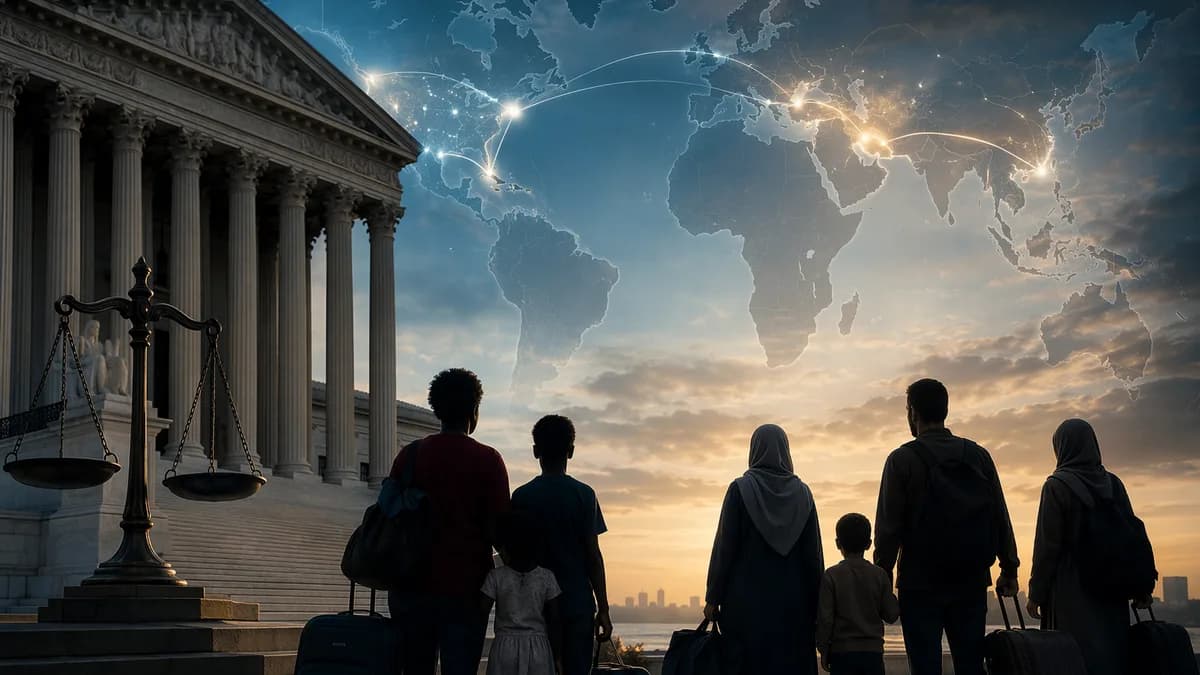
On Thursday, the US Supreme Court turned Temporary Protected Status from a shield into a cliff for hundreds of thousands of Haitians and Syrians who had been living and working legally in the US.
XOOMAR Intelligence
Analyst Take
Thursday’s 6-3 TPS ruling gives Trump a direct path to removals
The court ruled 6-3 for the Trump administration, clearing the way for the termination of Temporary Protected Status for hundreds of thousands of people from Haiti and Syria, according to Guardian World.
The ruling matters because TPS holders were not hiding from the government. They had permission to live and work in the US because DHS had deemed their home countries unsafe due to war, political instability, natural disasters or related crises. Now, if TPS ends, many could face potential deportation unless another immigration status, protection or pending application changes their individual circumstances.
This is not a narrow paperwork fight. It is a major win for Trump’s immigration agenda and a legal signal that courts may have little room to second-guess executive decisions ending humanitarian protections.
Justice Samuel Alito, writing for the conservative majority, said the TPS statute “plainly bars” judicial review of the administration’s termination decisions. Justice Elena Kagan, joined by Justices Sonia Sotomayor and Ketanji Brown Jackson, dissented.
“Haiti is not safe, and everyone knows it. The court’s ruling does not change the reality on the ground or the contributions we make here in the United States,” said Viles Dorsainvil, a Haitian TPS holder and co-founder of the Haitian Support Center in Springfield.
April arguments set up Haiti and Syria as test cases for Trump’s TPS crackdown
The decisive moment came after oral arguments in late April, when the conservative-controlled court appeared receptive to the administration’s claim that courts could not review TPS termination decisions.
Temporary Protected Status is a DHS designation for nationals of countries where return is considered unsafe. It allows people already in the US to stay and work legally for limited, renewable periods. It does not create a direct path to citizenship.
That temporary design is the pressure point. Haiti first received TPS after the 2010 earthquake. Syria first received it after the country descended into civil war in 2012. Both designations lasted because the underlying crises did not resolve quickly.
The Trump administration argued that TPS had stretched far beyond its intended temporary function. Advocates countered that DHS failed to follow the proper process and that Haiti and Syria remained too dangerous for forced return.
That unresolved danger is the core of the dispute: the administration says TPS cannot become permanent by default, while advocates argue the conditions that justified protection have not safely ended.
The court’s decision also follows last year’s Supreme Court move allowing the administration to strip TPS from more than 300,000 Venezuelans under the emergency docket. For XOOMAR readers tracking the legal arc, this latest decision fits with our prior coverage of how Supreme Court immigration rulings let Trump strip TPS.
The numbers show why this TPS decision reaches beyond two countries
The immediate affected population is large:
| Group | TPS population cited in source material | Current effect |
|---|---|---|
| Haitians | More than 350,000 | Vulnerable to deportation after court cleared termination |
| Syrians | 6,100 | Vulnerable to deportation after court cleared termination |
| All TPS holders | Nearly 1.3 million when Trump returned to office in January 2025 | Other designations now face greater legal risk |
| TPS countries | 17 countries, per AP | Program-wide exposure increases if DHS moves next |
The supplied record does not break down TPS holders by industry, employer type, tax contribution, family composition or local geography. That matters. Claims about specific sectors or community-level economic effects should be treated cautiously unless backed by separate data.
Still, the direct legal mechanism is clear. TPS includes work authorization. If the protection ends, work permits and deportation protection can disappear unless another legal status applies.
That is where economic exposure enters the story, as analysis rather than a source-provided statistic. Employers with TPS workers could face sudden authorization gaps. Cities with large Haitian or Syrian communities could face household instability. Families with pending immigration cases may still lose protection before those cases resolve.
David Bier, director of immigration studies at the libertarian Cato Institute, framed the ruling around legal immigration pathways rather than only deportation.
“It will be harder for the US to compete on the global stage or keep up with a growing fiscal crisis if policymakers continue down a path that targets legal immigration pathways,” Bier said.
The White House, advocates and the court are fighting over who gets the final word
The administration’s position is straightforward: TPS was meant to be temporary, and the executive branch should decide when a country no longer qualifies.
Advocates see the ruling differently. Their argument is that ending TPS for countries still considered unsafe turns a humanitarian program into a mass deportation tool. Lawyers for Haitian immigrants, Geoff Pipoly and Andy Tauber, said responsibility now shifts to Congress.
“Immigrants are one of America’s greatest strengths. The responsibility to save these lives is now with Congress.”
The Supreme Court majority focused on statutory limits. Alito wrote that courts cannot review these TPS decisions and rejected the claim that Haitian TPS holders were likely to succeed on arguments that the administration acted with racial bias.
Kagan’s dissent took the opposite view. She wrote that the statute permits judicial review of whether the DHS secretary “adhered to the procedures it mandates,” which is what plaintiffs disputed. She also said evidence that race played a role in the Haiti decision was “plain to see” in Trump’s statements.
The record includes Trump calling Haiti a “shithole” and a “hellhole” country. It also notes that during the 2024 campaign, Trump and JD Vance made false and derogatory claims that Haitians in Springfield, Ohio, were eating household pets.
For related executive-power context outside immigration, XOOMAR has also covered how Congress cornered Trump with an Iran war powers measure, another dispute centered on where presidential discretion ends and institutional checks begin.
TPS was built for temporary crises, but Haiti and Syria expose the flaw
Congress created TPS in 1990 to prevent deportations to countries suffering from natural disasters, civil strife and other instability. The design assumes danger may be temporary.
Haiti and Syria show the weakness in that assumption. Haiti’s TPS began after a catastrophic earthquake in 2010 and continued through later instability and violence. Syria’s began in 2012 during civil war, a conflict that lasted more than a decade before the fall of Bashar Assad’s government in late 2024, according to the supplied AP material.
The policy contradiction is sharp. A program can be legally temporary while the crisis that triggered it lasts for years. That gap leaves hundreds of thousands of people living legally in the US, building routines around renewable protection, while knowing the status can be switched off by a future administration.
The Supreme Court has now made that switch easier to defend in court.
That does not mean every TPS designation ends automatically. It does mean legal challenges to revocations face a steeper climb, especially when framed around whether DHS made the correct country-condition judgment.
The next fight moves to Congress, DHS timelines and enforcement choices
For TPS holders from Haiti and Syria, the immediate question is practical: when do work permits expire, how fast will DHS implement termination, and who becomes an enforcement priority?
For advocates, the legal path narrowed. That pushes attention toward Congress, where lawyers for Haitian immigrants explicitly said the responsibility now lies. The supplied record notes that a House bill extending protections for Haitians passed with a rare bipartisan vote in April but had languished in the Senate.
Future lawsuits may still test procedure, discrimination claims or country-condition evidence. But after Alito’s opinion, plaintiffs face a court majority that reads the TPS statute as sharply limiting judicial review.
The evidence that would confirm the hardest version of this ruling is simple: DHS moves next against more TPS countries, courts decline to intervene, and deportation exposure spreads across the broader 1.3 million TPS population. The evidence that would weaken that thesis would be congressional action, slower DHS implementation, or narrower enforcement guidance that limits removals despite the court victory.
Impact Analysis
- The ruling clears a path to end legal protections for many Haitian and Syrian TPS holders.
- It strengthens executive authority over humanitarian immigration decisions.
- Families and workers who had legal permission to stay may now face deportation risks.
Supreme Court positions on TPS termination review
| Side | Position | Justices |
|---|---|---|
| Majority | TPS statute bars judicial review of administration termination decisions | Samuel Alito and five other justices |
| Dissent | Opposed limiting review of humanitarian protection terminations | Elena Kagan, Sonia Sotomayor, Ketanji Brown Jackson |
Supreme Court vote on TPS termination case
Primary Sources & Disclosures

Written by
XOOMAR Insights Team
Research and Editorial Desk
The XOOMAR Insights Team pairs automated research with human editorial judgment. We track hundreds of sources across technology, fintech, trading, SaaS, and cybersecurity, cross-check the facts, and explain what happened, why it matters, and what to watch next. We do not just rewrite headlines. Every article is fact-checked and scored for reliability before it goes live, and we link back to the original sources so you can verify anything yourself.