A public health system can say an exposure source is eliminated and still leave New Yorkers staring at five deaths from the same NYC Legionnaires’ disease outbreak.
XOOMAR Intelligence
Analyst Take
The latest update from New York City’s health department puts the Upper East Side cluster at 82 identified cases, five deaths, eight people still hospitalized, and 56 discharged, according to Guardian World. The tension is sharp: officials say there have been no new diagnoses in six days and no new symptom reports in more than 10 days, yet the death toll has kept the outbreak in crisis territory.
Upper East Side cooling towers became the center of the NYC Legionnaires’ disease outbreak
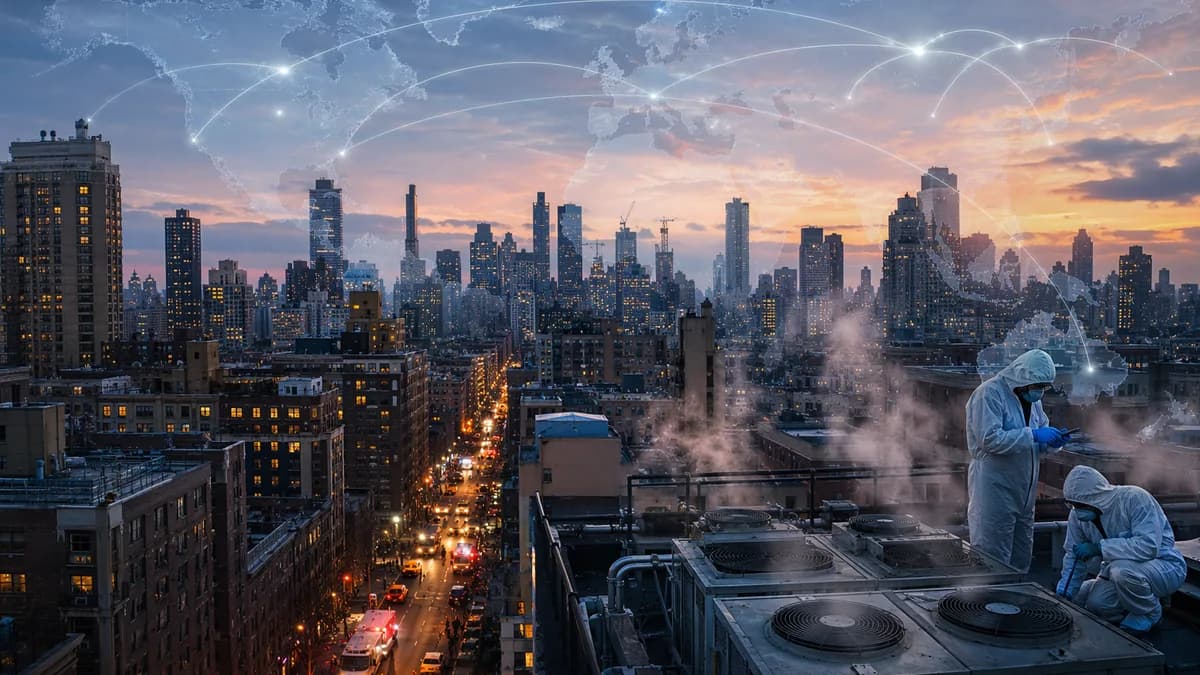
The working assumption for many residents is simple: if tap water is safe and home air conditioners are safe, the danger must be gone. The reality is more technical and more uncomfortable. The outbreak has been traced to cooling towers in buildings on Manhattan’s Upper East Side, the kind of rooftop mechanical systems most people never see but may live near every day.
Cooling towers matter because Legionella bacteria can spread through mist. People get Legionnaires’ disease by breathing in contaminated water droplets, not through ordinary person-to-person contact. That is why officials have stressed that residents can still drink tap water, bathe, shower, cook, and use air conditioners at home.
The city says confirmatory culture tests found live legionella bacteria in 34 cooling towers across 33 buildings. Another nine cooling towers tested negative, while results for the remaining 140 cooling tower systems are expected over the coming week.
“We believe that through our aggressive strategy of testing and remediation we have eliminated the source of exposure,” said Dr Alister Martin, New York City’s health commissioner.
That is reassuring. It is not closure. XOOMAR analysis: the central issue now shifts from immediate exposure control to maintenance, compliance, inspection speed, and whether the city’s tower oversight catches risk before illness appears.
The outbreak math is improving in one column and worsening in another
The case curve contains two stories at once.
- Cases: 82 people have been identified with Legionnaires’ disease.
- Deaths: Five people have died.
- Hospital pressure: Eight people remain hospitalized.
- Recoveries: 56 have been discharged.
- Transmission signal: Officials reported no new diagnosed cases in six days and no new symptom reports in more than 10 days.
That mix suggests the exposure period may be narrowing, but the human cost is still rising. Legionnaires’ disease can be treated with antibiotics, but the CDC says “about one out of every 10 people who gets sick with legionnaires’ disease will die due to complications from their illness.”
The risk is not evenly distributed. ABC News, citing health officials and CDC guidance, noted that complications can be fatal for certain patients, including people who are immunocompromised or have chronic lung diseases. The health department also advised anyone who spent time in affected ZIP codes 10028, 10075, and 10128, including Carnegie Hill and Yorkville, to seek medical attention if they develop flu-like symptoms.
The remaining uncertainty is practical. The public now needs the investigation to answer which towers mattered most, whether any maintenance failures preceded the outbreak, and how remediation decisions were made as test results came in.
Testing positive is not the same as proving the source
The city has a large environmental signal: 34 cooling towers with live bacteria across 33 buildings. But a positive environmental test does not automatically prove which tower infected which patient.
AP reported that officials still have not identified the source of the bacteria that sickened more than six dozen people in the last month. NBC New York added that the results may point to more than one contributing source, rather than one single tower.
That distinction matters. Source control means contaminated systems were cleaned, disinfected, or otherwise pushed out of immediate risk status. Epidemiological closure means investigators can connect the outbreak pattern to exposure evidence with enough precision to explain what failed and where.
Before and after the latest city update, the picture changed like this:
| Question | Earlier public concern | Latest reported position |
|---|---|---|
| Is the outbreak still producing new symptom reports? | Active concern across affected ZIP codes | No new symptoms reported in over 10 days, according to officials |
| Are cooling towers implicated? | Suspected focus of investigation | Live bacteria found in 34 cooling towers across 33 buildings |
| Is household water the issue? | Resident worry | Officials say tap water, bathing, showering, cooking, and home AC use can continue |
| Is accountability settled? | Not yet | City says it is focused on lab analysis and “holding accountable anyone found out of compliance with local laws” |
Residents, landlords, City Hall, and hospitals are not facing the same problem
Residents want instructions, not process language. The useful guidance is direct: seek care if you spent time in the affected ZIP codes and develop flu-like symptoms, especially if symptoms resemble pneumonia. ABC reported that symptoms can appear up to 14 days after exposure, according to the health department.
Building owners face a different pressure. If a tower tested positive, the city says it has already undergone remediation and been fully cleaned. That does not end scrutiny. It starts the documentation phase: maintenance records, testing history, cleaning schedules, and compliance with local rules.
Health officials are caught between two messages that can sound contradictory but may both be true: the source of exposure may be eliminated, and the outbreak investigation is still unfinished.
Mayor Zohran Mamdani has tried to draw that line clearly.
“I want to reassure concerned New Yorkers that they can continue to drink tap water, bathe, shower, cook and use air conditioners at home. In the days to come and in the weeks and months as well,” Mamdani said.
Mamdani’s role now goes beyond reassurance. As XOOMAR previously covered in Mamdani Netanyahu Arrest Vow Crashes Into Legal Wall, his public statements can quickly become tests of authority and execution. This outbreak is a more local test: can City Hall prove that health enforcement is fast enough when the hazard sits on rooftops?
New York has seen this movie before, and building systems keep appearing in the frame
The Upper East Side outbreak does not sit in a vacuum. NBC New York reported that last year, seven people died and more than 100 were sickened during an outbreak in Harlem. AP also cited that Harlem outbreak and reported that after it, city leaders authorized the Health Department in November to hire 23 more Legionella-focused water ecologists and supervisors, bringing the intended total to 56.
The staffing gap is now part of the story. AP reported the department currently has 35 people in those roles, with another 14 in orientation, training, and shadowing, and seven positions still to fill. The agency also said it performed nearly 1,600 cooling tower inspections in the first six months of the year, 35% more than during the same period in 2025.
That creates the hardest question for the city: if inspections rose and rules tightened, why did dozens of cooling towers still test positive for live bacteria?
XOOMAR analysis: the recurring pattern points less to medical surprise than to urban systems risk. Dense neighborhoods rely on mechanical equipment that can create public exposure when maintenance slips or detection lags. New York’s recent emergency burden has not been confined to disease either, as seen in Flash Flooding Swamps New York, New Jersey Weekend. The common thread is operational readiness under pressure, not the cause of the hazard.
The next test is whether prevention becomes routine instead of reactive
The immediate watch item is the remaining 140 cooling tower system results expected over the coming week. If those results show few additional positives and no new symptom reports emerge, the city’s claim that the exposure source has been eliminated will look stronger.
If more towers test positive, if more cases appear, or if violations surface, the story changes. The focus will move from outbreak response to preventable failure.
For New Yorkers, the practical stance is narrow but urgent: people who spent time in 10028, 10075, or 10128 should watch for flu-like or pneumonia-like symptoms and seek medical care quickly if they appear. For landlords and property managers, the message is harsher: cooling tower maintenance is no longer an invisible back-office task. It is public health infrastructure.
The NYC Legionnaires’ disease outbreak may fade from headlines if cases stop rising. The infrastructure risk will not. The evidence that matters next is concrete: final tower results, enforcement actions, inspection histories, and whether the city can show prevention happened before the next cluster, not only after the first deaths.
Impact Analysis
- Five deaths show the outbreak remains serious even after officials say the exposure source has been eliminated.
- The cluster highlights how building cooling towers can pose public health risks through contaminated mist.
- Residents need clear guidance because tap water, showers, cooking, and home air conditioners are not considered sources of spread.
Cooling Tower Test Results in the Upper East Side Outbreak
| Status | Count |
|---|---|
| Tested positive for live Legionella bacteria | 34 cooling towers across 33 buildings |
| Tested negative | 9 cooling towers |
| Results pending | 140 cooling tower systems |
NYC Legionnaires’ Disease Outbreak Toll
Primary Sources & Disclosures

Written by
XOOMAR Insights Team
Research and Editorial Desk
The XOOMAR Insights Team pairs automated research with human editorial judgment. We track hundreds of sources across technology, fintech, trading, SaaS, and cybersecurity, cross-check the facts, and explain what happened, why it matters, and what to watch next. We do not just rewrite headlines. Every article is fact-checked and scored for reliability before it goes live, and we link back to the original sources so you can verify anything yourself.