
A Pentagon alarm that looked serious enough to bring in hazmat teams ended as a false air quality alert, after officials locked down parts of the building and later said no hazard was found.
Global TrendsJune 11, 2026· 5 min read· By XOOMAR Insights Team
False Air Scare Sends Pentagon Lockdown Into Panic
Updated on June 11, 2026
XOOMAR Intelligence
Analyst Take
59/ 100
4 sources analyzedLow confidenceTrend20Freshness92Source Trust82Factual Grounding96Signal Cluster20
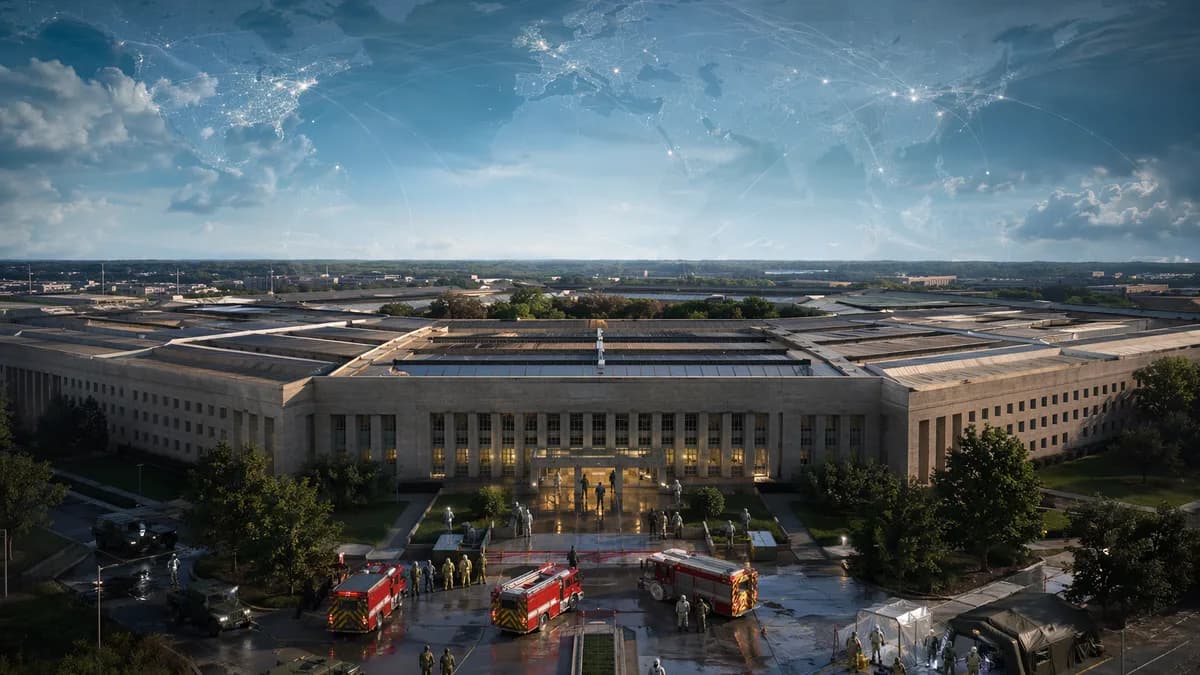
The Pentagon lifted the partial lockdown Thursday after testing cleared the affected areas, according to Independent World. First responders investigated the incident in protective gear and gas masks, a visible sign that officials treated the alert as a potential hazardous materials case until tests ruled out danger.
Pentagon clears building after sensor scare, not confirmed exposure
The expectation inside the US defense headquarters was blunt: shelter in place until officials knew whether the air quality alarm pointed to a real threat. The reality was less dramatic, but still disruptive. Pentagon spokesman Sean Parnell said testing found no hazard and normal operations resumed.
“Earlier this morning, Pentagon occupants were notified of a potential air quality issue, prompting immediate precautionary safety measures and evaluation. Subsequent testing confirmed no hazard exists, and normal operations have resumed.”
Parnell also thanked responders for moving quickly.
“We express our sincere appreciation to the first responders for their swift actions to ensure the safety of all personnel.”
The most precise public timing comes from emergency and Pentagon updates cited by related reports. The Arlington County Fire Department said at 10:41 a.m. that its units, including a Hazardous Materials Team, were operating at the Pentagon. The Pentagon Force Protection Agency said at 12:24 p.m. that shelter-in-place orders continued in affected areas. Parnell posted the all-clear at 1:31 p.m. ET, according to TIME.
Officials have not released the exact time the internal alarm first sounded.
CNN, cited in the Independent report, said the response was triggered by a malfunctioning sensor system that detected possible anthrax in the air. The Pentagon has not publicly confirmed that substance as the official trigger. That distinction matters. The public record says “air quality issue” and “no hazard exists.” The anthrax detail remains sourced reporting, not a Pentagon confirmation.
A severe alert briefly turned corridors into controlled zones
The lockdown hit several corridors inside the sprawling, five-sided building in Arlington, Virginia, where about 24,000 military personnel and civilians work, along with 3,000 non-defense support workers, according to the Independent. Some people were evacuated as a precaution, while others were told to remain in place during testing.
Reports cited by TIME said multiple floors and corridors were affected, including floors two through five in the fourth through the seventh corridors. Personnel outside the immediate areas of concern were evacuated from the US military headquarters, while staff in restricted zones waited for clearance.
The visible response was heavy by design. Emergency personnel wore chemical protective equipment and gas masks while investigating the source of the alert. Arlington fire crews worked with the Pentagon Force Protection Agency’s hazmat team.
That kind of response can look alarming from the outside. Inside a facility like the Pentagon, it’s also the point. The building runs strict safety and security procedures, so an uncertain sensor reading can quickly become a shelter-in-place order while teams test, isolate and verify.
A quick before-and-after view shows the gap between the initial assumption and the final result:
| Moment | Pentagon posture | Publicly confirmed status |
|---|---|---|
| Initial alert | Air quality issue detected | Exact trigger time not released |
| Emergency response | Hazmat teams deployed, affected areas locked down | Arlington fire said units were operating at 10:41 a.m. |
| Midday status | Shelter-in-place still active in affected areas | PFPA update at 12:24 p.m. |
| All-clear | Normal operations resumed | Parnell statement at 1:31 p.m. ET |
| Final finding | Tests completed | “No hazard exists” |
For XOOMAR readers, the lesson is less about military drama than operational risk. Sensor-driven systems can force instant decisions before humans know whether the signal is real. That same tension shows up in very different sectors, from AI infrastructure financing in Databricks Eyes $175B After CEO Trashes 2026 IPO to institutional reputation and timing in At 81, Peter Weir Grabs AFTRS' First Lifetime Award. Different worlds, same pressure: respond fast before the facts are complete.
The Pentagon has an all-clear, but not a full public timeline
The Pentagon has answered the safety question. It has not yet answered every process question.
The open issues are narrow but important:
- Trigger: What exactly caused the air quality alarm?
- Sensor system: Was a malfunction confirmed, and if so, where?
- Substance: Did internal systems flag anthrax specifically, as CNN reported, or something broader?
- Affected area: Which corridors and floors were formally locked down?
- Timeline: When did the alarm first fire, and when did internal testing begin?
The Independent reported that officials suspected a faulty sensor may have caused the alert. That fits the final outcome, but it doesn’t close the loop. A false alarm at the Pentagon still demands a post-incident account because the building houses the Defense Department’s headquarters and can’t afford confusion over whether an airborne threat response worked as designed.
No harm was reported at the site. Normal operations resumed. The incident also landed against the unavoidable backdrop of the building’s history: the Pentagon was targeted during the September 11, 2001, al-Qaeda attacks. That doesn’t mean Thursday’s scare was linked to terrorism. It explains why even a false air quality alarm inside the complex draws an aggressive emergency response.
The next useful update would be a confirmed incident timeline from Pentagon security officials or Arlington emergency responders, plus clarification on whether a specific sensor failed. Until then, the practical takeaway is simple: the system produced a disruptive false positive, responders treated it as real, and testing ended the lockdown without finding a hazard.
Impact Analysis
- The incident shows how seriously Pentagon security teams respond to potential hazardous-materials threats.
- Testing found no hazard, limiting the event to a disruption rather than a confirmed safety exposure.
- The response underscores the importance of fast public updates during alarms at sensitive government facilities.
Sources

Written by
XOOMAR Insights Team
Research and Editorial Desk
The XOOMAR Insights Team pairs automated research with human editorial judgment. We track hundreds of sources across technology, fintech, trading, SaaS, and cybersecurity, cross-check the facts, and explain what happened, why it matters, and what to watch next. We do not just rewrite headlines. Every article is fact-checked and scored for reliability before it goes live, and we link back to the original sources so you can verify anything yourself.
Explore More Topics
Related Articles
 Global Trends
Hegseth Budget Torches Cut Talk With $1.5tn Pentagon Ask
Hegseth went from demanding Pentagon cuts to seeking nearly $1.5tn, exposing how fast austerity vanishes around defense spending.
Jul 26, 20267 min
 Global Trends
$37.5B Iran War Cost Corners Pentagon on $67B Ask
Hegseth says the Iran war has cost $37.5B, but the Pentagon wants $67B more, putting its shifting math under fire in Congress.
Jul 22, 20267 min
 Global Trends
Trump’s $1.15tn NDAA Squeaks Through Bitter House Revolt
A $1.15tn NDAA barely cleared the House as Democrats turned Trump’s Iran war and voting agenda into a Senate showdown.
Jul 23, 20266 min
 Global Trends
900 Canada Wildfires Send Smoke Across the Atlantic
More than 900 Canada wildfires have burned 3m hectares, spreading smoke abroad as other weather extremes intensify.
Jul 25, 20266 min
 Global Trends
Houthi Attacks Turn Saudi Oil Escape Route Into Trap
Houthi attacks are squeezing Saudi Arabia’s Red Sea oil route just as Hormuz falters, raising the risk of wider supply shocks.
Jul 26, 20268 min
 Fintech
Musk Turns Paid X Users Into X Money App Banking Test
X Money is live for paid U.S. subscribers, turning Premium users into Musk’s first real test of banking inside X.
Jul 28, 20268 min
 Fintech
Apple Upgrade Turns iPhone Price Shock into Klarna Rent
Apple is using Klarna leases to soften iPhone, Mac and iPad price shock without cutting prices or loosening its upgrade grip.
Jul 28, 20268 min
 Trading
Gold Price Risks $4,000 Breakdown Before Fed Decision
Gold is slipping near $4,000 as traders wait for the Fed's rate signal, with yields and dollar strength threatening support.
Jul 29, 20268 min
 Technology
Fast Metals Mines Toxic Red Mud for Critical Minerals
Fast Metals raised $4.3M to mine critical minerals from red mud. Now it has to prove the leftover waste is safer.
Jul 29, 202612 min
 SaaS & Tools
Nearly 60 Webinar Tools Expose the Best Webinar Software
Webinar platforms are now judged by pipeline, not polish. Zapier’s 2026 picks show marketers which tools turn attendance into action.
Jul 29, 20268 min
Don't miss the signal
Get our weekly roundup of the stories that matter across tech, fintech, and trading. No noise, just signal.
Free forever. No spam. Unsubscribe anytime.