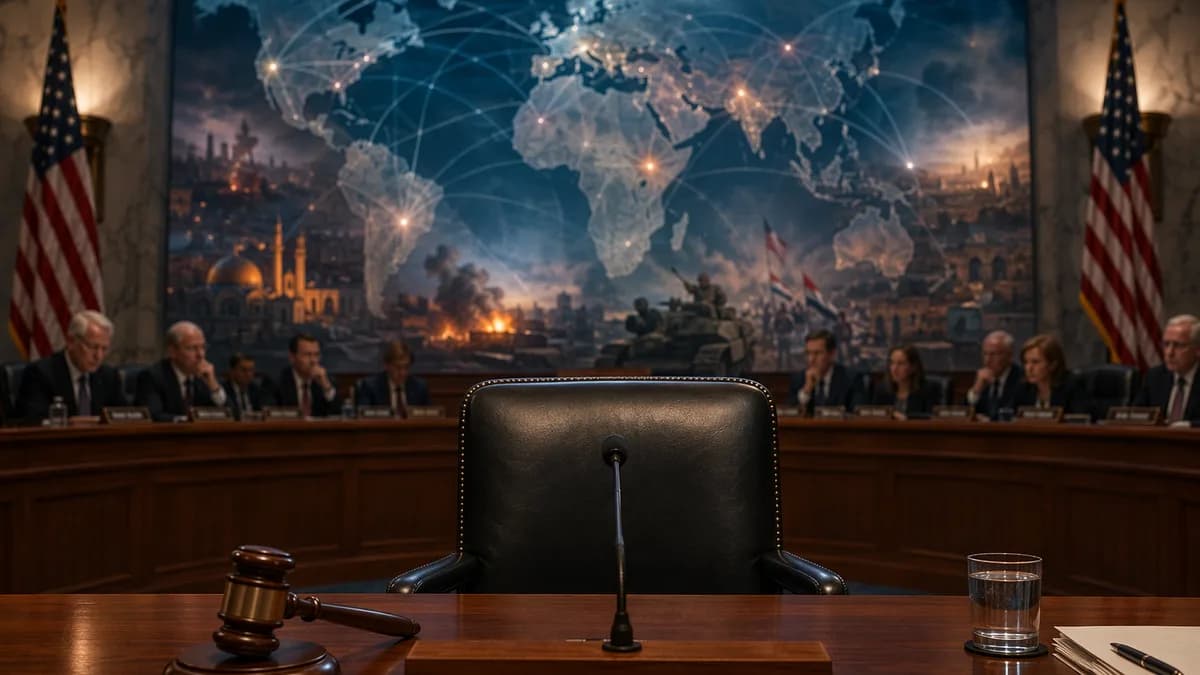
Trump and Biden put legal power and political legacy back at the center of Washington
The Todd Blanche attorney general hearing put Donald Trump’s former defense lawyer under Senate scrutiny Wednesday, while Joe Biden set a publication date for a memoir about his presidency and 2024 exit.
XOOMAR Intelligence
Analyst Take
That combination matters because Washington’s post-election fights are moving away from rallies and campaign ads and into harder institutional terrain: the Justice Department and the written record of a presidency. The developments were tracked in a live politics file by Guardian World, which also reported Biden’s forthcoming memoir through the Associated Press.
The connecting thread is control. Trump is trying to install Todd Blanche, his former personal defense lawyer, as attorney general. Biden is preparing Promise Me, America, a memoir due 17 November from Little, Brown and Company.
| Fight | Immediate trigger | Political signal |
|---|---|---|
| Todd Blanche attorney general hearing | Senate Judiciary Committee confirmation session | Whether Trump’s DOJ pick can claim independence after serving as his lawyer |
| Biden memoir | Promise Me, America scheduled for 17 November | Biden wants his version of the economy, presidency, and withdrawal decision in print |
Todd Blanche attorney general hearing puts Trump’s former defense lawyer on the spot
Todd Blanche, Trump’s nominee for attorney general and former personal lawyer, faced a contentious Senate Judiciary Committee hearing on Wednesday. The core issue was blunt: can someone who defended Trump personally run the Justice Department independently?
Democrats pressed that point from the start. Senator Dick Durbin, the ranking Democrat on the panel, accused Blanche of still acting like Trump’s lawyer despite his Justice Department role.
“This nation deserves an attorney general who loves the Constitution more than any single president,” Durbin said. “An attorney general focused on keeping America safe and combating corruption, not satisfying the president’s personal grievances.”
Blanche pushed back during the nearly five-hour session. When asked whether he and Trump were friends, he first replied, “I’m his lawyer,” then corrected himself and said “was his lawyer.” That slip gave Democrats exactly the frame they wanted for the Todd Blanche attorney general hearing: loyalty versus independence.
Republicans had a simpler counterframe. Trump, posting on Truth Social on Tuesday, said Blanche had done a “phenomenal job” as acting attorney general and urged “every Republican senator” to vote for him. The supplied reporting also says two Republicans on the panel viewed as potential opponents, Thom Tillis and John Cornyn, appeared to be leaning toward confirmation.
Senators probe how far Trump’s Justice Department reset could go
The sharpest exchanges focused on whether Blanche has already used the Justice Department to advance Trump’s political interests. Democratic senators Sheldon Whitehouse and Chris Coons questioned him over the firing of hundreds of career Department of Justice and FBI employees described in the source as seen as insufficiently loyal to Trump.
Whitehouse told Blanche: “You’ve cleaned house of every attorney who worked on a case related to Trump.” Coons said Blanche had been “prosecuting the president’s political enemies and firing rank-and-file prosecutors and FBI agents because of the cases they were assigned to.”
Blanche called Whitehouse’s questions “obnoxious” and accused him of lying about his tenure at the department. That exchange matters more than the theatrics. If Blanche advances, the Senate vote becomes a test of how much deference Republicans will give Trump on law enforcement appointments.
Other flashpoints piled up:
- James Comey: The source says Comey was indicted in April for allegedly threatening Trump’s life in an Instagram post.
- Anti-weaponization fund: Blanche was questioned about a $1.8 billion fund Democrats denounced as a “slush fund.” He said the fund was “dead.”
- IRS settlement: Blanche defended a deal shielding Trump and his sons from audits of past tax returns, which a federal judge voided Monday.
- Epstein files: Victims of Jeffrey Epstein attended the hearing, and Blanche said charges would be brought if the files produced prosecutable evidence.
The market and tech read-through is not about one soundbite. It’s about enforcement posture. The Justice Department’s independence affects how regulated companies evaluate legal risk, especially when a nominee is asked, in public, whether career prosecutors and politically sensitive cases will be insulated from presidential pressure.
For related XOOMAR reading on executive power fights, see DHS Election Claims Drag Trump’s 2020 Grievance Into Power and Speech Snub Has Trump Threatening TV Network Licenses.
House Democrats deliver a rare Israel aid rebuke
Claims about a major House Democratic rebuke on Israel aid should be treated cautiously here. The source material provided for this article does not establish the specific vote totals, amendment details, leadership positions, caucus size, or quoted statements needed to present that episode as a confirmed part of the day’s reporting.
Without those details, the article cannot responsibly describe the alleged vote as a verified rupture inside the Democratic caucus or use it as evidence of a broader shift in party discipline. Any analysis of congressional spending power and Israel aid would require sourcing that directly supports the amendment, the vote count, and the positions attributed to Democratic leaders.
That leaves the confirmed institutional story narrower but still significant: the day’s supported reporting centers on Trump’s attempt to place a former personal lawyer at the top of the Justice Department and Biden’s move to shape the record of his own presidency through a scheduled memoir.
Biden’s Promise Me, America sets a date for his version of 2024
Former president Joe Biden will publish Promise Me, America this fall, with Little, Brown and Company telling the Associated Press that the memoir is scheduled for 17 November.
The reported scope is broad. Biden says the book will touch on the economy and his decision to drop his bid for reelection. Those are the two confirmed anchors that matter most: his governing record and the decision that ended his campaign.
This is not just a personal project, based on the facts supplied. It is Biden’s chance to place his own account into the public record while the political class is still processing the consequences of 2024. The source does not say how candid the book will be, or how much detail Biden will offer on internal Democratic debates. That is the open question.
Memoirs from former presidents can function as political documents as much as personal reflections. Here, the confirmed timing and subject matter suggest Biden wants to defend both the economy he presided over and the judgment behind leaving the race.
Biden’s November release lands while Democrats are still sorting the record
The 17 November release date gives Biden a fixed moment to reenter the political conversation with his own narrative. The source does not provide polling, internal party accounts, or donor reaction, so the analysis has to stay narrow: the book’s confirmed topics put the economy and Biden’s withdrawal decision back in front of readers.
That matters because both subjects remain politically loaded. The economy was central to Biden’s presidency, and his exit from the race is one of the defining facts of the 2024 cycle. If Promise Me, America sticks to broad reflection, it may leave the hardest questions unanswered. If it gets specific, it could sharpen debates inside the party.
The contrast with Trump is stark. Trump’s fight is over who runs federal law enforcement. Biden’s is over how his presidency is remembered.
The bigger picture: Washington’s next fight is over who controls the record and who controls the law
The day’s supported stories point in the same direction: power after the campaign now runs through institutions. Trump’s attorney general pick is a test of how much personal loyalty the Senate will tolerate at the top of the Justice Department. Biden’s memoir is a bid to shape historical memory.
The next signal from the Todd Blanche attorney general hearing is not whether senators trade insults. They already did. The real test is whether Blanche offers enforceable limits on political influence at the Justice Department, and whether Senate Republicans demand them before confirmation.
For Biden, the watch item is candor. Promise Me, America will show how much he is willing to say about the decision that ended his campaign, and whether he treats the economy as a defense, an explanation, or both.
Impact Analysis
- Trump’s choice of Todd Blanche raises questions about Justice Department independence under a new administration.
- Biden’s memoir signals an effort to shape the historical record of his presidency and 2024 exit.
- Both developments show Washington’s post-election battles shifting from campaigns to institutions and legacy.
Two Washington Power Plays
| Fight | Immediate trigger | Political signal |
|---|---|---|
| Todd Blanche attorney general hearing | Senate Judiciary Committee confirmation session | Whether Trump’s DOJ pick can claim independence after serving as his lawyer |
| Biden memoir | Promise Me, America scheduled for 17 November | Biden wants his version of the economy, presidency, and withdrawal decision in print |
Primary Sources & Disclosures

Written by
XOOMAR Insights Team
Research and Editorial Desk
The XOOMAR Insights Team pairs automated research with human editorial judgment. We track hundreds of sources across technology, fintech, trading, SaaS, and cybersecurity, cross-check the facts, and explain what happened, why it matters, and what to watch next. We do not just rewrite headlines. Every article is fact-checked and scored for reliability before it goes live, and we link back to the original sources so you can verify anything yourself.