Trump's Iran deal exposes the fantasy behind America's war aims
Trump's Iran deal is not a victory lap. It is the bill coming due for a war sold with maximalist promises that military power could not plausibly deliver.

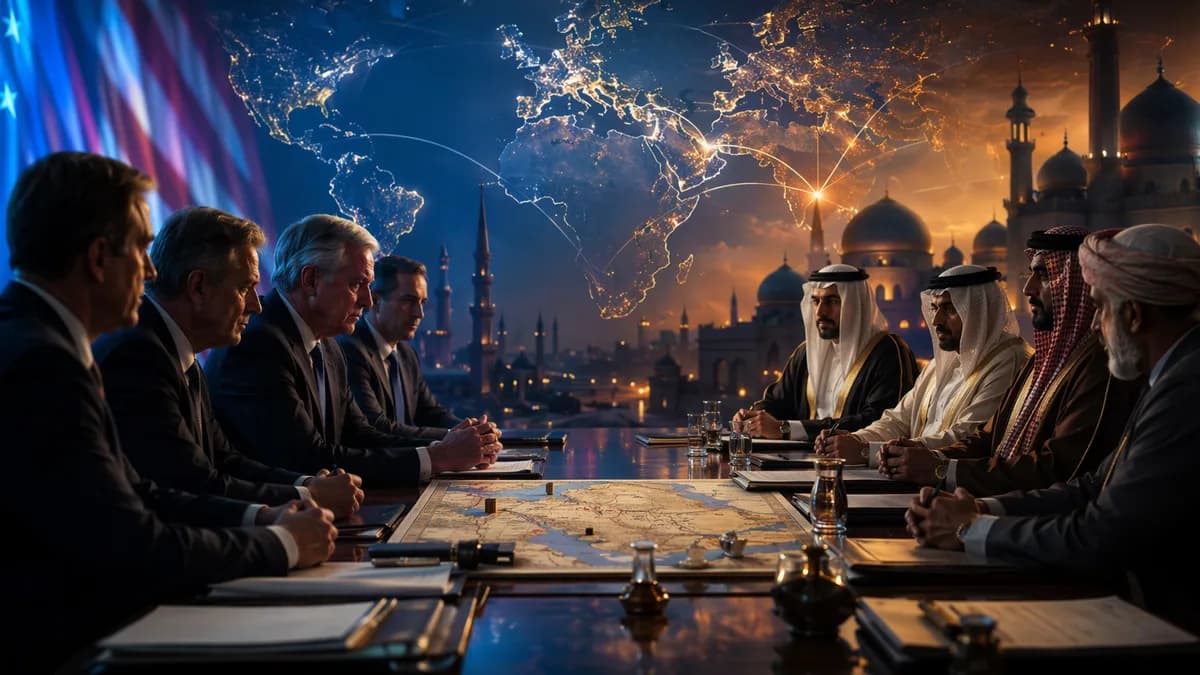
Trump's Iran deal is not a victory lap. It is the bill coming due for a war sold with maximalist promises that military power could not plausibly deliver.
XOOMAR Intelligence
Donald Trump entered the conflict vowing to eliminate Iran's nuclear programme, destroy its ballistic missile programme, and end Tehran's support for groups including Hezbollah and Hamas. He is leaving with Iran's word not to build a bomb, further nuclear talks, no written mention of ballistic missiles, and a memorandum of understanding that backs a ceasefire in Lebanon, according to Guardian World.
That is a retreat from ambition. It is also the least bad option once the original ambition collided with the map, the Strait of Hormuz, and the limits of American appetite for another grinding Middle East war.
The hard truth is simple: restraint now may carry a political cost, but staying trapped in an open-ended escalation would have cost more. Trump can spin the Trump Iran deal as strength. His critics can call it humiliation. Both miss the deeper lesson. The embarrassing part was not ending the war. The embarrassing part was starting it with goals that required far more than the administration was prepared to spend.
The administration's original demands sounded clean in a speech and impossible on contact with reality.
Eliminating Iran's nuclear programme is not the same as bombing sites. Destroying a missile programme is not the same as hitting launchers or depots. Ending Tehran's ties to Hezbollah and Hamas is not a discrete military task. Those objectives point toward regime change, long-term occupation, or a sustained regional war. The source material does not show Washington had a credible plan for any of those.
That gap matters. Military strikes can damage hardware. They cannot erase scientific knowledge, procurement habits, ideology, command networks, or a state security doctrine built over decades around survival under pressure.
Barbara Leaf, a distinguished diplomatic fellow at the Middle East Institute and a former US assistant secretary of state for near eastern affairs, put it sharply:
“The US rapidly found that overmatching an adversary that has spent four decades honing its asymmetrical warfighting doctrine and skills would not be the war it had prepared for.”
Here is the core mismatch:
| Original US aim | Deal reality described in the source material |
|---|---|
| Eliminate Iran's nuclear programme | Iran gives its word not to build a bomb and agrees to further nuclear discussions |
| Destroy the ballistic missile programme | No mention in writing of the ballistic missile programme |
| End support for Hezbollah and Hamas | Hezbollah celebrates a “victory” as the MOU institutes a ceasefire in Lebanon |
| Force strategic capitulation | The deal focuses on ending conflict and reopening the Strait of Hormuz |
This is why the Trump Iran deal should be judged less as a standalone diplomatic document and more as the after-action report on a bad premise.
As we argued in Trump's US-Iran Agreement Masks a Nuclear Deadline, the danger in this framework is not merely what it says today. It is what remains unresolved after the cameras move on.
Iran's decisive card was not rhetorical defiance. It was geography.
The Strait of Hormuz became the center of gravity because Iran could make the war hurt outside the battlefield. The Guardian account says almost every previous simulation of war with Iran assumed Tehran would quickly cut off the waterway. That is what gave Iran its most potent bargaining position.
Trump himself described the alternative as a “worldwide depression” if the strait remained closed. Once that risk sat on the table, Washington's choice narrowed fast: escalate, compromise, or drift.
Leaf said the US began with “disastrously unrealistic assessments of the regime’s resilience,” as well as Iran's readiness to seize the Strait of Hormuz and attack US and foreign facilities in the Gulf. That is the central failure. The administration appears to have assumed pressure would break Tehran before Tehran's counterpressure broke Washington's political tolerance.
The domestic side mattered too. Toughness sells until the costs arrive. A prolonged conflict with economic pain, risks to US and foreign facilities, and widening regional exposure becomes harder to defend than a campaign line about dominance. CNN reported that Trump's political pressure included rising gas prices, declining approval ratings, and weakening support from congressional Republicans over Iran.
That does not mean Iran won cleanly. It means Iran survived long enough to make the US reassess what victory would cost.
Call the agreement what it is: a scaled-down settlement that trades sweeping ambitions for an end to open conflict.
That is not appeasement by definition. Sometimes responsible statecraft means accepting that total victory is unavailable at a price the country is willing to pay. The Trump Iran deal may be politically ugly, but ugliness is not the same as strategic failure.
The better distinction is this: ending the war is defensible. Entering it with undeliverable promises was not.
The reported terms show why critics are angry. Forbes reported that the agreement would give Iran access to $300 billion in private funds toward investments in Iran, that the US Treasury Department would issue immediate waivers on exports of Iranian oil, and that Washington committed to lifting sanctions and unfreezing Iranian assets in a final agreement. It also reported a 60-day period for negotiations on Iran's nuclear programme and other issues.
Those are major concessions if they stand. But the alternative was not a cost-free march to Iranian capitulation. The alternative, after Iran used the strait and regional pressure points, was a wider fight without a credible endpoint.
Robert Malley, a former state department official and negotiator on the JCPOA, captured the practical case for the deal:
“The bottom line is that the MOU is far preferable to any of the alternatives on offer. Period.”
That is not praise. It is triage.
The hawkish critique deserves a serious answer because it may prove partly right.
Iran may read this deal as proof that endurance works. It may preserve core nuclear and missile capabilities, accept financial relief, and return later to expansion once pressure fades. US allies, especially Israel and Gulf states, may see the settlement as abandonment or weakness. A vague verification regime would make the agreement dangerous.
Sen. Bill Cassidy called it the “worst foreign policy blunder in decades” and wrote: “Reagan is rolling over in his grave.” Sen. Thom Tillis said the 14 points published Wednesday were “not sufficient for me to say it’s a good deal.” Those reactions are not fringe complaints. They point to a real flaw: the deal appears to leave central questions for later.
The counterargument still fails if it assumes open-ended war would solve what diplomacy may not.
A weak deal can be improved with intrusive monitoring, clear penalties, sanctions enforcement, and coordination with allies. A sprawling war with no achievable political endpoint cannot be cleaned up so easily. Washington should not pretend verification is optional. But critics should not pretend more bombing automatically produces better verification, less enrichment knowledge, or weaker regional networks.
This is the same discipline XOOMAR readers see in other domains: tools only work when matched to the real threat model. In tech, our coverage of how private code escapes cloud with local AI coding assistants made a similar point in a different arena. Control is not a slogan. It is architecture, incentives, monitoring, and enforcement.
Foreign policy is harsher because the failure mode is not a leaked repository. It is a war that becomes too costly to finish and too politically painful to admit.
The prescription is not mystery. US leaders should match goals to means before firing missiles, not after the war starts to go badly.
A disciplined Iran policy would focus on deterrence, inspections, sanctions enforcement, regional de-escalation, and blunt communication with allies about what Washington will and will not do. It would not promise to erase Iran's nuclear knowledge, missile doctrine, and regional relationships through a short conflict.
The next test is not whether Trump can brand the Trump Iran deal as a triumph. The test is whether the administration can turn a face-saving exit into a durable constraint on Iran's most dangerous pathways.
That requires published terms, not selective briefings. It requires a serious answer on ballistic missiles. It requires clarity on what happens after the 60-day clock. It requires convincing allies that ceasefire does not mean abandonment.
America damages its credibility when presidents promise to remake adversaries and then settle for survival terms. The lesson of this deal is not that diplomacy is weakness. The lesson is that fantasy makes war longer, bloodier, and harder to end.
| Original Aim | Deal Outcome |
|---|---|
| Eliminate Iran's nuclear programme | Iran gives its word not to build a bomb and agrees to further nuclear talks |
| Destroy Iran's ballistic missile programme | No written mention of ballistic missiles |
| End Tehran's support for Hezbollah and Hamas | A memorandum of understanding backs a ceasefire in Lebanon |

Written by
Research and Editorial Desk
The XOOMAR Insights Team pairs automated research with human editorial judgment. We track hundreds of sources across technology, fintech, trading, SaaS, and cybersecurity, cross-check the facts, and explain what happened, why it matters, and what to watch next. We do not just rewrite headlines. Every article is fact-checked and scored for reliability before it goes live, and we link back to the original sources so you can verify anything yourself.
 Global Trends
Trump says Iran strikes are shelved only if a rapid deal opens Hormuz and ends the nuclear threat. The pressure hasn't vanished.
 Global Trends
Trump paused U.S. strikes to force Iran back to talks, but the threat could deepen the Hormuz and nuclear standoff.
 Global Trends
Iran says it struck two US-escorted tankers, nearly closing Hormuz and forcing Trump to weigh war strategy as energy prices jump.
 Global Trends
CENTCOM hit Iran-backed groups in Iraq over alleged plots against US troops and Saudi oil sites, tightening the fuse on a wider clash.
 Global Trends
Iran’s war narrative is cracking as inflation, executions and public defiance turn daily life into Tehran’s most dangerous front.
 Trading
WTI oil fell 7.76% as Trump paused a strike on Iran, stripping out the war premium tied to the Strait of Hormuz.
 Trading
WTI crude oil slid nearly 8% as Iran deal hopes cut the war premium and dragged Hormuz risk back into focus.
 Trading
Brent sank over 7% after Trump paused new Iran strikes, but Hormuz remains effectively closed and supply risk still hangs over crude.
 Fintech
Card networks are turning tokens, fraud tools and payout rails into a wider growth machine beyond payments.
 Fintech
Mark Paoletta takes over the CFPB after Russell Vought hits his acting-director limit, leaving the agency in limbo.
Get our weekly roundup of the stories that matter across tech, fintech, and trading. No noise, just signal.
Free forever. No spam. Unsubscribe anytime.