
The US-Iran truce in Lebanon has quieted parts of the south, but it has not answered the question that decides whether families can actually go home: who controls the next shot.
Global TrendsJune 16, 2026· 12 min read· By XOOMAR Insights Team
US-Iran Truce Traps Lebanon in Israel-Hezbollah Fire
Updated on June 16, 2026
XOOMAR Intelligence
Analyst Take
58/ 100
4 sources analyzedLow confidenceTrend10Freshness97Source Trust92Factual Grounding90Signal Cluster20
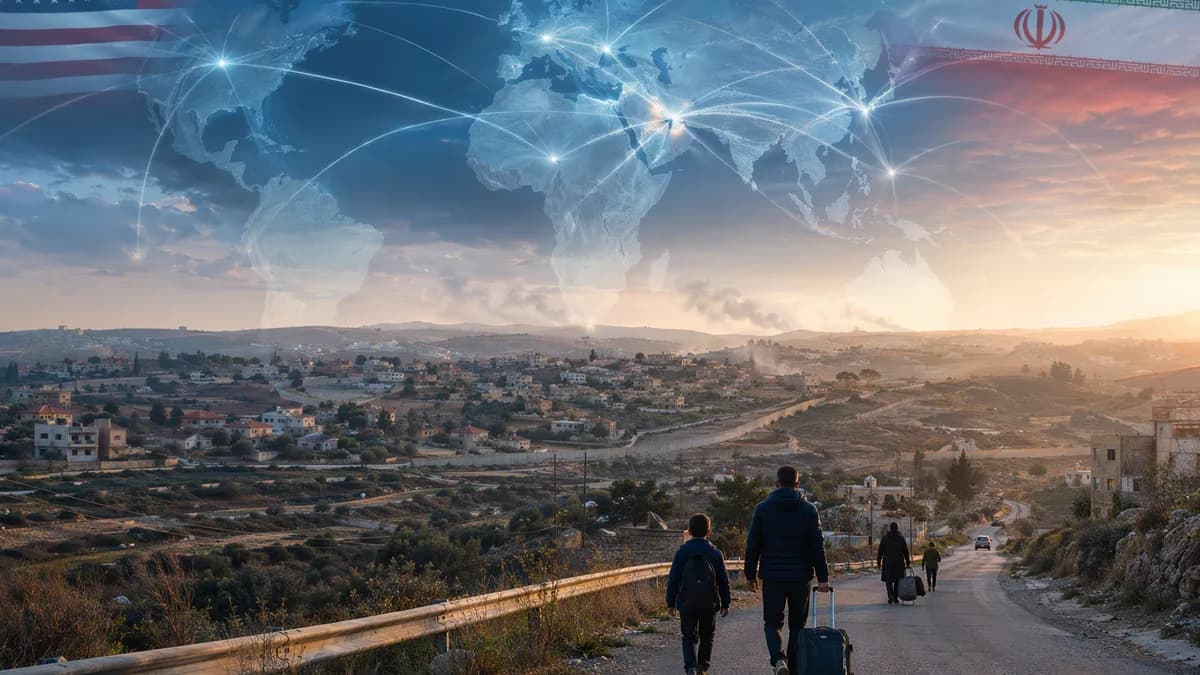
Hours after the ceasefire agreement between the US and Iran was announced, displaced families began returning to communities in southern Lebanon, even as authorities warned that it was not safe, according to BBC World. One widely shared video showed residents arriving by car in a village, only to find an Israeli armoured vehicle blocking a street.
That image captures the real story. This is not a Lebanese settlement. It is a regional pressure valve. The truce may cool the wider Iran-linked escalation, but Lebanon remains exposed because the forces driving the war sit largely outside Beirut’s control: Hezbollah, Israel, Iran, and Washington.
Lebanon's quiet after the US-Iran truce feels less like peace than a pause in somebody else's war
XOOMAR analysis: The silence in southern Lebanon is tactical, not structural. A pause can reduce immediate danger, but it does not resolve the border, Israeli military positions, Hezbollah’s arsenal, reconstruction, or the political question of who decides war and peace in Lebanon.
The BBC reports that a “fragile quiet appears to be holding,” even though Israel and Hezbollah carried out attacks over the past day. That distinction matters. A ceasefire that coexists with continued strikes is not peace. It is a contested pause, and Lebanese civilians are being asked to judge whether that pause is safe enough to risk returning home.
The emotional pull is obvious. Abo Ali, displaced from Jebchit in the Nabatieh area, said his family “had returned, but with caution.” Standing among heavily damaged buildings, he added:
“All of this can be compensated for, and rebuilt.”
Moustafa, returning to Aadshit, near Marjayoun, carried only a suitcase. His reaction was colder.
“For someone who's used to this area and has lived here, to come back and see this destruction is extremely hard.”
He then added: “Israel can't be trusted.”
The strongest counterpoint is that this truce may still matter. Even an imperfect halt can reduce casualties, allow partial returns, and create diplomatic space. But the thesis still holds because the agreement has not been made public, and BBC World says it remains unclear how it will apply to Lebanon. If the actual text later shows clear enforcement, withdrawal provisions, and buy-in from Israel and Hezbollah, that would weaken the view that this is only a pause.
The numbers behind Lebanon's fragile calm: displacement, deaths, and shattered homes
The scale of damage makes even a short lull valuable. An estimated 50,000 homes have been damaged or destroyed in Lebanon during the war. One million people remain displaced across the country, most of them Shia Muslims, according to the BBC report.
The death toll is already severe. Lebanon’s health ministry says more than 3,800 people have been killed, including many women and children. Its figures do not distinguish combatants from civilians. The Israeli military says it has killed more than 2,500 Hezbollah operatives. Israeli authorities say 30 Israeli soldiers and four civilians have been killed during the war on both sides of the border.
| Measure | Figure reported in source | Why it matters |
|---|---|---|
| Homes damaged or destroyed in Lebanon | Estimated 50,000 | Returns may be impossible even if fighting slows |
| People displaced across Lebanon | One million | The truce does not automatically restore normal life |
| Deaths reported by Lebanon’s health ministry | More than 3,800 | The human cost has already hardened political positions |
| Hezbollah operatives Israel says it killed | More than 2,500 | Israel may claim military gains but still seek a border buffer |
| Lebanon territory under Israeli occupation | Around 5% | No withdrawal plan means the conflict’s geography remains active |
The economic question sits inside those numbers. The BBC source does not provide data on banking conditions, currency moves, electricity supply, or fiscal capacity, so those should not be treated here as verified drivers of the current truce. What it does show is enough: dozens of villages have been destroyed, reconstruction has no clear start date, and no one has said who will pay.
That is economic exhaustion in its most practical form. Families cannot rebuild without money, security, and access. Shops cannot reopen if roads are blocked or villages are unsafe. Schools and hospitals cannot operate normally if communities are emptied or repeatedly struck.
A ceasefire without enforcement can unravel fast because damaged communities move faster than diplomats. People return before guarantees are tested. That creates a dangerous gap between formal diplomacy and human urgency.
Hezbollah's post-truce dilemma: claim deterrence, dodge total war, keep the weapons question closed
Hezbollah can present the lull as proof that armed pressure mattered, but the group also has reasons to avoid a wider war that further damages its own base. That tension defines its position after the US-Iran truce in Lebanon.
The BBC notes that Iran has financed, trained, and armed Hezbollah since its creation in the 1980s. The group remains more than a militia. It is also a political party and social movement that runs services including schools and hospitals. Despite being weakened in recent wars with Israel, it remains a significant force among Lebanon’s Shia Muslim community.
That makes the damage in southern Lebanon politically sensitive for Hezbollah. Its support base has absorbed displacement, destroyed villages, and military pressure. Iran, according to the BBC, wanted Lebanon included in the truce partly to strengthen its image among Hezbollah supporters and reinforce Tehran’s domestic influence.
This follows the same pressure point we examined in Iran's Lebanon Demand Jolts US-Iran Peace Deal Talks: Lebanon was not a side issue for Tehran. It became a bargaining chip tied to Iran’s credibility with Hezbollah’s constituency.
The counterpoint is that Hezbollah may feel vindicated. If Lebanon was included because Iran insisted on it, the group can argue that its alliance structure delivered protection. That message may resonate among supporters who already see the conflict through the lens of resistance.
But Hezbollah’s constraint is clear. The Lebanese government has tried to separate the conflict in Lebanon from the one in Iran, aiming to curb Iranian influence and isolate Hezbollah further. Critics accuse Hezbollah of dragging Lebanon into unnecessary wars with Israel on behalf of Iran. BBC World reports that those critics now see a chance to disarm it.
For now, Hezbollah has rejected discussing the future of its weapons. Lebanese authorities say disarmament can only happen through diplomacy, but a negotiated solution remains distant. That leaves Lebanon’s sovereignty problem intact: the state carries the costs of war, while key decisions remain shaped by actors beyond its institutions.
Lebanese civilians, Israel, Iran, and Washington are reading the same truce in different languages
The truce is one document, still unpublished. But each side is treating it as a different instrument.
| Actor | Likely reading based on source material | Main constraint |
|---|---|---|
| Lebanese civilians | A chance to return, but not a guarantee of safety | Destroyed homes, Israeli positions, fear of renewed strikes |
| Israel | A pause that may still allow pressure on Hezbollah | US pressure and the need to secure northern communities |
| Iran | A way to protect Hezbollah’s role while limiting escalation | Need to preserve influence without further costly confrontation |
| Washington | A mechanism to stop regional escalation from spreading | Agreement details are not public, Lebanon application unclear |
Many Lebanese want normal life restored but do not trust the machinery around them. That distrust is not abstract. Two previous ceasefire announcements in Lebanon failed to stop the war, the BBC reports. The deal that ended the last Israel-Hezbollah conflict in 2024 also did not bring peace, with Israel continuing to attack what it described as Hezbollah-linked targets almost every day.
Israel’s position is explicit. Israeli authorities say they want a Hezbollah-free security zone along the border to protect northern Israeli communities from rockets and drones. After the US-Iran truce was announced, Israeli Defence Minister Israel Katz said Israel would stay indefinitely in land seized in Lebanon. Our earlier coverage of Israel Defies US-Iran Deal with Lebanon Troop Pledge traced why that pledge sits uneasily beside any regional ceasefire formula.
Iran’s incentive is different. The BBC says including Lebanon in the truce was crucial for Tehran’s image among Hezbollah supporters and for reinforcing Iran’s influence domestically. That means Iran needs Hezbollah preserved as a deterrent and political asset, but it also has reason to avoid a direct confrontation that expands the cost of war.
Washington’s goal, based on the source, appears to be pressure management. Israel had argued that its conflict against Hezbollah was separate from the one with Iran and should continue. But under US pressure, BBC World reports, Israel may have no option other than to wind down, if not stop, its campaign.
The counterpoint is that US pressure may be enough to keep the quiet in place. It might be, for a time. But if Israel insists on indefinite positions in Lebanon, and Hezbollah rejects Israel’s claimed freedom of action, the truce becomes a lid on a boiling pot.
The failed ceasefire pattern is now Lebanon's central risk
The supplied source does not provide the terms of UN Security Council Resolution 1701, so this analysis will not treat its provisions as verified detail. The relevant historical pattern in the BBC material is narrower and sharper: ceasefires have stopped headlines before, without stopping the war.
BBC World reports that two other ceasefire announcements in Lebanon failed to halt the fighting. It also reports that the deal ending the last Israel-Hezbollah conflict in 2024 did not deliver peace. Israel continued almost daily strikes on what it described as Hezbollah-linked targets.
That history matters because it shows how tactical quiet can become a holding pattern. The guns slow. Civilians return. Political leaders claim restraint. Then one side defines a target, a threat, or a violation, and the cycle restarts.
The strongest counterpoint is that this truce may have a different sponsor structure. It is tied to the US-Iran track, not only the Israel-Hezbollah front. Iran’s pressure may change Israel’s calculation, and US pressure may limit Israel’s room to continue.
Still, a durable border arrangement needs more than pressure from capitals. It needs defined territory, monitoring, withdrawal terms, and a Lebanese state role credible enough to matter. The BBC report shows none of those pieces settled yet.
For households and investors, the lull cuts tail risk but does not reopen the Lebanon trade
For Lebanese households, the immediate effect is practical. Some families can test a return. Shelters may face less pressure. Movement near parts of the south may become possible, though authorities have warned that it is not safe yet.
That warning is the core signal for investors too. Lebanon risk has not reset. It has repriced from active escalation to uncertain pause. There is a difference.
XOOMAR analysis: regional investors, insurers, lenders, and businesses should treat the truce as a reduction in immediate tail risk, not a recovery signal. The source supports that view because the biggest variables remain unresolved: around 5% of Lebanon’s territory is under Israeli occupation, Israeli officials have signalled an indefinite presence, Hezbollah rejects talks on its weapons, and reconstruction funding is unclear.
The BBC report also notes that many displaced residents will not be able to return home even with a ceasefire. That blocks the basic chain any recovery would need: return, rebuild, reopen, reinvest.
The counterpoint is that markets often move before politics settles. A sustained reduction in strikes could improve confidence at the margin. But in this case, confidence would need evidence: fewer attacks, safe access to villages, a reconstruction mechanism, and clarity on whether Israel’s “security zone” claim hardens into a long-term occupation.
Three paths after the truce: frozen border, negotiated pullback, or another sudden escalation
The most likely near-term path is a frozen border. Strikes decline, rhetoric stays high, Israeli forces remain in seized areas, Hezbollah avoids a full war but keeps its weapons off the negotiating table, and Lebanese civilians live inside a conditional quiet.
A better path would be a negotiated border mechanism. That would require some combination of monitored pullback, clearer limits on armed presence near the frontier, a stronger Lebanese state role, and agreement on what counts as a violation. The source does not show that such a framework exists yet.
The worst path is renewed escalation. The trigger could be a rocket attack, an Israeli operation, an assassination, a local clash, or a shift in Iran’s regional posture. The BBC report already shows how fragile the lull is: Israel and Hezbollah have still carried out attacks, and the agreement’s application to Lebanon remains unclear.
The thesis will be proven wrong if the unpublished US-Iran agreement turns into a concrete Lebanon mechanism: public terms, visible withdrawals, verified monitoring, and a reconstruction track that lets displaced families return without gambling with their lives.
Until then, the US-Iran truce in Lebanon is best read as a pause in a wider war. The streets may be quieter. The conflict has not been settled.
Impact Analysis
- Lebanese civilians face pressure to return home before security conditions are truly settled.
- The truce reduces immediate danger but leaves the core drivers of conflict unresolved.
- Lebanon remains vulnerable because key decisions about war and peace are being shaped by outside powers and armed groups.
Truce vs. Lasting Peace in Southern Lebanon
| Current Truce | Unresolved Reality |
|---|---|
| Has reduced immediate violence in parts of southern Lebanon | Does not settle who controls escalation or the next strike |
| Allows some displaced families to attempt returning home | Authorities still warn that conditions are not safe |
| Reflects a wider US-Iran de-escalation | Leaves Lebanon exposed to decisions by Hezbollah, Israel, Iran, and Washington |
Sources

Written by
XOOMAR Insights Team
Research and Editorial Desk
The XOOMAR Insights Team pairs automated research with human editorial judgment. We track hundreds of sources across technology, fintech, trading, SaaS, and cybersecurity, cross-check the facts, and explain what happened, why it matters, and what to watch next. We do not just rewrite headlines. Every article is fact-checked and scored for reliability before it goes live, and we link back to the original sources so you can verify anything yourself.
Explore More Topics
Related Articles
 Global Trends
Israel Defies US-Iran Deal with Lebanon Troop Pledge
Israel says troops will stay in Lebanon, challenging the US-Iran deal's call to halt military operations there.
Jun 15, 20268 min
 Global Trends
Iran's Lebanon Demand Jolts US-Iran Peace Deal Talks
Iran is tying any US peace deal to Israel leaving Lebanon, testing whether Trump can force Netanyahu into a wider regional bargain.
Jun 16, 20268 min
 Global Trends
Beirut Strikes Threaten to Blow Up Iran Peace Deal
Israeli strikes on Beirut could wreck a near-signed Iran peace deal by putting Lebanon back at the center.
Jun 14, 20265 min
 Global Trends
Trump Iran Ceasefire Traps Netanyahu Before Election
Trump’s Iran ceasefire turns Netanyahu’s security pitch into a political trap before Israel’s next election.
Jun 15, 20268 min
 Global Trends
US-Iran Ceasefire Buys 60 Days as Gulf Peace Slips
The ceasefire reopens Hormuz and cools the Gulf, but the core disputes remain untouched.
Jun 16, 202612 min
 Cybersecurity
12M Patients Face Ransom Threat in iRhythm Cyberattack
iRhythm says hackers stole patient data from third-party apps and demanded ransom, raising questions over a breach tied to 12M patients.
Jun 16, 20267 min
 Technology
Best Tablets for Sheet Music That Won't Fail Mid-Gig
The iPad Pro 13-inch leads premium players, Samsung owns the giant-screen Android lane, and TCL offers the value surprise.
Jun 16, 202622 min
 Technology
Best Phones for Low-Light Video Rescue Night Clips
Low-light video demands more than night photos. Galaxy, iPhone and Pixel lead, but the right pick depends on what you shoot.
Jun 16, 202626 min
 Cybersecurity
Active Directory Pentesting Tools Expose Hidden AD Risk
Red teams need more than scanners. The right AD stack exposes attack paths, weak credentials, and privilege traps before intruders do.
Jun 16, 202621 min
 Cybersecurity
Compliance Traps Split the SIEM vs XDR SOC Decision
SIEM wins on logs, compliance, and forensics. XDR wins on faster cross-layer response. Fit beats hype for enterprise SOCs.
Jun 16, 202622 min
Don't miss the signal
Get our weekly roundup of the stories that matter across tech, fintech, and trading. No noise, just signal.
Free forever. No spam. Unsubscribe anytime.