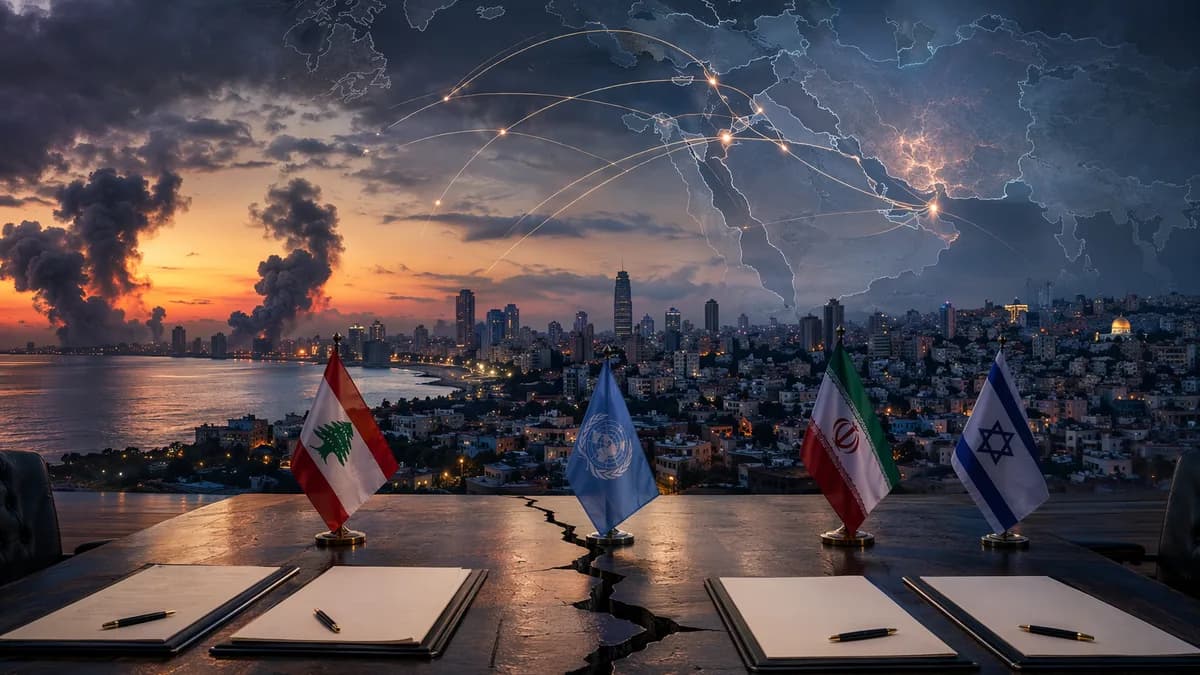
The question now is whether a peace deal can survive the very front Iran says must be included in it: Lebanon.
XOOMAR Intelligence
Analyst Take
Israel struck Beirut on Sunday after what it described as Hezbollah fire into northern Israel, and Iran’s parliament speaker Mohammad Bagher Ghalibaf threatened to halt peace talks with the United States, according to Time. The talks were reportedly in their final stages, with Donald Trump saying the deal was due to be signed the following day.
Can a Beirut strike derail a deal that Trump said was almost signed?
Ghalibaf, who Time identifies as Iran’s top negotiator in the current talks, framed the Israeli strike on Dahieh, Beirut’s southern suburbs, as proof that Washington cannot deliver on its side of any bargain.
“The Zionists’ aggression against Dahieh once again showed that the United States either lacks the will to implement its commitments or lacks the ability to do so,” Ghalibaf wrote on X.
He added:
“If you do not have the will or the ability to fulfil your commitments, then there is no point in talking about continuing down this path.”
That is the core danger for the proposed deal. Iran has insisted that any agreement to end the war include a halt to Israel’s bombing campaign against Hezbollah and Israel’s occupation of southern Lebanon. Israel has resisted that condition.
Trump criticized the Israeli strikes on Sunday, writing that they “should not have happened, particularly on a special day when we are so close to a Peace Deal with Iran.” He called on all sides to “stand down.”
"There should be no more attacks by Israel anywhere in Lebanon, but there should also be no more attacks by any other party, including Hezbollah, against Israel," Trump posted.
Israel said the Beirut strikes answered “continued Hezbollah attacks on Israel’s territory, including a terror drone strike this morning.” Prime Minister Benjamin Netanyahu and Defense Minister Israel Katz added: “Israel will not tolerate firing into its territory.”
The sequence matters. Hezbollah fire, Israeli strikes on Beirut, then Iranian threats to halt talks. That is how a diplomatic signing window can narrow within hours.
Why does Lebanon sit inside an Iran peace negotiation?
Lebanon matters because Iran made it part of the deal architecture. The talks are not only about Iran’s nuclear program or the Strait of Hormuz. They also touch the regional fronts tied to Tehran’s allies.
Hezbollah is Iran’s major Lebanese ally, but the source material does not establish that Tehran ordered the latest Hezbollah fire. The safer reading is political: every Israeli strike on Beirut raises pressure on Iran to show that a deal with Washington will not leave Hezbollah exposed.
That pressure is not theoretical. Iranian Brigadier General Mohammad Jafar Asadi, deputy head of the Khatam al-Anbiya Central Headquarters, said the latest Israeli strikes “will not go unanswered.”
The Lebanon front has already exacted a heavy toll. Israeli attacks have killed more than 3,700 people in Lebanon, including 132 health workers and 247 children, according to Lebanon’s Health Ministry cited by Time. Around 1 million Lebanese people have been displaced.
Israel says 24 of its soldiers and four civilians have been killed over the same period. Human Rights Watch has accused Israel of “numerous violations of the laws of war in Lebanon with total impunity,” while also accusing Hezbollah of failing to take adequate measures to protect civilians.
For markets, the immediate channel remains Hormuz. Trump claimed Saturday that the deal would reopen the Strait of Hormuz, which Time describes as a vital oil shipping route closed by fighting for months, leading to a surge in energy prices around the world. For more context on how that risk has shaped the deal narrative, see XOOMAR’s related coverage of Trump’s Iran deal leak fight and Hormuz risk and the earlier snag over Tehran rejecting Trump’s clock.
What does Trump’s “stand down” demand actually test?
Trump’s statement is crisis messaging, but it is also a test of leverage. He has been presenting the Iran deal as close, and Beirut now tests whether Washington can restrain the two actors most likely to break the process: Israel and Hezbollah.
Time reported that tensions between Trump and Netanyahu had already risen over Lebanon. According to Axios, cited by Time, Trump called Netanyahu “crazy” during a phone call earlier this month and accused him of reacting disproportionately to Hezbollah attacks.
That context makes Sunday’s strike sharper. If Trump cannot stop Israeli attacks on Beirut while negotiating with Iran, Ghalibaf’s public argument gains force inside Tehran. If Hezbollah keeps firing into Israel, Netanyahu can argue that restraint is impossible.
The proposed deal itself remains partly opaque. Trump claimed Saturday that Iran had agreed not to seek a nuclear weapon, that no money would change hands despite Iran’s demand for reparations, and that the Strait of Hormuz would reopen. He also wrote:
“At the appropriate time, when all is calm, we will go in and get the Nuclear Dust, buried deep under the powerful sunken granite mountains, thanks to our beautiful B-2 Bombers and their brilliant pilots, and downblend and destroy it, whether in Iran, or the United States.”
Axios reported last month, accor
The Stakes
- The Beirut strike could derail peace talks that Trump said were near completion.
- Lebanon has become a central test of whether any Iran deal can hold.
- Further escalation between Israel and Hezbollah risks widening the conflict.
Key Actors and Positions
| Actor | Position |
|---|---|
| Iran | Threatened to halt peace talks, arguing the Beirut strike shows the U.S. cannot enforce commitments. |
| United States | Trump said the Iran peace deal was close and urged all sides to stand down. |
| Israel | Said the Beirut strikes were a response to continued Hezbollah attacks, including a drone strike. |
| Hezbollah | Accused by Israel of firing into northern Israel and attacking Israeli territory. |
Primary Sources & Disclosures

Written by
XOOMAR
Data desk
XOOMAR is a capital markets software and data company. Every brief on this site starts from a dataset the company collects itself from primary sources (CFTC, SEC EDGAR, FINRA, the Federal Reserve, exchange APIs) and names the numbers it is built on, with a link to the data page so you can check them. Briefs are reviewed before they go out and corrected in place when the data is revised.