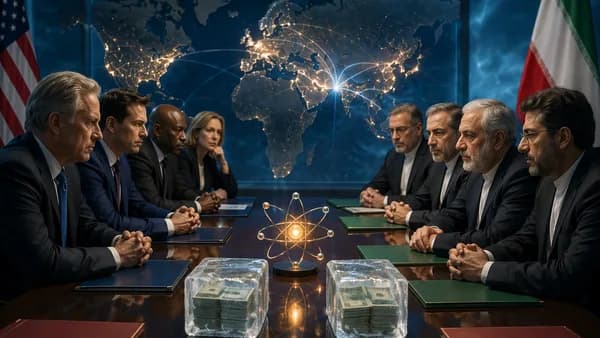
Donald Trump says a US-Iran memorandum will be signed on Sunday, but Tehran says it will not be signed on that timetable. That split matters because the proposed deal would reopen the Strait of Hormuz to international shipping and, according to Trump, block Iran from obtaining a nuclear weapon, according to Guardian World.
XOOMAR Intelligence
Analyst Take
The talks are moving, but the public messaging is already diverging. Pakistan’s prime minister, Shehbaz Sharif, said Islamabad was preparing for an electronic signing within 24 hours, while Iran’s foreign ministry said the exact date remained unresolved.
Trump says US-Iran nuclear deal is ready today, but Tehran slows the clock
Trump said Saturday that the US was set to sign Trump’s US-Iran agreement on Sunday. He framed it as a security and shipping deal: Iran would be prevented from obtaining a nuclear weapon, and the Strait of Hormuz would reopen to international shipping.
Sharif backed the momentum narrative. He said Pakistan was preparing for an electronic signing within 24 hours, with technical-level talks to follow next week.
“We are closer to a peace deal than ever before,” Sharif wrote on social media.
Iran did not match that certainty. Esmaeil Baghaei, an Iranian foreign ministry spokesperson, warned against treating the signing as locked.
“We will have to wait and see about the exact date of the signing of the memorandum of understanding, although it will not be tomorrow,” Baghaei was quoted as saying. “The possibility of this happening in the coming days cannot be ruled out.”
That sentence is doing a lot of work. Tehran is not rejecting the deal. It is rejecting Trump’s clock.
| Actor | Public position | Practical meaning |
|---|---|---|
| Trump | Deal set to be signed Sunday | Washington is selling immediate momentum |
| Shehbaz Sharif | Electronic signing within 24 hours | Pakistan is presenting itself as an active mediator |
| Iran foreign ministry | Not tomorrow, possible in coming days | Tehran wants timing flexibility |
| Downing Street | Trump and Keir Starmer discussed Trump-Iran ceasefire efforts to end the conflict | Allies are trying to assess the deal’s durability |
XOOMAR analysis: this is not yet a completed agreement. The most important signal is not Trump’s claim, or Sharif’s optimism, or Iran’s caution alone. It is the gap between them.
Hormuz reopening promise keeps shipping verification ahead of oil speculation
The Strait of Hormuz sits at the center of the Iran deal oil risk narrative because the reported agreement would make it immediately “open to all.” That phrase is the operative market and security claim, but the reports do not yet provide the signed text or the enforcement mechanics.
Trump has also kept pressure in the frame, saying the US retains the “ultimate alternative” if diplomacy fails. That means the public offer and the threat posture are moving together, not separately.
CBS News reported that the US shot down several Iranian attack drones in the Strait of Hormuz early Saturday, apparently targeting commercial ships, and that Trump called the incident “TOTALLY UNACCEPTABLE.” That detail gives the reopening language real weight. This is not just a clause in a document. It concerns active maritime risk.
For market readers, the useful test is confirmation, not rhetoric.
- Signing: Is there a confirmed electronic signing, with both US and Iranian acknowledgment?
- Text: Does the memorandum specify what “open to all” means in operational terms?
- Enforcement: Who verifies access through the Strait of Hormuz?
- Sequencing: Do technical-level talks begin next week, as Sharif said?
For related XOOMAR reading on the same negotiation-risk thread, see Trump Torches Iran Deal Leak as Hormuz Risk Spikes and US Dollar Defies Peace Talk as Hormuz Risk Stays Hot.
XOOMAR analysis: oil desks, insurers and shipping operators should not treat a political statement as equivalent to a reopened route. The next meaningful signal is whether ships, governments and military forces behave as if the Strait is actually secure.
Iranian street rallies expose pressure on Tehran over any US compromise
Iran’s caution is not happening in a vacuum. Pro-government night-time rallies have continued across Iran for more than 100 nights, and some participants are protesting an agreement with the US.
A resident in the north-eastern city of Mashhad told Reuters in Dubai that some protesters chanted:
“Death to the compromiser,”
The chant appeared to refer to Iranian foreign minister Abbas Araqchi, according to the Guardian report. CBS, citing AFP, also reported protests outside a foreign ministry office in Mashhad after Araqchi discussed a possible peace deal in a televised interview.
That domestic pressure helps explain why Tehran may be slowing the public timeline. A fast signing could be read by hardline factions as a concession. A delayed signing gives Iranian officials room to argue that the text, timing and terms are still being shaped.
The size and reach of the protests are not clear from the supplied reporting. The safe read is narrower: visible hardline opposition exists, and it can reduce Tehran’s room to move quickly.
This follows the same core tension tracked in XOOMAR’s related coverage of A Near Iran Deal Cracks as Trump Threatens Payback. The current talks may be closer to a formal document, but the political constraint inside Iran has not disappeared.
Starmer call shows allies are testing whether the deal is real
Trump also discussed efforts to end the Iran conflict in a call with UK prime minister Keir Starmer, Downing Street said Saturday. The call places the claimed deal inside a wider diplomatic scramble: allies need to know whether the memorandum is real, close, or being oversold.
The UK readout, cited by CBS, said Starmer supported Trump’s efforts to end the conflict and stressed the importance of “ensuring any deal delivers a durable and lasting peace.”
That phrase points to the unresolved issue. A signing ceremony would be a milestone, but the durability test starts after the announcement.
The next concrete markers are procedural:
- A confirmed signing time from all sides, not only Washington or Islamabad.
- Public Iranian endorsement of the memorandum.
- Details on Hormuz access, especially what “open to all” requires.
- The start of technical-level talks next week.
- No renewed military escalation that undercuts the signing window.
The risk list is just as clear: timing breaks down, Iranian backlash forces delay, Hormuz guarantees remain vague, or Trump returns to threats if the talks stall.
Washington is selling momentum. Tehran is buying time. Until the memorandum is signed and its terms are visible, the region is still waiting for proof.
Impact Analysis
- A deal could reopen the Strait of Hormuz, a critical route for international shipping.
- The proposed memorandum is being framed as a way to block Iran from obtaining a nuclear weapon.
- Diverging public statements suggest the talks are advancing but remain politically fragile.
Public Positions on the Proposed US-Iran Memorandum
| Actor | Public position | Practical meaning |
|---|---|---|
| Donald Trump | Says the agreement will be signed Sunday | Washington is projecting immediate momentum |
| Iranian foreign ministry | Says the signing will not happen on that timetable | Tehran is not rejecting the deal but is disputing the timing |
| Shehbaz Sharif | Says Pakistan is preparing for an electronic signing within 24 hours | Islamabad is reinforcing expectations of near-term progress |
Primary Sources & Disclosures

Written by
XOOMAR
Data desk
XOOMAR is a capital markets software and data company. Every brief on this site starts from a dataset the company collects itself from primary sources (CFTC, SEC EDGAR, FINRA, the Federal Reserve, exchange APIs) and names the numbers it is built on, with a link to the data page so you can check them. Briefs are reviewed before they go out and corrected in place when the data is revised.