
On Tuesday, Venezuela opposition talks moved from expectation to schedule, but the most powerful opposition name in the country, María Corina Machado, was left outside the lead negotiating role. That is the story beneath the announcement: formal dialogue is starting, yet the opposition’s mandate is already contested.
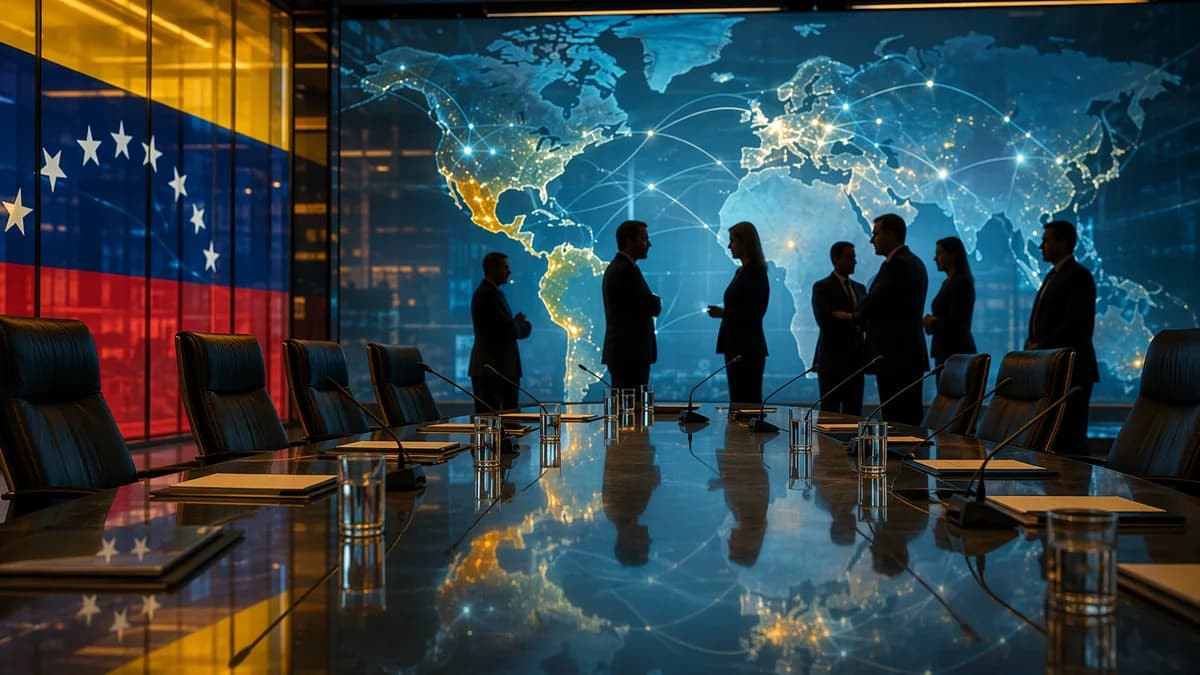
Global TrendsJuly 19, 2026· 8 min read· By XOOMAR Insights Team
Machado Loses Lead as Venezuela Opposition Talks Start
Updated on July 19, 2026
XOOMAR Intelligence
Analyst Take
68/ 100
4 sources analyzedMedium confidenceTrend10Freshness96Source Trust90Factual Grounding88Signal Cluster20
The interim government said it would begin formal talks with opposition figures aimed at “strengthening democracy”, according to Guardian World. The talks are backed by the US, which says it wants a “democratic transition” in a country still reeling from twin earthquakes that killed more than 4,700 people.
On Tuesday, Venezuela opposition talks opened with Machado sidelined
The central tension is simple. The talks are supposed to rebuild democratic rules, but the opposition figure many voters and parties expected to lead that process will not be at the table as chief negotiator.
Instead, the main opposition representative will be Dinorah Figuera, who had lived in exile in Spain since 2018 and recently returned to Caracas. Figuera announced the formal talks on Tuesday. Jorge Rodríguez, president of the national assembly and brother of acting president Delcy Rodríguez, later confirmed them.
That matters because Machado is not a peripheral figure. The source describes her as the country’s most popular opposition figure and a Nobel laureate. A coalition of parties had decided only weeks earlier that she would lead negotiations over new elections. Her exclusion changes the politics before the process even starts.
XOOMAR analysis: this is not just a personnel switch. It shifts the center of gravity from a high-profile opposition leader with a direct popular mandate to former members of the 2015 national assembly, the last opposition-controlled congress elected under Chavismo. That may make talks easier for Washington and Caracas to manage. It may also make them harder for voters to trust.
June 24 earthquakes turned a political negotiation into a recovery test
The immediate trigger is the disaster. The twin earthquakes struck on 24 June, killing more than 4,700 people, with the BBC reporting at least 4,734 confirmed deaths and a toll still rising as bodies are found beneath rubble.
Jorge Rodríguez cited the devastation as the reason for talks.
“Only through unity can we move forward with reconstruction and maintain peace,” Rodríguez said, according to the BBC.
The humanitarian crisis changes the political calendar. A country trying to rebuild homes, services, and basic trust cannot treat elections as a distant procedural issue. The state’s response to the earthquakes is already under pressure, with public anger growing over what many see as a botched response, according to the source material.
The opposition’s stated priority is institutional: “strengthening the electoral system and restoring guarantees for political participation.” The BBC adds that the opposition statement called for strengthening democratic institutions and the electoral system, plus guarantees for political participation.
The measurable tests are therefore clear:
- Election timetable: no timetable for new elections has been announced.
- Electoral authority: Figuera said she returned with the aim of pushing for renewal of the National Electoral Council.
- Political participation: guarantees must cover candidates, parties, and critics.
- Political prisoners: despite releases after Maduro’s ouster, 372 remain behind bars, according to Foro Penal, as cited by the BBC.
- Monitoring access: outside verification would matter more than statements.
- Public deadlines: without dates, the process can drift.
As XOOMAR covered in a different context, mass-casualty events can quickly become tests of state accountability, as seen after the Uganda school bus crash that triggered a probe. Venezuela’s disaster is far larger, and its political stakes are national.
August 1 is the first deadline, but Washington is already central
The joint working group is due to begin on 1 August with former members of the 2015 national assembly, which Figuera once led. That assembly was the first and only opposition-controlled congress elected under Chavismo, the movement named after former president Hugo Chávez. Many of its members were later imprisoned or forced into exile.
The US role is unusually explicit. Figuera said she returned at the invitation of the US state department. The department praised her first meeting with Jorge Rodríguez as the beginning of a “roadmap for a political dialogue on a democratic transition.” The assembly’s social media account thanked the US for its support. Marco Rubio reposted the statement.
The Guardian also cites the New York Times as saying Rubio has in effect been running Venezuela from Washington as a “de facto viceroy”. That phrase captures the risk for the US. If the talks produce enforceable election conditions, Washington can claim it helped unlock a transition. If they produce vague reform language while Delcy Rodríguez’s interim government stays in place, US backing may look like cover for a managed stalemate.
XOOMAR analysis: the US appears to be choosing stability and process over Machado’s immediate return. The source says the White House has discouraged Machado from returning, reportedly out of concern that it could lead to civil unrest. That may reduce short-term volatility. It also risks alienating the opposition voters who see Machado as the clearest democratic standard-bearer.
Figuera’s return splits the opposition’s incentives
Figuera returned to Venezuela a week before the earthquakes and held her first meeting with Jorge Rodríguez. Her return caught much of the opposition by surprise. That sequence matters. The channel existed before the disaster, but the earthquakes gave it urgency and political cover.
Machado, meanwhile, has repeatedly expressed her intention to return to Venezuela. She presented her Nobel prize to Donald Trump, but the White House has so far discouraged her return, reportedly because of concerns about civil unrest. She said opposition coalition parties would meet on Wednesday to “define a public position” on the announced talks.
Different groups now want different things:
| Stakeholder | Likely priority based on source material |
|---|---|
| Interim government | Legitimacy, reconstruction coordination, political calm |
| Figuera-led opposition group | Electoral system reform and participation guarantees |
| Machado and supporters | A stronger mandate for negotiations over new elections |
| US government | A “democratic transition” without unrest |
| Voters and earthquake survivors | Relief, accountability, and a credible ballot |
The 2015 assembly gives Figuera institutional history. Machado gives the opposition popular force. The talks need both forms of legitimacy. If one replaces the other, the process starts weaker.
The regional pattern of dissidents operating from exile is not unique to Venezuela. XOOMAR recently covered another case of political pressure ending outside the country in Cuba Lets Luis Manuel Otero Alcántara Walk Into Exile. The comparison has limits, but the recurring issue is familiar: exile can preserve voices, yet distance can complicate political mandate.
Venezuela’s prior election fight hangs over every promise
The talks cannot be separated from the 2024 presidential election. The Guardian says Nicolás Maduro is widely believed to have stolen that vote. The BBC adds that the CNE declared Maduro the winner even though voting tallies gathered by electoral observers and independently verified showed an overwhelming victory for opposition candidate Edmundo González.
That is why vague language about democracy will not be enough. Venezuela opposition talks will be judged on whether the machinery of elections changes, not whether officials issue warmer statements.
The recurring danger in such processes is delay. Talks can reduce pressure without transferring power. They can blur deadlines. They can turn electoral reform into a technical committee while the people controlling institutions keep leverage.
This round has two differences. First, the earthquakes raised the cost of paralysis. Reconstruction requires trust, coordination, and outside support. Second, Machado’s sidelined role could either discipline talks by forcing negotiators to prove results, or fracture the opposition if her supporters reject the process as illegitimate.
Investors and Venezuelans will watch rules, not speeches
For Venezuelans, democracy becomes operational only when it changes daily political risk: who can run, who can organize, who can report, who can vote, and whether results are accepted. For businesses and investors, the same logic applies in narrower form. They will not price speeches. They will watch whether institutions become predictable enough for contracts, financing, reconstruction, and public services to function.
The source material does not provide enough evidence to assess oil prospects, sovereign risk, sanctions sequencing, or lender behavior in detail. Those are possible downstream issues, but the hard evidence now is political: no election timetable exists, the electoral authority remains central to the dispute, and hundreds of political prisoners remain jailed.
That makes the first phase easy to judge. If the 1 August working group publishes deadlines, reform targets, and verification mechanisms, the process has substance. If it produces only broad promises to strengthen democracy, it risks becoming another pressure valve.
Before any new election date, three paths are visible
The best case is a monitored roadmap: negotiators agree on an election timetable, electoral authority changes, participation guarantees, humanitarian coordination, and room for Machado’s coalition to shape the process.
The muddle-through case is more likely on the facts available: talks continue, limited concessions appear, aid coordination improves, but core electoral rules remain disputed and the timetable stays vague.
The breakdown case is sharper. Machado’s exclusion deepens opposition fractures, the interim government resists binding commitments, and Washington faces pressure to abandon dialogue for harder measures.
The first real signal will not be the opening ceremony on 1 August. It will be whether Venezuela opposition talks produce published deadlines that outside observers can verify. If negotiators avoid that test, “strengthening democracy” will remain a slogan, not a transition.
Impact Analysis
- The talks could shape Venezuela’s path toward a democratic transition.
- Machado’s exclusion risks deepening divisions inside the opposition.
- The process begins as Venezuela faces instability after earthquakes that killed more than 4,700 people.
Opposition Negotiating Roles
| Figure/Group | Role in Talks | Political Significance |
|---|---|---|
| María Corina Machado | Excluded from lead negotiating role | Described as Venezuela’s most popular opposition figure and previously chosen by a coalition to lead election talks |
| Dinorah Figuera | Main opposition representative in formal talks | Former exile in Spain who returned to Caracas and announced the talks |
| Former 2015 National Assembly members | Emerging center of opposition representation | Linked to the last opposition-controlled congress elected under Chavismo |
Sources

Written by
XOOMAR Insights Team
Research and Editorial Desk
The XOOMAR Insights Team pairs automated research with human editorial judgment. We track hundreds of sources across technology, fintech, trading, SaaS, and cybersecurity, cross-check the facts, and explain what happened, why it matters, and what to watch next. We do not just rewrite headlines. Every article is fact-checked and scored for reliability before it goes live, and we link back to the original sources so you can verify anything yourself.
Explore More Topics
Related Articles
 Global Trends
World Cup Halftime Show Drowns in Its Own Star Power
FIFA’s first World Cup halftime show had every star and no clear purpose. Spectacle alone missed the moment.
Jul 19, 20268 min
 Global Trends
Marine One Turns Trump World Cup Final Into Power Play
Marine One made Trump's World Cup final visit a power image, with Gianni Infantino at his side and a quieter crowd than expected.
Jul 19, 20269 min
 Global Trends
13 Dead in Los Gallardos Fire as Spain Names Victims
Spain identified all 13 Los Gallardos fire victims, correcting an early fear that 23 people were missing.
Jul 19, 20266 min
 Global Trends
Israel Pullout Now Hangs on Joseph Aoun's Trump Talks
Aoun wants U.S. help to force an Israeli pullback while curbing Hezbollah, putting Trump at the center of Lebanon's fragile deal.
Jul 19, 20266 min
 Global Trends
17 Troop Deaths Push US Airstrikes on Iran into New Phase
A 17th US troop death adds pressure for wider strikes on Iran as missiles near Jordan pull Israel closer to the conflict.
Jul 19, 20267 min
 Technology
Nvidia Locks in Japan’s AI Future on Jensen Huang Visit
Japan wants sovereign physical AI, but Huang’s Tokyo trip shows Nvidia is still the compute gatekeeper.
Jul 19, 20268 min
 Fintech
Wells Fargo Earnings Crush Fears With $6.4B Profit
Wells Fargo beat expectations with $6.4B profit and cleaner credit, but margin pressure still threatens its $50B income goal.
Jul 19, 20268 min
 Technology
Ride or Die Online Skips the Streaming Guesswork on Prime
Ride or Die streams globally on Prime Video July 15, with all eight episodes arriving at once and no country-by-country app hunt.
Jul 19, 20268 min
 Fintech
World Bank Guarantees Push $1.1B Trade Finance Bet
Deutsche Bank and the World Bank are using guarantees to unlock $1.1B in trade finance for riskier frontier markets.
Jul 20, 20268 min
 Technology
Biased AI Claims Ignite Meta Layoff Lawsuit Fight Over Leave
Ex-Meta staff say AI rankings penalized protected leave in layoffs, putting automated HR scoring under legal fire.
Jul 20, 20268 min
Don't miss the signal
Get our weekly roundup of the stories that matter across tech, fintech, and trading. No noise, just signal.
Free forever. No spam. Unsubscribe anytime.