
Luis Manuel Otero Alcántara is free in Miami, but the harder question is whether Cuba has removed one of its loudest dissident artists from prison only to push him out of the country.
Global TrendsJuly 19, 2026· 6 min read· By XOOMAR Insights Team
Cuba Lets Luis Manuel Otero Alcántara Walk Into Exile
Updated on July 19, 2026
XOOMAR Intelligence
Analyst Take
58/ 100
4 sources analyzedLow confidenceTrend10Freshness96Source Trust92Factual Grounding92Signal Cluster20
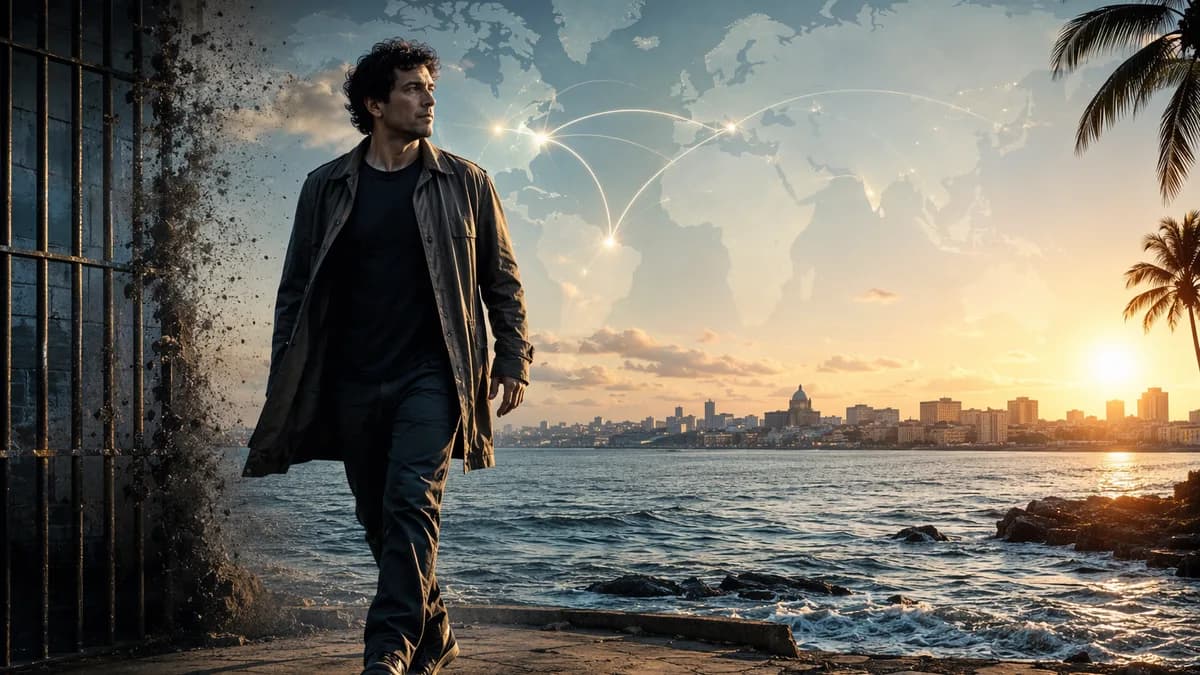
The 38-year-old Cuban dissident has gone into exile in the United States after leaving Cuba, where he had served a five-year prison sentence, according to BBC World. He was arrested in 2021 during Cuba's largest anti-government protests in decades and had been held in the maximum-security Guanajay prison near Havana.
How did Luis Manuel Otero Alcántara move from Guanajay prison to Miami exile?
Otero Alcántara emerged at Miami airport to a reception built for symbolism. Supporters sang the Cuban national anthem as he raised his forefinger and thumb in the shape of an L, standing for "Libertad", Spanish for freedom and a recognized anti-government sign.
His whereabouts had been unclear in recent days. Cuban authorities held him in an unknown location while the US approved a parole request, the BBC reported.
That sequence matters. It gives the broad outline of his release, but not the full mechanics. The public record supplied so far does not establish whether there was a negotiated arrangement, what conditions were attached, or whether Cuban authorities required exile as a condition of leaving custody.
Otero Alcántara did not soften his message after landing.
"I believe the dictatorship has to end, and the Castro dynasty has to end, as well," Otero Alcántara told journalists. "Because as long as there is a Castro in power, there will be corruption."
He leads the San Isidro Movement, known as SIM, a group of artists, journalists and intellectuals that has campaigned for freedom of speech and democracy in Cuba. Cuban authorities allege SIM is funded by Washington and has been used to subvert the state. The movement denies those claims.
Many members say they have been repeatedly targeted by security forces. Some say they have been arbitrarily detained.
XOOMAR analysis: The most important fact is not only that Luis Manuel Otero Alcántara is out of prison. It is that his freedom begins outside Cuba. That changes the pressure point. He can speak more freely from the US, but he is no longer physically present in the Cuban cultural and protest space that made him such a threat to Havana.
Why does Luis Manuel Otero Alcántara's exile sharpen the fight over Cuban artists?
Otero Alcántara's case sits at the junction of art, dissent and state control. He is not just a political opponent in the conventional sense. He is a performance artist whose public profile grew through cultural protest and opposition to official censorship.
Before his 2021 arrest, Otero Alcántara and other SIM members used social media to document their campaign against state censorship, CNN reported. They also documented Cuban police and security officials who often shadowed them. His protests and hunger strikes led to multiple detentions.
CNN reported that human rights groups considered him one of the highest-profile political prisoners on the island. It also reported that he shared a Grammy win for "Patria y Vida" (Homeland and Life), a song criticizing the Cuban government's failures and repression.
The Cuban government has not yet commented, according to CNN.
The tension is sharp because exile cuts both ways. For Otero Alcántara personally, it means release from Cuban detention and a platform in Miami. For Cuba's opposition movement inside the country, it means a major figure has been removed from the streets, studios and neighborhoods where his activism took root.
That is why his arrival immediately became more than a human-interest moment. It revived scrutiny of the wider post-2021 crackdown, when hundreds were arrested during major anti-government protests in Cuba.
For readers tracking XOOMAR's broader global coverage of state accountability and public consequences, our recent reporting on the Genoa bridge disaster verdict and global science coverage such as 48 Light-Years Away, Earth-Like Exoplanet Tempts Scientists sit in the same Global Trends stream, though this Cuba story turns on political detention and exile.
How is Washington folding Otero Alcántara's case into a harder Cuba line?
US Secretary of State Marco Rubio framed Otero Alcántara's release as proof of a broader indictment against Havana.
The Cuban government's "brutal crackdown against its own people five years ago is yet another reminder of the unique misery and evil that is innate to the communist system," Rubio said in a statement.
Rubio added:
"Otero Alcántara's only 'crime' was refusing to stay silent and using his art to demand the basic freedoms everyday Cubans have been denied for almost seven decades."
The case has long fed diplomatic tension between Washington and Havana. The BBC notes that Otero Alcántara and fellow SIM member Maykel Castillo, known as "Osorbo", have been a recurring source of friction. Castillo is serving an eight-year prison sentence.
That tension has intensified in recent months. The Trump administration has hit Cuba with an oil blockade, sanctions and has openly threatened military intervention, according to the BBC. Last week, CBS, the BBC's US news partner, reported that the Pentagon was looking at military options in Cuba, while quoting officials who said briefings did not mean any decision to carry out an operation had been made.
The US oil blockade has worsened an ongoing fuel crisis, with Cubans facing extended blackouts and food shortages in recent months, the BBC reported.
Washington also announced in May an unprecedented murder indictment against former Cuban leader Raúl Castro over the 1996 downing of two planes, an incident that killed four people. Russia and China condemned the move.
Tourism has also been hit. Fewer than 360,000 people visited the island in the first five months of 2026, down nearly 60% from the same period last year, according to Onei, as cited by the BBC.
Which questions will follow him from Havana to Miami?
The immediate question is what Otero Alcántara says next. His first extended public comments from the US could give new detail on prison conditions, the circumstances of his transfer, and whether he views exile as a choice or the only available path out.
A second question sits with Havana. Cuban authorities often cast dissidents as foreign-backed actors rather than legitimate political opponents, and the government's framing of this departure will shape how it treats other jailed activists.
Washington also has decisions to make. Rubio has already used the case to sharpen criticism of Cuba. The next signal will be whether the US treats Otero Alcántara's arrival as a singular release or as evidence for more pressure tied to political prisoners, sanctions and diplomacy.
For families of detainees still in Cuba, the practical issue is narrower and more urgent: whether this release opens a path for others, or whether it shows that freedom may come only at the price of exile.
The Stakes
- Otero Alcántara’s exile highlights Cuba’s continued pressure on prominent dissidents and artists.
- His release raises questions about whether political prisoners are being freed only if they leave the country.
- The case keeps international attention on free speech, democracy activism and US-Cuba tensions.
Sources

Written by
XOOMAR Insights Team
Research and Editorial Desk
The XOOMAR Insights Team pairs automated research with human editorial judgment. We track hundreds of sources across technology, fintech, trading, SaaS, and cybersecurity, cross-check the facts, and explain what happened, why it matters, and what to watch next. We do not just rewrite headlines. Every article is fact-checked and scored for reliability before it goes live, and we link back to the original sources so you can verify anything yourself.
Explore More Topics
Related Articles
 Global Trends
US Aid Workers Turn Kenya Ebola Quarantine Into Flashpoint
Seven asymptomatic US aid workers are quarantining in Kenya, turning Ebola controls into a fight over risk, consent, and sovereignty.
Jul 18, 20267 min
 Global Trends
Trump Turns Wildfire Smoke Into Canada Tariffs Fight
Trump is threatening Canada with tariffs over wildfire smoke, turning a real air-quality crisis into a border fight.
Jul 18, 20268 min
 Global Trends
US Iran Strikes Drag Hormuz Fight Into Seventh Night
A seventh straight night of US strikes turns the Hormuz fight into sustained pressure on Iran’s ports, power and military network.
Jul 17, 20266 min
 Global Trends
DHS Election Claims Drag Trump’s 2020 Grievance Into Power
DHS gave Trump’s unproven 2020 claims a security-agency megaphone, turning a grievance into a credibility test.
Jul 17, 202613 min
 Global Trends
US Strikes on Iran Rip Into Airport, Bridges and Rail
Reported US strikes hit Iranian transport targets as Tehran says 38 people died and more than 400 were injured.
Jul 17, 20266 min
 Technology
$600 Withings Body Scan 2 Turns a Scale Into a Clinic
Withings' $600 Body Scan 2 is now on sale in the U.S., promising 60-plus biomarkers and medical-style readings at home.
Jul 19, 20265 min
 Cybersecurity
42 US Attacks Pull Russian Cybercrime Hosts Into Court
DOJ says Russian bulletproof hosts enabled attacks on 42 US entities, shifting pressure from hackers to infrastructure sellers.
Jul 19, 20267 min
 Technology
Kimi K3 Forces Anthropic’s AI Price Premium Into Doubt
Moonshot’s Kimi K3 could undercut Anthropic with a huge open-weight model, turning frontier AI into a pricing fight.
Jul 18, 20267 min
 Global Trends
Israel Pullout Now Hangs on Joseph Aoun's Trump Talks
Aoun wants U.S. help to force an Israeli pullback while curbing Hezbollah, putting Trump at the center of Lebanon's fragile deal.
Jul 19, 20266 min
 Global Trends
Creditors Plot Court Fight Over Thames Water Nationalisation
Thames Water’s £17bn creditor bloc is preparing a legal fight if Burnham pushes nationalisation.
Jul 19, 20268 min
Don't miss the signal
Get our weekly roundup of the stories that matter across tech, fintech, and trading. No noise, just signal.
Free forever. No spam. Unsubscribe anytime.