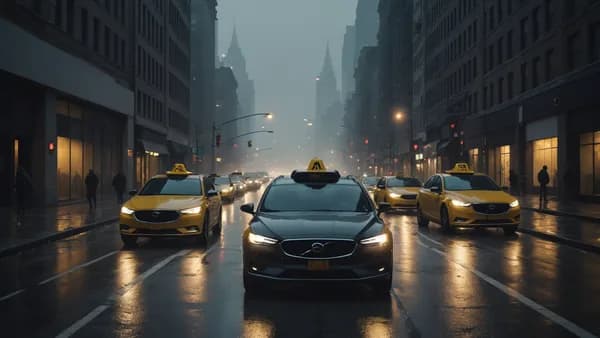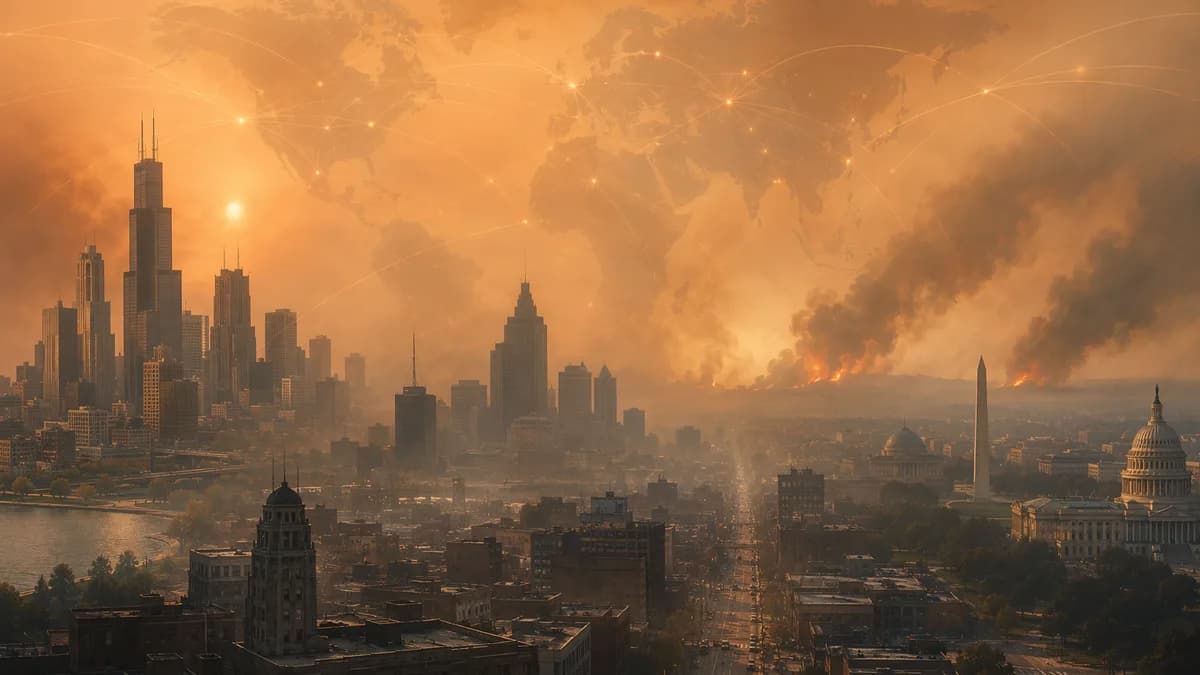
What happens when wildfire smoke turns Chicago, Detroit, New York and Washington, DC into some of the dirtiest-air cities on Earth, even though the fires are burning hundreds of miles away?
XOOMAR Intelligence
Analyst Take
That is the real question beneath this week’s orange-gray skylines. The images are striking, but the more important story is operational: major US cities are being forced to manage a toxic atmospheric event they did not ignite and cannot control. A blanket of smoke moved across the Midwest, Northeast and Mid-Atlantic as fires burned in Minnesota and western Ontario, with Canada reporting 119 out-of-control blazes as of Friday afternoon, according to Wired.
The old mental map no longer works. Wildfire smoke is not confined to Western fire zones. It now behaves like a regional systems shock, carried by the jet stream into dense urban corridors where residents, employers, schools and public agencies have to make fast decisions with incomplete information.
How did a Canadian fire event put US cities among the world’s worst air rankings?
The mechanics are blunt. Fires in Canada burned intensely enough to loft smoke into the atmosphere, where winds pushed it eastward. That is how Chicago and Detroit ended up with the worst air quality in the world on Friday, while New York and Washington, DC also cracked the top 10, according to Wired.
The public-facing number is the Air Quality Index, but the health concern is the fine particulate matter inside wildfire smoke, commonly tracked as PM2.5. These particles can move deep into the lungs. During a smoke event, the skyline becomes the warning sign, but the real exposure is microscopic.
Reported conditions shifted across cities as the plume moved:
| City or region | Reported condition from supplied sources |
|---|---|
| Chicago | Among the world’s worst air quality cities on Friday |
| Detroit | Among the world’s worst air quality cities on Friday |
| New York | Cracked the top 10 list, with smoke obscuring major landmarks |
| Washington, DC | Cracked the top 10 list, with smoke reducing visibility around federal landmarks |
| Baltimore and D.C. | Washington Post source material reported very unhealthy AQI values of 281 and 247 as of 6 a.m. |
The numbers can change quickly because the plume is mobile. Wind direction, fire intensity, rain, storms and new lightning-triggered fires can all alter where the smoke goes next. That makes public messaging harder. A city can wake up unhealthy, improve by afternoon, then face another plume if conditions shift.
Why are cities far from forests still so exposed?
Distance from flames no longer guarantees distance from danger. Wired reported that smoke from fires in Minnesota and western Ontario was being carried eastward by the jet stream. That turns the atmosphere into a delivery system for pollution.
This is the harder lesson for cities such as Washington, DC and New York. Their exposure depends less on how close they are to burning forests and more on whether the weather pattern connects them to the source. A remote fire can become an urban health emergency without burning a single building.
That changes the climate-risk conversation. A city can avoid direct wildfire flames, coastal flooding or a hurricane landfall and still face a shutdown-style air event. Outdoor activity becomes conditional. Visibility drops. Residents search for masks. Officials tell people to stay indoors.
USA Today’s supplied reporting showed the breadth of the event, with alerts in parts of Minnesota, Wisconsin, Michigan, Illinois, Indiana, Ohio, West Virginia, Pennsylvania, New York, Vermont, New Jersey, Delaware, Maryland, Virginia and the Carolinas on July 17. That is not a local emergency. It is a corridor-wide exposure event.
Which smoke emergency are residents, workers and officials actually dealing with?
There is no single smoke emergency. Doctors see one crisis. Outdoor workers see another. Parents see a third. City officials get all of them at once.
Public health officials focus on particulate exposure, especially for people with existing vulnerabilities. The supplied ABC News and Yahoo material says smoke contains fine particles that can travel deep into the lungs, and Yale School of Public Health associate professor Kai Chen said an N95 is the best type of mask for people who need to work outdoors, are more sensitive to smoke or are in a high-risk group because it is designed to filter at least 95% of airborne particles.
Philadelphia’s warning captured the broad public-health risk:
“Everyone may experience negative health effects from particulate matter in the air,” Philadelphia officials warned. “Members of sensitive groups may experience more serious health effects.”
The household divide is practical. Some people can stay inside, work remotely and use better masks. Others cannot avoid exposure because their job or housing situation gives them fewer options. The source material does not quantify that divide, but the policy implication is clear: advice to “stay indoors” works best for people who have safe indoor air to retreat to.
City governments are already making visible tradeoffs. New York City made free KN95 masks available at hundreds of locations, according to the supplied ABC News and Yahoo material. In Milwaukee, where air was in the hazardous category, the Milwaukee Brewers allowed ticket holders to exchange tickets for another regular season home game. In Cleveland, the Guardians postponed Friday night’s home game because of air quality.
For readers tracking how governments respond when broad policy or environmental shocks land unevenly on households, XOOMAR has covered similar institutional pressure points in $100,000 Visa Bond Could Lock Out Green-Card Hopefuls and Aiko Shut Out as Japan Imperial Succession Bill Passes.
What changed after the 2023 orange-sky warning?
This week’s smoke echoes 2023, when Canada’s worst wildfire season on record sent smoke into the East Coast and turned skies orange, according to Wired. The repetition matters. Once can be treated as an anomaly. Twice becomes a planning failure if cities act surprised again.
Wired also points to similar orange-sky scenes in Europe, Australia and California in recent years, with fires ripping through Spain this summer. The visual pattern is now familiar across continents: smoke moves farther than the public expects, lands in places not culturally associated with wildfire risk and forces emergency decisions in dense population centers.
The longer-term numbers are grim. Wired cited a Nature study published last year that projected wildfire smoke could cause 71,420 excess deaths annually by mid-century in the US alone, a 73 percent increase compared with the 2010s. The researchers also estimated that up to 1.9 million people in the US could die between now and then because of smoke-related health issues.
That projection is the clearest reason to treat wildfire smoke as more than a bad-weather day. The health burden accumulates. Repeated exposure changes the stakes for hospitals, insurers, schools, employers and municipal budgets.
When does clean indoor air become basic city infrastructure?
XOOMAR analysis: this event points toward a new urban baseline. Clean indoor air will have to be treated less like a private consumer upgrade and more like public infrastructure during smoke season.
For residents, the supplied guidance points to a few practical moves: monitor air quality alerts, reduce outdoor exposure when conditions deteriorate and use properly rated masks such as N95 or KN95 when exposure can’t be avoided. For cities, the harder question is access. If officials tell people to stay indoors, they need enough indoor places where the air is actually safer.
That puts libraries, schools, shelters, senior centers and transit hubs into a different category. During a smoke event, they can become clean-air refuges if filtration, staffing and public communication are ready before the plume arrives.
Employers and schools face similar pressure. Outdoor activities, sports, commuting and public events can be disrupted by smoke even when roads, buildings and power systems remain intact. The Cleveland and Milwaukee sports decisions show how quickly air quality moves from a health metric into an economic and scheduling problem.
Which evidence will show whether cities learned the lesson before the next plume?
The next test is not whether the sky turns orange again. Wired reports that the fires showed no signs of abating and that more smoke could arrive later this summer. The test is whether cities respond faster, with clearer thresholds and fewer improvised decisions.
Evidence that would support the thesis: more mask distribution plans, clearer school and sports cancellation rules, public indoor clean-air sites, employer policies for outdoor exposure and tighter coordination between weather alerts and public health messaging.
Evidence that would weaken it: if this week becomes another photo archive of hazy monuments and skylines, followed by little planning before the next plume.
The practical conclusion is sharp. Cities that treat wildfire smoke as a recurring systems problem will protect residents better than cities that wait for the next blanket of smoke to prove the risk all over again.
Impact Analysis
- Wildfire smoke is increasingly affecting major cities far from active fire zones.
- Fine particulate pollution from smoke can pose serious health risks even when fires are hundreds of miles away.
- Cities, schools, employers and residents must make rapid decisions during air-quality emergencies they cannot directly control.
Reported wildfire smoke impacts by city
| City or region | Reported condition |
|---|---|
| Chicago | Among the world’s worst air quality cities on Friday |
| Detroit | Among the world’s worst air quality cities on Friday |
| New York | Cracked the top 10 for worst air quality |
| Washington, DC | Cracked the top 10 for worst air quality |
| Canada | Reported 119 out-of-control blazes as of Friday afternoon |
Primary Sources & Disclosures

Written by
XOOMAR Insights Team
Research and Editorial Desk
The XOOMAR Insights Team pairs automated research with human editorial judgment. We track hundreds of sources across technology, fintech, trading, SaaS, and cybersecurity, cross-check the facts, and explain what happened, why it matters, and what to watch next. We do not just rewrite headlines. Every article is fact-checked and scored for reliability before it goes live, and we link back to the original sources so you can verify anything yourself.