$29.99 is the sharpest detail about the 8BitDo FlipPad, because this tiny USB-C controller is making a different bet from most phone gaming hardware: the best mobile controller may be the one small enough to stay attached, packed, or ready when boredom hits. The Verge reports that preorders are live now through 8BitDo’s online store and Amazon, with release expected on July 30th.
XOOMAR Intelligence
Analyst Take
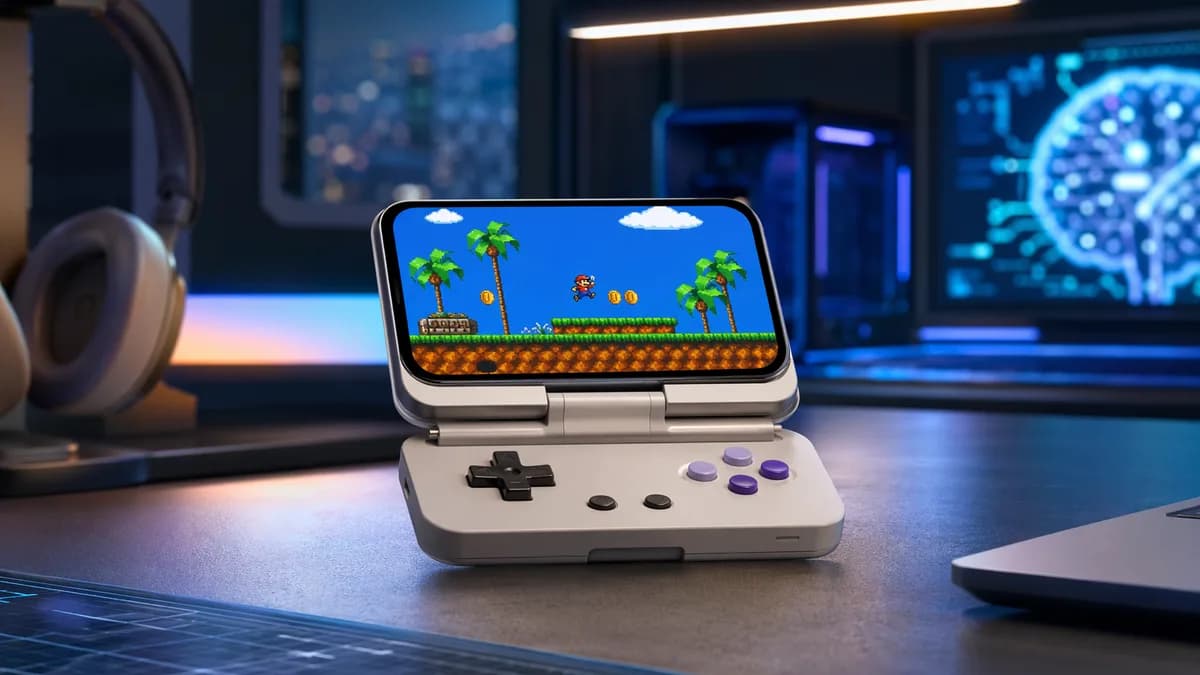
The FlipPad’s pitch is not console-grade control. It’s friction removal. No Bluetooth pairing. No internal battery to charge. No bulky grip wrapped around the whole phone. It plugs into a smartphone’s USB-C charging port, flips over the lower part of the display, and turns vertical phone games into something closer to a pocket handheld.
“The FlipPad draws all the power it needs from your phone’s charging port.”
That one design choice explains almost everything. The 8BitDo FlipPad is thinner and lighter because it doesn’t carry its own battery. It’s cheaper than GameSir’s Pocket Taco because it strips the accessory down to the part that matters most for short retro sessions: physical buttons.
FlipPad makes phone gaming feel physical again, and that’s the point
Touchscreen controls are fine until a game asks for timing, diagonals, or repeated button presses. The FlipPad exists for that gap. It gives a phone the tactile certainty that emulator overlays can’t match, without forcing the user into a full-size mobile controller setup.
The Verge tested it with Game Boy, GBA, Super Nintendo, and Sega Genesis games using Delta and RetroArch on an iPhone. That matters because the FlipPad is not trying to be a universal controller for every phone-made game. It’s aimed at vertical play, especially older games that fit well above the controller area.
The Game Boy comparison works because the value is behavioral, not just visual. Pocketability, fast setup, and familiar buttons count more here than deep triggers or analog sticks. For a five-minute session, the controller you can actually carry beats the better one sitting somewhere else.
That same phone-first thinking has shown up across different hardware experiments, from devices trying to reduce app dependence, as in Pinwheel Revives Landline Phone for Kids to Kill Apps, to broader questions about what phones should control in daily life, as covered in ChatGPT Smart Speaker Threatens Your Phone's Grip at Home. The FlipPad sits on the gaming side of that debate: keep the phone, but change how it feels.
The FlipPad spec story starts with one missing part: the battery
The FlipPad connects directly through the phone’s charging port instead of Bluetooth. That cuts out pairing steps, which The Verge’s Andrew Liszewski specifically praised when moving the gamepad between multiple phones. It also means the FlipPad draws power from the phone during play.
That tradeoff is clean. Less accessory maintenance. More dependence on the phone’s own battery.
| Feature | 8BitDo FlipPad | GameSir Pocket Taco |
|---|---|---|
| Price | $29.99 | $34.99 |
| Connection | USB-C direct connection | Wireless, with rechargeable battery |
| Power | Draws power from phone | Uses internal battery |
| Fit | Thin enough to leave attached when slipped into a pocket, per The Verge | Larger and heavier because it clamps front and back |
| Case tolerance | Worked with thin silicone cases on OnePlus and Google Pixel phones, failed with a thicker Nomad folio-style iPhone 16 Pro case | Opens wide enough for devices inside a thick case |
| Shoulder buttons | Four round buttons on the front | Shoulder buttons positioned on the back of the phone |
| Standalone use | Not described as standalone | Can work as a standalone wireless controller, including with the Switch |
The hinge is the clever part. The USB-C connector lets the controls flip down, so users can unlock the phone or switch apps without disconnecting the controller. That’s a small convenience, but small conveniences define whether a pocket accessory survives beyond the first week.
The limitation is equally physical. The USB-C connector is not adjustable or extendable. If your case is too thick, the FlipPad may not connect. The Verge had no issue with OnePlus and Google Pixel phones in thin silicone cases, but it did not work with an iPhone 16 Pro inside a thicker Nomad folio-style case.
Game Boy nostalgia helps, but discipline carries the product
8BitDo is selling a feeling, but the FlipPad can’t live on nostalgia alone. The company offers it in black and in a colorway inspired by the original Game Boy, yet the more important design call is restraint: no thumbsticks, no clamp, no battery, no top-edge shoulder buttons.
That restraint creates the product’s strengths and its pain points.
The Verge says the FlipPad looks and feels as premium as 8BitDo’s more expensive console controllers. Button labels are etched into most of the buttons. The D-pad and ABXY buttons use silicone membranes, but feel stiffer and clickier than other 8BitDo controllers, with less travel.
The shoulder buttons are the weak spot. Instead of sitting on the top edge, they form a row of four round buttons along the front. The Verge calls that layout awkward when using index fingers while thumbs handle the rest. XOOMAR analysis: that’s the cost of making the controller thin enough to justify its existence. If 8BitDo had prioritized traditional ergonomics, it likely would have drifted toward the larger devices it is trying to avoid.
Pocket Taco versus FlipPad is a real split, not a simple win
The Pocket Taco still has a case. A bigger controller can be more comfortable, more secure, and more flexible. The Verge notes its larger D-pad and buttons feel more like traditional controller buttons, and its rear-positioned shoulder buttons are easier for index fingers to reach.
It also clamps more securely than the FlipPad. That matters because the FlipPad is secured only through its USB-C connector, and The Verge found it can wiggle back and forth by about a quarter of an inch while playing.
The FlipPad wins on the opposite axis. It’s thinner, lighter, smaller, and cheaper. It asks less of the user before play starts. For casual Game Boy and Game Boy Color sessions, that may be enough.
This is the real market split shown by these two CES 2026 devices. Pocket Taco is for players who want a more stable miniature controller. FlipPad is for people who want a controller they might actually keep nearby.
Phone gamers and emulator fans won’t value the same features
Casual phone players get the simplest benefit: a low-cost way to add buttons without buying a dedicated handheld. The $29.99 price keeps the decision closer to accessory territory than platform commitment.
Emulation fans get the clearer target use case. The FlipPad works best with games played vertically and positioned high enough that the controller does not block the action. The Verge found that Delta centered games vertically when using a controller, causing partial obstruction, but that could be fixed by turning on touch controls and using a skin that places the game closer to the top of the screen.
Cloud gaming and remote play users should be more cautious. The supplied source does not test those use cases, and the lack of thumbsticks makes the FlipPad a poor fit for many modern 3D games. This is a retro-first controller by design.
Accessory makers will read the product differently. XOOMAR analysis: if users accept direct USB-C controllers that borrow power from the phone, more companies may try thinner no-battery designs. But FlipPad also shows the hard constraints: case compatibility, screen coverage, port alignment, and cramped controls don’t disappear just because the device is clever.
Next for tiny phone controllers: the pocket is the battlefield
The 8BitDo FlipPad is not trying to replace a dedicated handheld or a full-size controller shell. Its stronger claim is more modest: it can make spontaneous phone gaming less annoying.
That’s why the unresolved questions matter. Will the USB-C hinge hold up? Will thicker cases block too many phones? Will battery drain bother users during longer sessions? Will the front-row shoulder buttons feel tolerable after the novelty fades?
The evidence that would strengthen the FlipPad thesis is simple: users keep it attached, carry it often, and choose it over touchscreen controls for short sessions. The evidence that would weaken it is just as clear: wobble, case problems, and awkward shoulder buttons push it into drawerware.
For now, 8BitDo has made the right compromise for a specific kind of player. The FlipPad’s achievement is not that it makes phone gaming feel serious. It’s that it makes it feel easy enough to start.
Key Takeaways
- The FlipPad offers a cheaper, simpler way to add physical controls to phone gaming.
- Its USB-C design removes Bluetooth pairing and battery charging friction.
- The accessory is aimed at retro and vertical-play games rather than full console-style mobile gaming.
8BitDo FlipPad vs. Typical Phone Controllers
| Feature | 8BitDo FlipPad | Typical Full-Size Mobile Controller |
|---|---|---|
| Price | $29.99 | Not specified |
| Connection | USB-C | Often Bluetooth or wired |
| Power | Draws power from phone | Often uses an internal battery |
| Design focus | Pocketable vertical-play controller | Larger grip-style setup |
| Best use case | Retro games and emulator play | Broader mobile gaming |
Primary Sources & Disclosures

Written by
XOOMAR Insights Team
Research and Editorial Desk
The XOOMAR Insights Team pairs automated research with human editorial judgment. We track hundreds of sources across technology, fintech, trading, SaaS, and cybersecurity, cross-check the facts, and explain what happened, why it matters, and what to watch next. We do not just rewrite headlines. Every article is fact-checked and scored for reliability before it goes live, and we link back to the original sources so you can verify anything yourself.