
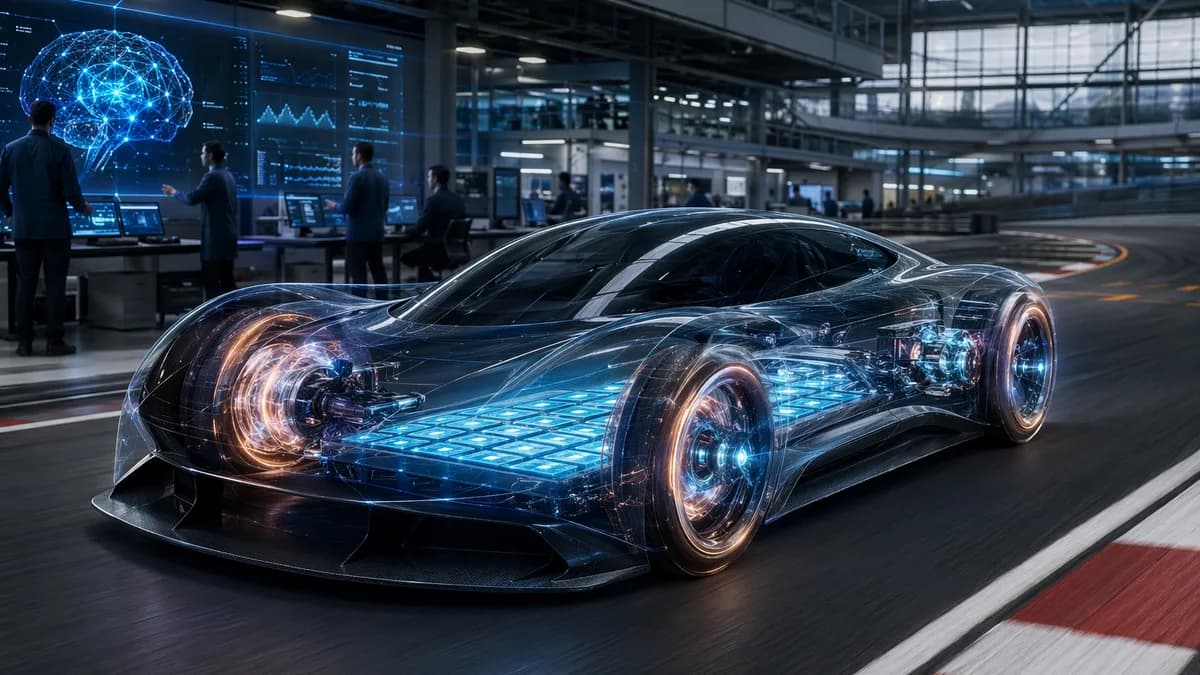
Four electric motors, an 800-volt architecture, and a 100kWh battery are BMW’s clearest signal yet that the next electric M car won’t be sold on silence and efficiency. It will be sold on control.
TechnologyJune 12, 2026· 7 min read· By XOOMAR Insights Team
BMW Neue Klasse M Turns EV Muscle Into Software War
Updated on June 12, 2026
XOOMAR Intelligence
Analyst Take
71/ 100
4 sources analyzedMedium confidenceTrend10Freshness100Source Trust88Factual Grounding92Signal Cluster40
BMW unveiled the Neue Klasse M concept around Le Mans, positioning it as the first look at a new design language for its performance division, according to The Verge. The company’s own line is blunt enough to matter:
“Born on the racetrack. Made for the streets.”
That’s marketing, yes. But it also gives away the strategy. BMW knows the M badge can’t move into EVs on acceleration numbers alone. The hard part is making an electric performance car feel intentional, physical, and repeatable when the engine no longer does the emotional work.
Four Motors Turn the M Badge Into a Software Problem
The headline detail is not the red paint or the Le Mans timing. It’s the four-motor M eDrive system, managed by BMW’s Heart of Joy central computer.
BMW says that setup allows wheel-specific control of both drivetrain and braking. In practice, that means the car’s character will depend heavily on software calibration: how power moves across the wheels, how braking blends with recuperation, and how quickly the car responds when grip changes.
That’s the real shift. The electric M car becomes less about one heroic engine and more about orchestration.
| Neue Klasse M element | What BMW is signaling |
|---|---|
| Four electric motors | Wheel-specific torque and braking control |
| Heart of Joy computer | Centralized control over response, traction, and recuperation |
| 800-volt architecture | Fast-charging readiness and high-output electrical design |
| 100kWh battery | Serious energy capacity for performance use |
| Structural battery housing | Battery pack as part of the chassis stiffness strategy |
BMW also says the system enables high energy recuperation, optimal traction, and “exceptionally direct response.” That last phrase is the one to watch. Directness is where performance EVs either earn credibility or feel like fast appliances.
100kWh and 800 Volts Are Useful Numbers, but Not the Decisive Ones
The concept uses BMW’s sixth-generation cylindrical cells, paired with an 800-volt architecture and a 100kWh battery. The battery housing is structurally integrated in both the front and rear axles, a detail that matters because rigidity shapes how a car turns, brakes, and absorbs load.
BMW hasn’t provided the full production spec sheet here. That absence matters. Horsepower, weight, charging curves, thermal limits, brake durability, and repeated-lap behavior will decide whether the first true electric M sedan is credible.
The Verge notes that the M3 ZA0, with its quad motor setup and an estimated 1,000 horsepower, is going into production next spring. That number will grab headlines. It shouldn’t be the only one readers care about.
For an electric M car, the sharper questions are:
- Cooling: Can the drivetrain and battery maintain output after hard use?
- Braking: How well does the car blend physical braking with recuperation?
- Weight: Does the structural battery help enough to offset mass?
- Response: Does the software make the car feel precise, or just brutally quick?
- Charging: How does the pack behave after track-style driving?
XOOMAR analysis: BMW is selling confidence before full proof. The hardware sounds serious, but the credibility test will come when the company shows how the production car performs after repeated stress, not just in a single launch or a static reveal.
The New M Look Keeps the Muscle, Drops the Old Center of Gravity
The Neue Klasse M concept is a two-door sedan with wide wheel arches, precise lines, a muscular shoulder section, and a low, aggressive stance. It doesn’t chase soft EV minimalism. BMW is trying to carry over visual tension from combustion-era M cars without pretending the old formula still applies.
The front end integrates BMW’s kidney grille with the headlights for what The Verge describes as a more shark-like appearance. BMW is also introducing M Yellow Lights, inspired by GT racing and the M Hybrid V8, along with three-dimensional Track Lights that are expected to become signature features for future M vehicles.
The aero work is not subtle:
- V-shaped hood vent: Helps cool the EV drivetrain.
- Trimaran-style front bumper: Takes inspiration from high-speed sailing boats.
- Ducktail rear spoiler: Adds downforce.
- Floating diffuser: Supports stability at speed.
This is where the concept is useful. BMW is not presenting electrification as a clean-sheet rejection of M design. It is trying to rebuild M around electric hardware while keeping the posture of a track-bred sedan.
For readers following how high-compute systems increasingly shape physical products, the same broader tension appears outside autos too. XOOMAR has covered infrastructure pressure in Seattle’s one-year pause on new AI datacenters, where the question is not whether the technology works, but whether the surrounding systems can support it.
Natural Fibers and Nubuck Say This Is Still a Driver’s Cabin
Inside, BMW gives the concept four newly developed bucket seats made from integrated natural fibers. The steering wheel, door panels, and roll bar use black nubuck leather. A floating dashboard is wrapped in black knit material with M-specific hexagonal backlighting.
The red accents are concentrated on the M gear selector, steering wheel shift paddles, and digital displays. That matters because BMW is still framing the cabin around driver control rather than pure screen minimalism.
The most interesting material detail is the use of natural fibers. HotCars reports that BMW has worked with natural fibers in motorsport since 2019 and says the material can deliver similar traits to carbon fiber while cutting production-related CO2e by about 40 percent. That claim is material-specific, not a statement about the whole vehicle.
XOOMAR analysis: BMW is trying to make sustainability visible without making the concept look soft. Natural fibers appear in places tied to performance structure and aero, not just trim. That’s a smarter message than treating lower-impact materials as decorative virtue signaling.
This Concept Is Closer to Production Than BMW’s Wilder EV Experiments
The Verge makes a key comparison: this Neue Klasse M concept appears much closer to reality than the VDX vehicle BMW showed last year. It also shares similarities with the recently revamped i3, which suggests it could preview a production-ready Neue Klasse M3.
That distinction matters. Some concepts exist to stretch design language with no immediate showroom consequence. This one looks more like a controlled preview of the electric M formula BMW is preparing to sell.
The electric M shift also follows BMW’s release of several i-series M performance vehicles, but The Verge notes the upcoming M3 will be the first to bear the proper M badge. That raises the bar. A performance trim can be forgiven for compromise. A real M car has less room to hide.
There’s a useful parallel in infrastructure-heavy technology: as we wrote in Seattle Slams Door on New AI Datacenters for a Year, advanced systems often run into their real test when ambition meets physical constraints. For BMW, those constraints are battery heat, mass, charging behavior, and chassis feel.
BMW’s Electric M Future Will Be Judged After the Concept Lights Go Off
The Neue Klasse M concept does its first job well. It shows that BMW understands an electric M car needs more than speed. It needs a control philosophy, a visual identity, and hardware that can survive performance use without turning the badge into decoration.
The watch item now is evidence. Real specs. Real weight. Real thermal behavior. Real charging data after hard driving. Real lap consistency. And, most of all, whether the production car has a personality drivers can describe without mentioning 0 to 60 mph.
BMW doesn’t get to inherit M credibility automatically in the electric era. The concept is a promising signal, but the next phase has to prove that Neue Klasse, M eDrive, and the Heart of Joy can create a car that feels alive when the engine is gone.
The Bottom Line
- BMW is positioning its future electric M cars around control and driving feel, not just acceleration.
- Four-motor control could make software calibration central to the next generation of performance cars.
- The concept shows how EV platforms may redefine traditional performance brands built around engines.
Neue Klasse M Concept: Key EV Performance Signals
| Element | What BMW Is Signaling |
|---|---|
| Four electric motors | Wheel-specific torque and braking control |
| Heart of Joy computer | Centralized control over response, traction, and recuperation |
| 800-volt architecture | Fast-charging readiness and high-output electrical design |
| 100kWh battery | Serious energy capacity for performance use |
| Structural battery housing | Battery pack used as part of chassis stiffness strategy |
Sources

Written by
XOOMAR Insights Team
Research and Editorial Desk
The XOOMAR Insights Team pairs automated research with human editorial judgment. We track hundreds of sources across technology, fintech, trading, SaaS, and cybersecurity, cross-check the facts, and explain what happened, why it matters, and what to watch next. We do not just rewrite headlines. Every article is fact-checked and scored for reliability before it goes live, and we link back to the original sources so you can verify anything yourself.
Explore More Topics
Related Articles
 Technology
Cash Burn Clouds Tesla Q2 Earnings After $28.2B Haul
Tesla's revenue rebound beat expectations, but a $1.1B free cash flow loss leaves investors with a spending problem.
Jul 26, 20267 min
 Technology
Apple Maps Seizes Ford EV Dashboards in $30K Truck Bet
Ford will bake Apple Maps into 2027 EVs, making navigation, charging and battery prep part of its $30K electric truck push.
Jul 23, 202611 min
 Technology
Ford’s $30,000 Electric Truck Forces a Hard EV Reset
Ford’s $30,000 electric truck is its EV reset, a smaller pickup built to prove affordability and profit can coexist.
Jul 20, 202610 min
 Technology
Rivian Drags Trump Tariffs Back to Court for Cash Refund
Rivian wants a full refund on Trump-era tariffs, turning a Supreme Court win into a cash fight as its R2 spending climbs.
Jul 25, 20267 min
 Technology
A $9 Autonomous Key Turns App Addiction Into Real Work
Autonomous Key uses a $9 NFC fob to make addictive apps harder to reopen, betting tiny friction can beat reflexive scrolling.
Jul 27, 20268 min
 Global Trends
Logo Revolt Haunts Cracker Barrel CEO Masino's Exit
Julie Masino is leaving after Cracker Barrel's logo revolt became a culture-war test. David Deno inherits the bruised brand.
Jul 27, 20266 min
 Global Trends
53 Years Later, Chile Jails Víctor Jara Murder Fugitive
Chile jailed Nelson Haase Mazzei, the last fugitive in the Víctor Jara murder case, 53 years after the singer was killed.
Jul 27, 20268 min
 Global Trends
Years on Run End As Police Catch Victor Jara Murder Fugitive
Nelson Haase, convicted in Victor Jara’s murder, was captured after fleeing a 25-year sentence in a landmark Pinochet-era case.
Jul 27, 20265 min
 Global Trends
Tariff Detours Crush the US Manufacturing Jobs Pitch
Tariffs haven't sparked a US factory jobs boom. Chinese inputs are taking longer routes, with higher costs and more automation.
Jul 27, 20268 min
 Technology
Samsung QD-OLED Monitor Crashes Below $300 in Rare Deal
Samsung’s 27-inch G50SF QD-OLED monitor fell to $299.99, pushing premium OLED gaming into midrange pricing.
Jul 27, 20266 min
Don't miss the signal
Get our weekly roundup of the stories that matter across tech, fintech, and trading. No noise, just signal.
Free forever. No spam. Unsubscribe anytime.