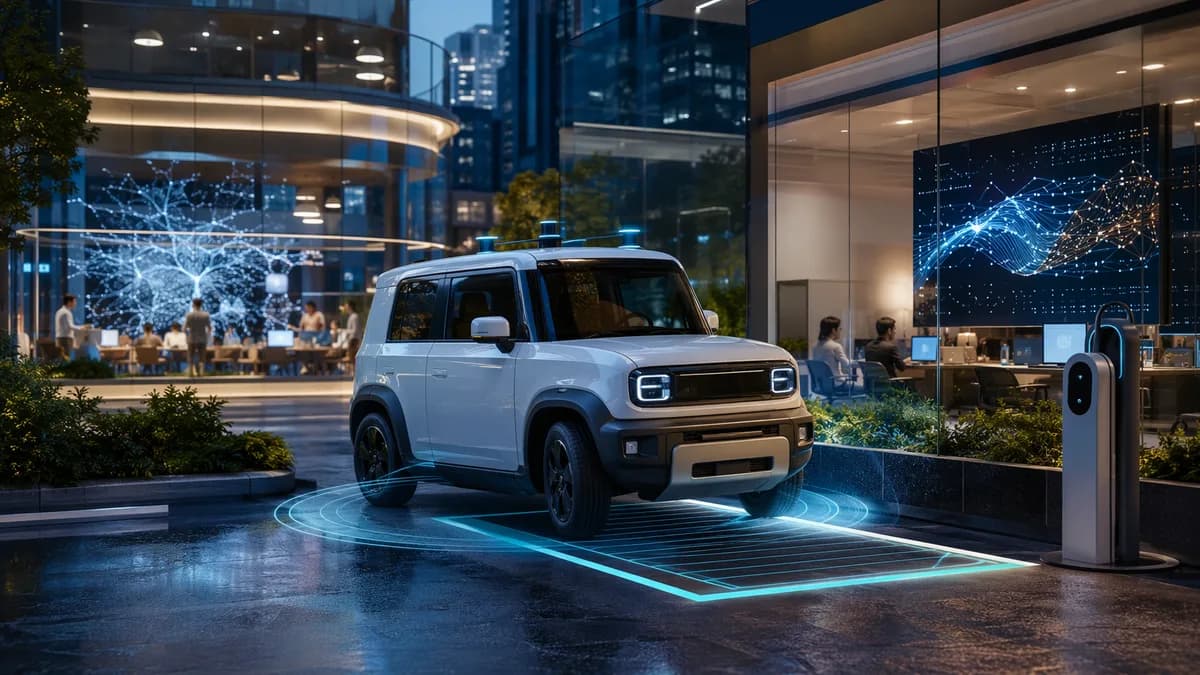
Chip Motors EV is asking Americans to accept a $15,000 vehicle that can’t use highways, tops out at 25 mph, and still wants to feel smarter than the family SUV.
XOOMAR Intelligence
Analyst Take
That tension is the story beneath the cute grille. Miami-based Chip Motors has unveiled an open-air, Jeep-like electric runabout called Chip, with reservations open now and deliveries planned for 2027, according to The Verge. The company calls it a “life utility vehicle,” but its regulatory lane is clearer: it is a low-speed vehicle, legal only on roads with speed limits of 35 mph or below.
The real test isn’t whether Chip Motors can build a small EV. It’s whether American buyers will grant cultural permission to a vehicle that looks playful, acts semi-robotic, and admits up front that it’s not built for every trip.
Chip Motors EV turns the second car into the main experiment
The Chip Motors EV lands in a strange pocket of the market. It is not a normal compact car. It is not quite a golf cart. It is not a robotaxi. It is a four- or six-seat local mobility device with a digital “face,” voice commands, in-wheel motors, and a remote parking pitch.
That positioning matters. Chip doesn’t need to replace a pickup or crossover in the driveway. It needs to replace short trips made by vehicles that are larger, heavier, and more expensive than the job requires. The Verge describes the target use cases as grocery runs and kid pickups, the kind of local errands where range and highway speed matter less than convenience.
Chip Motors CEO Jameson Detweiler frames the product as a response to the inefficiency of using large, costly cars for short local trips. That is the strongest argument for the vehicle. It’s also the hardest one to sell in a country where buyers often judge value by how much vehicle they get for the price.
“I believe that we are going to be the first mass market American robot,” Detweiler said.
XOOMAR analysis: that line reveals the strategic bet. Chip is not merely selling transportation. It is selling a small, friendly machine that happens to move people and errands around town.
The specs narrow the market before buyers even see the price
Chip’s published numbers are clear enough to define both the opportunity and the ceiling.
| Vehicle or category | Price | Top speed | Range | Seats | Road access |
|---|---|---|---|---|---|
| Chip four-seat EV | $15,000 | 25 mph | Estimated 100 miles | 4 | Roads with 35 mph limits or below |
| Chip six-seat EV | $18,000 | 25 mph | Estimated 100 miles | 6 | Roads with 35 mph limits or below |
| TELO MT1 mini truck | From $41,500, per supplied Forbes material | Not provided in supplied material | 260 miles base, up to 350 miles longer range | Not provided | Highway-capable status not specified in supplied material |
| Aptera three-wheel EV | $41,000, per supplied Forbes material | Not provided | Up to 400 miles | 2 | Highway-legal, per supplied Forbes material |
Chip uses a 15 kWh lithium iron phosphate battery. The company says it can charge overnight from a standard 110-volt household outlet, or in 4 hours using a Level 2/240-volt charger through a NACS charge port. The Verge notes Chip’s own site describes charge times as “illustrative,” pending final specs.
The range number also remains an estimate. That matters because Chip’s addressable market depends on trust. A local EV with a 25 mph cap does not need highway range, but buyers still need confidence that the vehicle can handle school, groceries, beach runs, and repeat errands without becoming another device to manage.
Reservations require $250. That lowers the psychological barrier. The harder comparison comes later, when buyers weigh a tiny LSV against used cars, compact cars, leases, or golf carts. Chip has to win on convenience, charm, operating cost, and local fit, not raw utility.
For readers tracking the broader hardware question, the same tension between novelty and practical adoption runs through XOOMAR’s coverage of Buttons, Not Recorders, Win Aina $5.5M for AI Agent Hardware and Windows 11 8GB RAM Flops on Microsoft’s Own Laptop: a product’s concept only matters if the daily experience holds up.
Remote parking gives Chip a tech hook, but legal limits define the business
Chip’s flashiest feature is Chip Go!, a remote driving system that would let owners summon the vehicle, tell it to park itself, or send it out without anyone behind the wheel. The system is not full autonomy at launch. Detweiler told The Verge that remote operators will power these features for now, while the company aims eventually for Level 4 autonomous driving.
The low-speed context helps the pitch. A remotely operated vehicle traveling below 25 mph on neighborhood streets is a different technical challenge than highway driving. Detweiler argued cellular networks already manage latency spikes intelligently, but he declined to provide more detail on the teleoperation system.
One important claim stands out: Chip intends to take legal responsibility while its vehicles are remotely operated. That is not a small promise. If the company wants customers to treat remote parking as more than a demo trick, responsibility has to be clear before the first difficult incident.
The open-air design cuts both ways. It makes Chip look fun, light, and approachable. It also raises practical questions the current source material does not fully answer: weather exposure, theft concerns, crash expectations, insurance terms, servicing, and how cities will treat these vehicles outside warm-weather neighborhoods.
XOOMAR analysis: self-parking is less important as a convenience feature than as a category signal. It tells buyers Chip is not a cheaper golf cart. It is a software-defined local vehicle. Whether that distinction survives contact with real streets is the central test.
Tiny vehicles keep flirting with America because local trips are badly matched to full-size cars
The Verge places Chip alongside a broader crop of small and unusual vehicles, including the Slate Truck, Amble’s dune buggy, the Fiat Topolino, and Japanese kei cars and trucks with an existing fan base. That comparison is useful because it shows Chip is part of a recurring American temptation: small vehicles are admired as clever objects, then often rejected as primary transportation.
Detweiler’s specific opening is the post-pandemic spread of golf carts beyond golf communities. He told The Verge the biggest driver in sales has been young families in warm-weather markets using them as second vehicles for short trips. Supplied Forbes material also cites a $6 billion U.S. market for electric golf carts, including public-road use in coastal, suburban, and retirement communities.
That is Chip’s clearest beachhead. Not a national conversion. A local wedge.
The source material also includes a tougher EV backdrop. Supplied Forbes data says U.S. EV sales fell 24% through the first half of 2026, while worldwide battery-powered model sales rose 2%. It also cites Cox Automotive putting the average new EV price at about $55,000, around $5,000 above the overall industry average.
Against that price context, a $15,000 Chip looks accessible. Against a used car or a mainstream compact vehicle, its speed and road limits look restrictive. Both readings can be true.
Buyers, campuses, hotels, and insurers will not judge Chip the same way
The strongest early buyers are likely to be people and organizations whose daily routes already fit the vehicle: warm-weather neighborhoods, resort communities, planned developments, campuses, hotels, warehouses, and households that need a second or third vehicle for short trips.
Individual commuters may be harder. A 25 mph cap is acceptable until one route requires a faster arterial road. Open-air charm works until rain, cold, or storage becomes a daily issue. A friendly LED face helps the vehicle stand out, but it does not answer every safety question.
Chip does include a roll bar and a flat floor-mounted battery pack that The Verge says are intended to protect occupants. It also uses cameras and radar, per supplied Forbes material. Still, this is not being sold as a conventional passenger car. That distinction will shape how buyers, cities, insurers, and financing providers respond.
XOOMAR analysis: unconventional vehicles often fail not because nobody wants them, but because the surrounding infrastructure hesitates. If insurers price uncertainty too high, cities restrict access, or service options remain thin, the product becomes a curiosity instead of a habit.
Chip Motors does not need America to become a small-car country
The next phase of American EV adoption may not be one big replacement cycle. It may split into tools: full-size EVs for all-purpose driving, small electric runabouts for local trips, and robotaxis for routes where ownership stops making sense.
Chip fits that narrower future. It could reduce household transportation costs if it replaces short SUV errands, especially where owners can charge at home and stay on low-speed roads. But that only works if the places people actually go are legal, safe, and socially normal for low-speed vehicles.
The evidence to watch is simple. Reservations matter less than deliveries. Deliveries matter less than repeat use. Chip Motors needs to show that owners use the vehicle after the novelty fades, that remote parking works without eroding trust, and that cities or private communities give it enough road space to be useful.
America probably won’t suddenly become a microcar market. But the Chip Motors EV does not need that. It needs to prove tiny can be practical in the right neighborhoods first. If it does, small EVs may finally earn a legitimate lane instead of living as automotive punchlines.
The Bottom Line
- Chip tests whether Americans will accept a low-speed EV as a practical second vehicle.
- Its $15,000 price could appeal to buyers looking to cut the cost of short local trips.
- The vehicle’s limits highlight the gap between urban mobility needs and America’s SUV-first car culture.
Chip Motors EV vs. Conventional Family Vehicle
| Category | Chip Motors EV | Conventional family SUV/car |
|---|---|---|
| Road use | Legal only on roads with speed limits of 35 mph or below | Built for broader road and highway use |
| Top speed | 25 mph | Not specified in article |
| Role | Short local trips such as grocery runs and kid pickups | Often used for both local trips and longer travel |
| Market position | Low-speed vehicle with four- or six-seat configurations | Full-size everyday vehicle |
| Price/timing | $15,000 with deliveries planned for 2027 | Not specified in article |
Chip Motors EV Speed Limits
Primary Sources & Disclosures

Written by
XOOMAR Insights Team
Research and Editorial Desk
The XOOMAR Insights Team pairs automated research with human editorial judgment. We track hundreds of sources across technology, fintech, trading, SaaS, and cybersecurity, cross-check the facts, and explain what happened, why it matters, and what to watch next. We do not just rewrite headlines. Every article is fact-checked and scored for reliability before it goes live, and we link back to the original sources so you can verify anything yourself.