
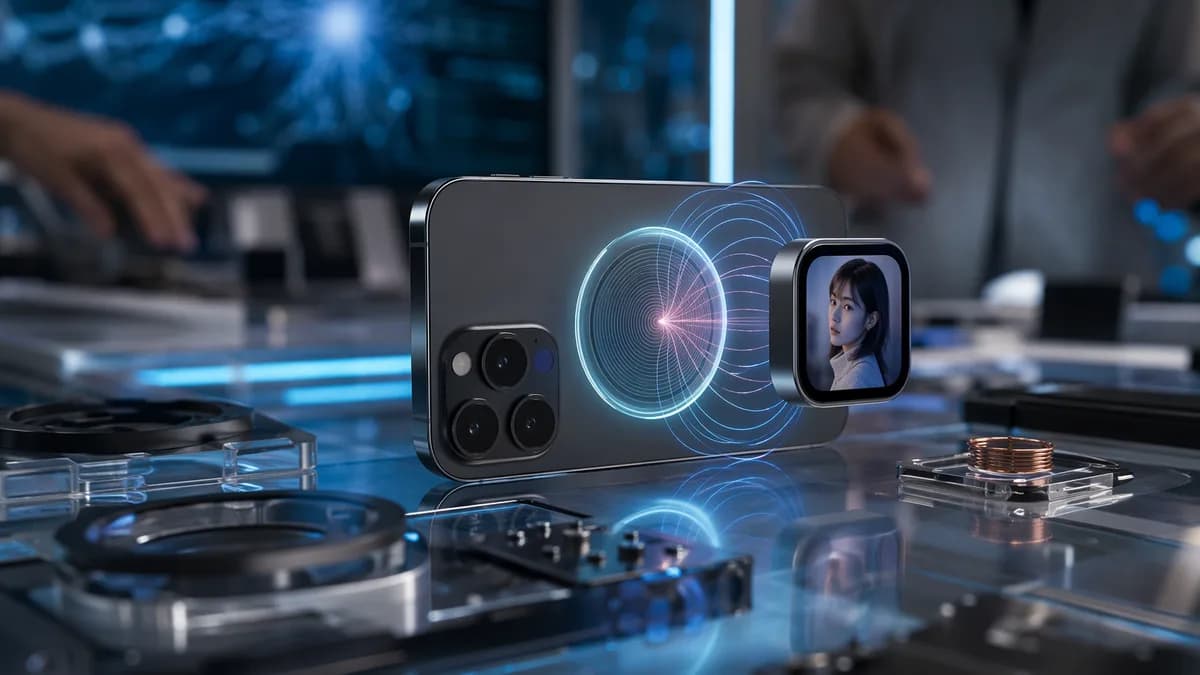
The Oppo Bubble is the best argument yet that Android’s Qi2 delay is no longer just a charging problem. It’s an accessory problem. Oppo has built a clever, charming second screen for phone photography, but its magnetic attachment depends on extra hardware because the phones it supports don’t have magnets built in, according to The Verge.
TechnologyJune 25, 2026· 8 min read· By XOOMAR Insights Team
Oppo Bubble Exposes Android’s Messy Qi2 Accessory Gap
Updated on June 25, 2026
XOOMAR Intelligence
Analyst Take
72/ 100
4 sources analyzedMedium confidenceTrend10Freshness99Source Trust88Factual Grounding90Signal Cluster20
That is the whole Android accessory problem in miniature. The idea is good. The execution is close. The platform support is missing. XOOMAR’s view: if Android phone makers want playful hardware like this to feel natural, they need a shared magnetic standard, not another case, ring, or workaround.
Oppo Bubble proves Android phone makers need Qi2, not another clever workaround
The Oppo Bubble is a detachable smart second screen that connects wirelessly to compatible Oppo phones. It can act as a selfie preview for the rear cameras or as a wireless camera remote. That makes sense. Rear cameras are usually the cameras people actually want to use, but framing yourself with them remains awkward unless the phone gives you a second viewfinder.
The Verge’s Dominic Preston calls it “the best version of this idea I’ve used yet,” which is exactly why the magnetic compromise stings. A bad accessory can be dismissed. A good accessory exposes the weakness around it.
The Bubble is currently compatible with Oppo’s Reno 16 phones, plus “a few other Reno and Find X phones,” per The Verge. Yet Oppo “still hasn’t released a single smartphone with Qi2 charging magnets inside.” So the product built around magnetic attachment works only with phones that need extra magnets to attach it.
That’s not polish. That’s a warning label.
The Bubble gets the second-screen selfie idea closer than past phone gadgets
The hardware is unusually focused. The Bubble is 7mm thick, weighs 27.5g, and uses a 1.73-inch circular OLED touchscreen. It has a 550mAh battery, charges over USB-C, and connects to the phone wirelessly, so it avoids the clumsiness of a dangling cable.
Oppo’s accessory can access the phone’s camera, shoot photos or video, and cycle through basic zoom options across the rear lenses. It also has 33 feet of range, letting it work as a remote when it is not stuck to the back of the phone. Oppo includes a silicon bumper case and a star-shaped lanyard attachment, which makes the Bubble feel less like a lab demo and more like something the company expects people to carry.
There are limits. The circular screen is not ideal for framing a rectangular image. There is no tap-to-focus. Unlike the Insta360 Snap, there is no ringlight. Since it taps into the Oppo camera app rather than mirroring the whole display, it cannot be used with apps like Instagram, though The Verge notes that this also avoids accidentally showing private material on a second screen.
That tradeoff is reasonable. The real flaw sits underneath the product: the attachment system.
Extra magnets turn Oppo Bubble into a half-finished Android compromise
The Bubble needs help to stick to a phone. Buyers need either a magnetic case or the included stick-on magnetic ring. The Verge found that the included ring was “simply too weak for the job,” with the Bubble sliding too easily and raising drop concerns.
“It’s frankly daft that this magnetic accessory works exclusively for phones that don’t have any magnets,” The Verge wrote.
That line lands because it is not a minor gripe. It describes a structural failure. A magnetic accessory should not require a user to modify the back of a modern phone before the core feature feels usable.
The stronger magnets in Oppo’s official Reno 16 magnetic case worked better, but even that did not fully solve the problem. The Verge says pressing the Bubble’s button can push the whole device off its magnetic mount unless the user braces it with a second finger.
Here is the practical contrast:
| Setup | What the user gets | The problem |
|---|---|---|
| Stick-on magnetic ring | Lets Bubble attach to supported Oppo phones | The Verge found the connection weak and slide-prone |
| Official Reno 16 magnetic case | Stronger attachment than the ring | Button presses can still push the Bubble off |
| Built-in Qi2 magnets | Standard magnetic alignment built into the phone | Oppo has not shipped this in its phones, per The Verge |
Qi2 is not magic, and this source does not test a Qi2 version of the Bubble. But the direction is obvious. A detachable screen should feel as natural as pairing earbuds or dropping a watch on its charger. Every extra plate, adhesive ring, or special case makes the accessory feel less premium before the user even opens the camera.
For readers tracking the broader convenience fight in consumer hardware, that same friction shows up in charging habits too. XOOMAR has covered accessory simplicity in Prime Day Charging Deals Crush Cable Clutter for Less, and the Bubble sits in a similar category: small hardware only wins when the setup disappears.
Android’s slow Qi2 adoption is holding back accessories Apple already made familiar
The Verge frames the problem bluntly: “Android manufacturers, Google aside,” have “stubbornly” refused to adopt Qi2 so far. That matters because magnetic alignment is not only about wireless charging. It gives accessory makers a predictable attachment point.
Apple’s MagSafe trained users to expect wallets, stands, battery packs, mounts, grips, and camera accessories that snap into place. Android phone makers do not need Apple’s branding. They need the shared standard that lets accessory companies build once and target more than a tiny pool of supported models.
The Bubble shows why. Oppo has a neat idea, but it is Oppo-only. It works with compatible Oppo models and can pair quickly enough to access the camera even while the phone is locked. That locked-down design has upside. It gives Oppo tighter control over the experience.
The cost is reach. Most Android users cannot use this accessory at all. Even Oppo users need magnets added through a case or ring. That is how a promising idea gets trapped inside a brand silo.
Camera accessories are especially sensitive to this problem because they depend on muscle memory. If a tool is meant to help people capture a shot quickly, the attachment cannot feel uncertain. That is true for phone gadgets, creator cameras, and compact shooting gear, a theme XOOMAR has also explored in 8K Loses Out in DJI Osmo Pocket 4P’s Fast 4K Fight.
The best defense of Oppo still proves the Qi2 point
The strongest defense of Oppo is simple: the Bubble already works within the limits Oppo controls. It pairs quickly with compatible phones. It integrates with the Oppo camera app. It includes a bumper case and lanyard. It avoids full display mirroring, which lowers the risk of showing private content on a second screen.
That is not nothing. It is a thoughtful product.
But that defense only carries the argument so far. The Bubble costs €129, about $150, which The Verge notes is “markedly more” than the $80 Insta360 Snap. At that price, a magnetic accessory should not need an adhesive workaround that still feels too weak, or a special case that still makes the button awkward.
The missing piece is not imagination. Oppo clearly has that. The missing piece is standardization. If major Android brands treat built-in magnetic alignment as optional, accessories like the Bubble will keep arriving with an asterisk attached.
Oppo Bubble should shame Android flagships into magnetic standards
The Oppo Bubble is the kind of phone accessory Android should be producing more often: small, strange, useful, and tied to a real pain point. It turns the better rear cameras into easier selfie cameras. It doubles as a remote. It has enough personality to avoid feeling like another black rectangle.
Yet the product’s central weakness is bigger than Oppo. A tiny second screen should not need a sticker to belong on the back of a flagship phone. If Oppo, Samsung, Xiaomi, and other Android brands want accessories to feel less improvised, Qi2 needs to move from optional spec-sheet trivia to standard hardware on premium phones first, then down the lineup.
The next proof point is clear. If another Android maker copies the Bubble and still ships it with a magnetic ring in the box, the industry has learned the wrong lesson. The accessory is not the problem. The platform still refuses to snap into place.
The Bottom Line
- Oppo Bubble shows that Android’s Qi2 delay is limiting accessory design, not just charging convenience.
- A good second-screen selfie accessory exposes how awkward magnetic add-ons remain without built-in phone support.
- A shared magnetic standard could make playful Android hardware feel seamless instead of dependent on cases or rings.
Android Magnetic Accessory Paths
| Approach | What It Enables | Limitation |
|---|---|---|
| Oppo Bubble with extra magnets | Wireless selfie preview and camera remote for compatible Oppo phones | Requires added magnetic hardware because supported phones lack built-in Qi2 magnets |
| Built-in Qi2 magnets | Native magnetic attachment for accessories across Android phones | Delayed adoption means accessories still rely on workarounds |
Sources

Written by
XOOMAR Insights Team
Research and Editorial Desk
The XOOMAR Insights Team pairs automated research with human editorial judgment. We track hundreds of sources across technology, fintech, trading, SaaS, and cybersecurity, cross-check the facts, and explain what happened, why it matters, and what to watch next. We do not just rewrite headlines. Every article is fact-checked and scored for reliability before it goes live, and we link back to the original sources so you can verify anything yourself.
Explore More Topics
Related Articles
 Technology
Sony Xperia 1 VIII Dumps Zoom Trick to Keep Fans Hooked
Sony’s Xperia 1 VIII gets a bolder look and drops optical zoom, but keeps the quirks loyalists still demand.
Jun 21, 20268 min
 Technology
BYOK Turns a $199 Plastic Slab Into a Writer's Escape
BYOK strips writing down to a screen and your keyboard. At $199, its lack of features is the whole pitch.
Jun 25, 20269 min
 Technology
Prime Day Charging Deals Crush Cable Clutter for Less
Prime Day's best charging deals target clutter, weak bricks, slow cables, and travel pain with smarter USB-C and Qi2 gear.
Jun 24, 20268 min
 Technology
Steam Machine Cost Exposes DIY PC's Hidden Premium
Valve's $1,049 Steam Machine undercuts a comparable DIY mini PC. Compact design is the real price trap.
Jun 23, 20267 min
 Technology
Prime Day Deals Under $50 Crush the Big-Ticket Hype
The best Prime Day value may be under $50, where chargers, games, smart home gear, and repair tools are getting real cuts.
Jun 24, 20268 min
 Global Trends
Harvey Weinstein Rape Charge Collapses as Accuser Bows Out
A judge dismissed the Jessica Mann rape count after she refused a fourth trial, narrowing Weinstein's New York case.
Jun 25, 20265 min
 Fintech
$11B Valuation Tests Airwallex's Agentic Commerce Bet
Airwallex raised $320 million at an $11 billion valuation as it races to make agentic commerce the next layer of global finance.
Jun 25, 20266 min
 Technology
Apple Price Hikes Dump AI Data Center Costs on Buyers
Apple is raising prices across iPads, Macs and more, blaming AI data center demand for memory and storage cost spikes.
Jun 25, 20267 min
 Technology
Polestar US Ban Freezes 2027 EVs in China Crackdown
Washington blocked Polestar’s 2027 EV pipeline, turning Chinese ownership into a U.S. market liability.
Jun 25, 20268 min
 Technology
Idle GPUs Haunt Netris Series A in a16z's $15M Bet
Netris raised $15M from a16z to automate AI neocloud networking and cut the costly lag between buying GPUs and selling live capacity.
Jun 25, 20268 min
Don't miss the signal
Get our weekly roundup of the stories that matter across tech, fintech, and trading. No noise, just signal.
Free forever. No spam. Unsubscribe anytime.