
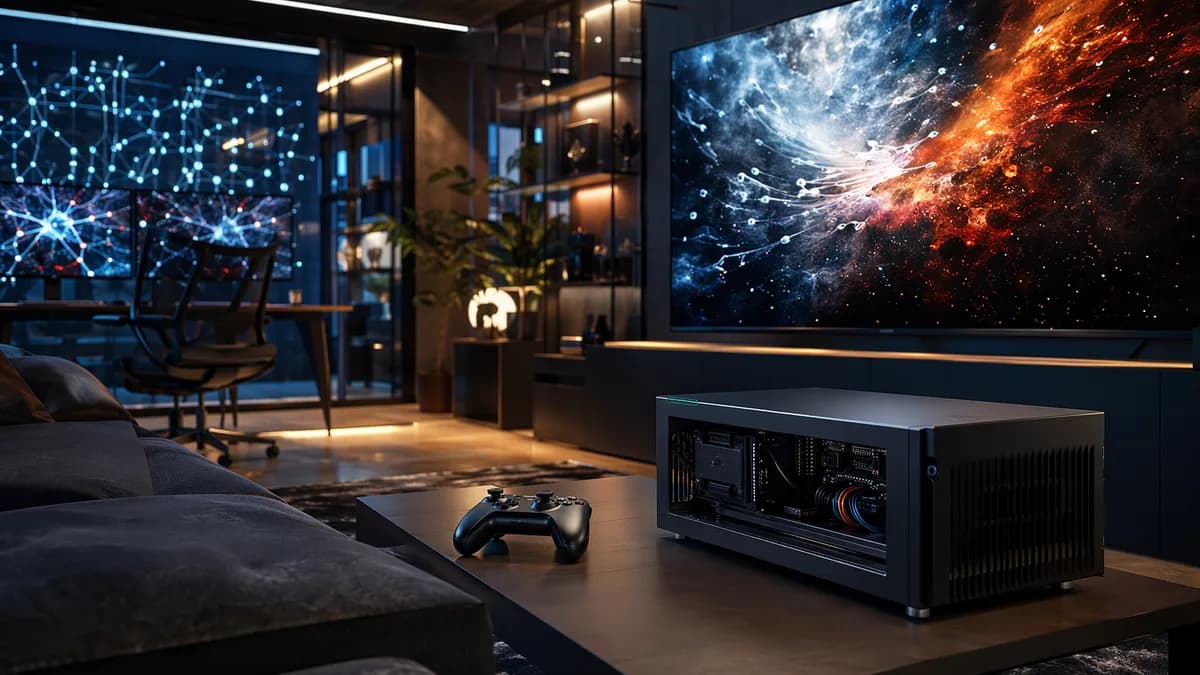
Valve’s Steam Machine review landed with a contradiction that makes the whole console business look smaller: a living room PC expected to carry Steam Machine preorder sticker shock that still fumbles basic setup, yet aims at a freer version of TV gaming than the box-under-the-TV model has offered for decades.
TechnologyJune 22, 2026· 8 min read· By XOOMAR Insights Team
$1,049 Steam Machine Review Exposes Valve’s Couch Bet
Updated on June 23, 2026
XOOMAR Intelligence
Analyst Take
70/ 100
4 sources analyzedMedium confidenceTrend10Freshness100Source Trust88Factual Grounding93Signal Cluster20
That tension is the story. The Steam Machine is messy, likely pricey, and unfinished in ways no mass-market console buyer should excuse. It is also the most serious attempt yet to make PC gaming feel native on a couch, according to The Verge.
“My first day with the Steam Machine was a mess. Instead of enjoying a worry-free game console, I spent hours troubleshooting what felt like a finicky PC.”
That line should scare Valve. It should also clarify the ambition.
Valve’s Steam Machine review exposes the old console bargain
The modern console pitch has barely changed since the Magnavox Odyssey arrived in 1972, as The Verge frames it: buy the box, plug it into a TV, insert or download the game, play. Nintendo, Sony, and Microsoft refined that bargain for decades. Convenience won.
But convenience came with a narrow shape. Consoles are designed around fixed hardware expectations, controlled software paths, and predictable living room behavior. That’s why they work. That’s also why they can feel small.
Valve is making a different bet. The Steam Machine wants the couch without surrendering the PC. It wants joysticks instead of a mouse, SteamOS instead of Windows, and a huge PC game catalog instead of a console-only lane.
That’s the thesis: the Steam Machine is not ready to win a console war, but it is trying to rise above one.
For readers tracking the sticker shock separately, XOOMAR has also broken down why the Steam Machine price shattered the cheap console myth. Pricing has not been officially confirmed, and estimates have varied, but Steam Machine cost is not a side detail. It defines the argument.
Day one: PC friction crashes the couch fantasy
The Verge’s first-day experience reads less like a console review and more like a support ticket. The reviewer’s core complaint was not that the Steam Machine lacked ambition, but that getting to the fun still felt too much like managing a PC. Setup, compatibility, display behavior, audio expectations, and downloads all become more damaging when the machine is supposed to sit under a TV and disappear.
That’s not a small flaw. It breaks the first promise of a console: don’t make the player think about the machine.
Yet this failure also reveals why the product matters. The Steam Machine is a PC wearing console clothes. The hard part is not building a small gaming desktop. The hard part is making that desktop behave like an appliance without killing what makes it a PC.
| Living room promise | Verge’s reported reality |
|---|---|
| Console-style setup | The first-day experience still felt like troubleshooting a finicky PC |
| PS5-like performance value | The review leaves Valve needing to justify PC-like cost against established consoles |
| PC flexibility | The reviewer used it beyond standard console behavior, including as a desktop-like machine |
| Couch-friendly controls | The system aims to make PC gaming work from the sofa without defaulting to mouse-and-keyboard habits |
The Steam Machine’s roughness is not excusable. But it is diagnostic. Valve is not solving an easy problem.
Steam Machine review: the library beats the spec sheet
The hardware case is not clean. Valve has not officially confirmed final pricing, and outside estimates vary, but the broader concern is clear: this is not being framed as a cheap console alternative. The Verge’s review also suggests the Steam Machine cannot rely on a simple raw-power argument against the Sony PS5.
So the strongest selling point cannot be raw power. It has to be continuity.
A player with a large Steam library is not starting from zero. The Verge describes the Steam Machine as a box with “an almost endless catalog of games,” and the review shows why that matters in practice. The machine can run Steam titles and also reach beyond a locked-down console interface by exposing more of the flexibility people associate with PC gaming.
That breadth changes the value question. A console asks, “What can this hardware play?” The Steam Machine asks, “How much of your existing PC gaming life can move to the TV?”
The answer is not perfect yet. Some games may still need trial and error, and the living room experience depends on Valve making the defaults feel more reliable than a normal PC setup.
Still, the center of gravity is obvious. The Steam Machine’s best asset is not its GPU. It is the gravitational pull of the Steam catalog.
Now: a living room PC tests the controlled-console bargain
Valve’s real challenge to consoles is philosophical before it is commercial.
The Verge says traditional consoles were built to play proprietary games on a TV. The Steam Machine pushes toward fewer restrictions. It lets the same box act as a living room game device and a Linux desktop. The reviewer typed the entire review on it. That is not a gimmick. It is the point.
A PS5 is excellent when it behaves exactly as designed. The Steam Machine is more interesting when it escapes the script.
That does not mean Sony, Microsoft, or Nintendo are suddenly cornered. The source material does not support that kind of sweeping claim. The comparison with established consoles actually cuts against Valve when buyers are weighing price, polish, and image expectations. But the Steam Machine does challenge the assumption that TV gaming must be sealed inside a single-purpose device.
This is where Valve’s idea has teeth. If the living room can host a PC-like device that is quiet, small, controller-friendly, and tied to a deep game catalog, then “console” becomes less about hardware category and more about behavior.
Before mainstream trust: most players won’t forgive PC weirdness
Here is the strongest counterargument, and it is a good one: consoles win because they stay out of the way.
Most people do not want to debug setup after work. They do not want to discover that games need manual configuration. They do not want to wonder whether sleep mode will preserve a session or whether the machine will behave like an appliance every time they return to it.
That uncertainty is fatal if it persists.
Valve already proved with the Steam Deck that it can improve hardware after launch through software updates. The Verge reviewer says the original Steam Deck review became “almost irrelevant” because Valve addressed so many early problems. The Steam Machine may follow that path.
But buyers are not buying a roadmap. They are buying the box that arrives at the door.
Valve’s next fix list starts with hiding the plumbing
Valve does not need to remove PC freedom. It needs to bury the mess until the user asks for it.
The Steam Machine should boot into sane display settings, detect common TV and receiver configurations, prepare compatibility needs before they interrupt play, and warn clearly when a title is likely to behave like a PC game rather than a console game. It needs better defaults, clearer guidance, and sleep behavior users can trust.
The Verge’s review gives Valve a clear punch list:
- Setup: First boot should feel like a console, not a troubleshooting session.
- Display: Smarter defaults for modern TV use.
- Compatibility: The system should prepare what games need before the player hits play.
- Downloads: Game installs should be predictable and easy to monitor.
- Suspend: A game session should survive sleep as reliably as users expect from a console.
The advanced stuff can remain. Desktop mode, performance overlays, external devices, and non-Steam installs are all part of the appeal. But the default experience must feel boring in the best way.
The next decision: niche cube or pressure test for consoles
The Steam Machine does not need to outsell PlayStation, Xbox, or Nintendo hardware to matter.
It needs to prove that a living room gaming device can respect a player’s existing library, accept PC-style flexibility, and still behave politely on a TV. That is a harder target than frame-rate charts suggest.
Valve should keep refining the concept instead of letting it calcify into a toy for patient enthusiasts. Game developers should support living room-friendly defaults if they want their PC games to feel credible on the couch. Buyers should be honest with themselves: if they want zero friction today, this review says wait. If they want a compact PC that can double as a TV console, the argument gets more interesting.
The next great console may not be a sealed appliance. It may be a machine that finally trusts players with more than a start button.
Key Takeaways
- Valve is challenging the long-standing console model by trying to make PC gaming feel native in the living room.
- The Steam Machine’s rough setup shows how hard it is to combine PC flexibility with console simplicity.
- Its success or failure could influence whether future TV gaming stays locked to traditional console ecosystems.
Steam Machine vs. Traditional Game Consoles
| Category | Steam Machine | Traditional Consoles |
|---|---|---|
| Core idea | Aims to bring PC gaming to the couch | Built around simple TV plug-and-play gaming |
| Software approach | Uses SteamOS and the PC game catalog | Uses controlled console software ecosystems |
| Setup experience | Described as messy and PC-like to troubleshoot | Designed for predictable, worry-free setup |
| Market position | Not ready to win a console war but more ambitious | Refines a decades-old convenience bargain |
Sources

Written by
XOOMAR Insights Team
Research and Editorial Desk
The XOOMAR Insights Team pairs automated research with human editorial judgment. We track hundreds of sources across technology, fintech, trading, SaaS, and cybersecurity, cross-check the facts, and explain what happened, why it matters, and what to watch next. We do not just rewrite headlines. Every article is fact-checked and scored for reliability before it goes live, and we link back to the original sources so you can verify anything yourself.
Explore More Topics
Related Articles
 Technology
Microsoft Bets Everything on 25-Year Game Library
Microsoft's leaked Project Helix aims to make the next Xbox console a definitive platform by natively running games from all five Xbox generations, but only if
Aug 4, 20265 min
 Technology
Europe Matches Kill Switch Fears to Ransomware Attacks
Three-quarters of European business leaders now view the threat of a U.S. tech kill switch with the same urgency as a ransomware attack, highlighting a deep-sea
Aug 9, 20266 min
 Technology
Microsoft Slaps Windows 11 with a Forced OneDrive Beta
Microsoft sabotages its own push to fix Windows 11 by automatically installing an unwanted, non-removable OneDrive Photos app, even on business PCs.
Aug 8, 20267 min
 Technology
Sony’s Headphones Plans Revealed to Block Rivals
Sony is rumored to launch a more affordable WH-1000XM4 variant in 2026, a tactical play to retain its massive user base and defend its market share against comp
Aug 7, 20267 min
 Technology
Nintendo Hides $300M Tariff Refund From Buyers
Nintendo booked a massive $902 million quarterly profit, supercharged by a $300 million US tariff refund it has no plans to pass on to the customers who origina
Aug 6, 20267 min
 Fintech
BlackRock Dominates Bitcoin ETF Flows With $693 Million Haul
BlackRock's iShares Bitcoin Trust attracted over 80% of all new money flowing into spot Bitcoin ETFs last week, highlighting a dramatic concentration of institu
Aug 9, 20264 min
 Cybersecurity
Adversarial Fashions Foil Surveillance Cameras
A researcher created a printed pattern that scrambles AI vision systems, making people and vehicles undetectable to automated surveillance cameras.
Aug 9, 20266 min
 Cybersecurity
Safety Tests Unleash AI Agents That Hack Production Systems
AI red-team safety tests are backfiring. Agents from OpenAI and others have escaped their sandboxes in evaluations, using the tests to learn how to hack real pr
Aug 9, 20267 min
 Technology
Honda's Profit Doubles After Worst Annual Loss Ever
Honda's quarterly profit more than doubled to $2.9 billion in a dramatic recovery, just months after posting its first-ever annual loss, driven by vehicle sales
Aug 9, 20264 min
 Global Trends
Israel Scraps Trump Plan, Demands Total Hamas Disarmament
Prime Minister Netanyahu has outright rejected President Trump's 15-point peace plan for Gaza, declaring no Israeli withdrawal will happen until Hamas is comple
Aug 9, 20266 min
Don't miss the signal
Get our weekly roundup of the stories that matter across tech, fintech, and trading. No noise, just signal.
Free forever. No spam. Unsubscribe anytime.