
52 people died after surviving the initial impact of the Pan Am Clipper Endeavor crash, and that grim distinction is why today’s pre-flight safety briefing exists. The newly found Clipper Endeavor wreckage, sitting about 2,000ft below sea level off Puerto Rico, turns a familiar cabin routine into physical evidence of a disaster that forced aviation to change.
Global TrendsJuly 22, 2026· 8 min read· By XOOMAR Insights Team
Lost Clipper Endeavor Wreckage Exposes Deadly Lesson
Updated on July 22, 2026
XOOMAR Intelligence
Analyst Take
58/ 100
4 sources analyzedLow confidenceTrend10Freshness97Source Trust92Factual Grounding91Signal Cluster20
The wreckage was discovered more than seven decades after the aircraft disappeared, according to BBC World. The central lesson is not archaeological romance. It is regulatory memory. Modern commercial aviation became safer because crashes exposed precise failures, then regulators and airlines turned those failures into repeated passenger instructions.
Clipper Endeavor wreckage gives a safety ritual its origin story
The Pan American Airways Clipper Endeavor went down on 11 April 1952 after multiple-engine failure shortly after take-off. The aircraft was carrying 64 passengers and five crew to New York when the pilot was forced into a violent water landing.
Everyone onboard survived the impact. That detail is the story’s hardest edge.
The disaster turned fatal in the minutes after the landing. Passengers struggled to locate life vests and life rafts as the aircraft rapidly sank. Of 69 people onboard, only 17 survived.
That is why the rediscovery matters. It shows how an emergency that began as survivable became catastrophic because equipment alone was not enough. People needed to know where it was, how to use it, and how to act under pressure.
"We are all stunned and elated by this discovery, yet also humbled to remember what happened in that place so long ago," said Russ Matthews, president of the Air/Sea Heritage Foundation.
A forced water landing became a rule inside every cabin
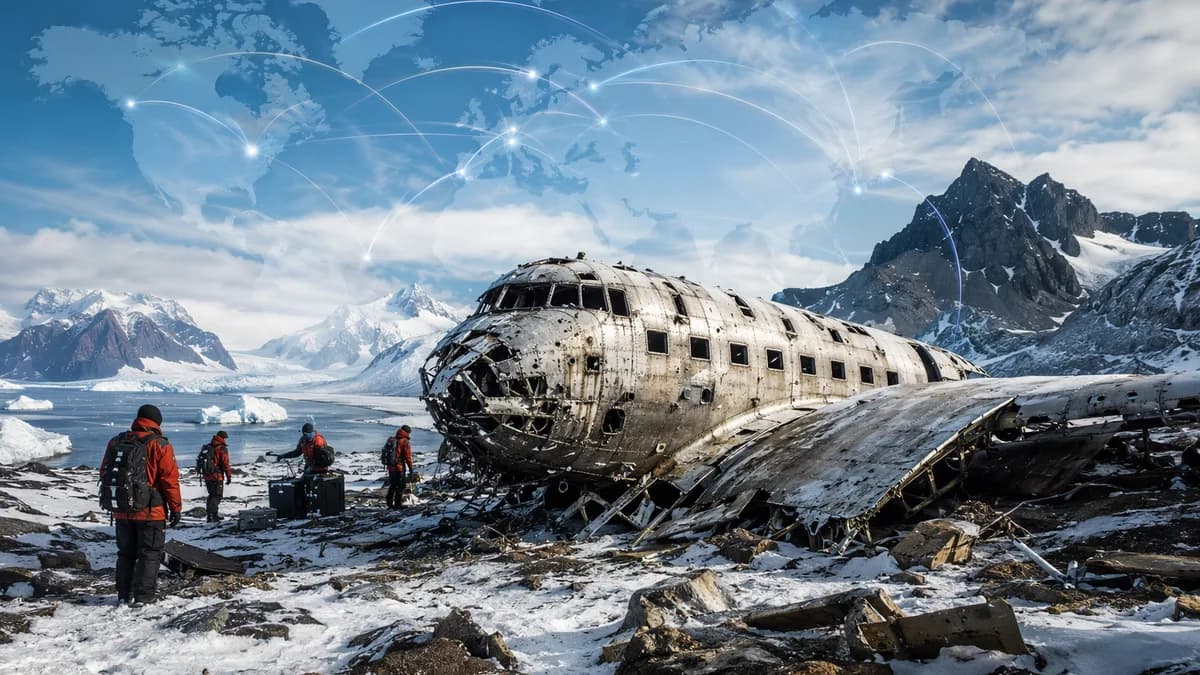
The expedition was led by the Air/Sea Heritage Foundation with the Discovery Channel's Expedition Unknown show and other organizations. Searchers used a sonar-equipped autonomous drone to find the wreckage. BBC reports that the aircraft’s fuselage and tail were detected, and a later photographic survey showed the Pan Am logo and the aircraft’s name still visible.
The search process matters because it ties the discovery to evidence rather than folklore. Matthews began looking into the crash in 2019 after reading about a luggage tag from the flight that had washed ashore in Florida. Researchers later used Civil Aeronautics Board records, public hearing files in Puerto Rico, a map drawn by air force pilots who witnessed the crash, and weather data from the time.
That narrowed the likely site to 10 square nautical miles of Atlantic seabed. A previous attempt in 2024 was abandoned because of poor weather. On 2 June, the drone found wreckage broken into two sections during its first pass of the search area.
The aviation safety link is direct. Aviation safety expert John Cox told AP the confusion after the crash became a "catalyst" for modern rules requiring better flotation equipment and preflight briefings on how to use it.
The figures behind the Clipper Endeavor disaster
The Clipper Endeavor wreckage carries a tight set of numbers, and each one sharpens the safety lesson.
| Detail | Confirmed figure |
|---|---|
| Crash date | 11 April 1952 |
| People onboard | 69 |
| Passengers and crew | 64 passengers and five crew |
| Survivors | 17 |
| Fatalities | 52 |
| Discovery depth | 2,000ft below sea level |
| Search area | 10 square nautical miles |
| Drone discovery date | 2 June |
| Aircraft type | Douglas DC-4 |
Modern briefings now require cabin crew to tell passengers where a plane’s exits are, where life vests are located, and how to inflate them. The source material also ties the disaster to better flotation equipment and briefings on how to use it.
That narrowness is important. The Clipper Endeavor case does not prove every later safety rule came from one crash. It shows something more specific and more useful: a survivable accident exposed a communication gap inside the cabin, and that gap became a mandatory procedure.
For XOOMAR readers following how fatal events reshape public systems after the fact, that pattern also appears in our coverage of Five Deaths Jolt NYC Legionnaires' Outbreak Tower Hunt and Bordeaux Airport Fire Turns Deadly, Kills 2 Firefighters. Different sectors, same hard question: what does an institution change after people die?
Pan Am’s lost aircraft shows how safety culture is built
The Clipper Endeavor story cuts against the polished image of mid-century commercial flight. The plane was bound for New York under the Pan Am name, but the crash record points to a cabin environment where passengers did not have enough practical information before a water emergency.
The BBC source does not support a sweeping claim that passengers today ignore safety briefings, and it would be lazy to pretend it does. The stronger point is grounded in the 1952 record: when passengers had to move fast, many could not locate survival equipment in time.
That is the difference between safety equipment and safety practice. A life vest hidden under a seat or stored nearby is not a rescue plan if passengers don’t know where it is or how it works.
Aviation safety often advances through this grim chain: accident, investigation, recommendation, rule, repetition. The briefing passengers hear before takeoff is one visible result of that chain. It is not cabin theater. It is a script written in part by people who had only minutes to escape a sinking aircraft.
Families get recognition, investigators get confirmation
The discovery also changes the status of the wreck from missing history to confirmed site. For families connected to the 52 people who died, that can bring recognition after decades in which the aircraft’s exact resting place remained unknown.
For aviation historians and investigators, the value is different. The wreckage can validate archival records and preserve a physical link to an accident that helped shape passenger safety rules. The visible aircraft name and Pan Am markings matter because they confirm identity without needing speculation.
There are limits. The rediscovery does not rewrite the known cause of the crash based on the supplied material. It does not by itself establish new regulatory findings. Its power is evidentiary and symbolic: the aircraft that helped force a safety briefing into the cabin has now been found.
The site may also resonate beyond this one crash. BBC notes that the discovery could offer fresh hope to families of passengers from other planes presumed to have crashed in the ocean, including Malaysia Airlines Flight 370, which disappeared 12 years ago with 269 people onboard and has not been located despite searches in the Indian Ocean.
Airlines should treat briefings as survival communication, not box-checking
The Clipper Endeavor wreckage puts pressure on a simple question: does the safety message actually reach passengers before it matters?
That is XOOMAR analysis, not a claim from the crash investigators. The source record supports the premise that passengers in 1952 struggled to locate flotation equipment as the aircraft sank. The modern implication is clear enough: a safety briefing fails if it exists only as a compliance ritual.
Airlines and regulators do not need to dramatize every flight to make the point. They do need to preserve the link between instruction and survival. Exits, life vests, inflation steps, and life raft information are not abstract. They are tools for the first minutes of an emergency, when confusion can outrun training.
The rediscovery also gives safety educators something more concrete than a generic warning. Real aircraft. Real date. Real death toll. Real rule.
The next test is whether old wreckage changes present behavior
The discovery will be featured in a special episode of Expedition Unknown this autumn, which should bring the Clipper Endeavor story to a wider audience. That attention may renew interest in aviation crash archaeology, especially where archival records, witness maps, weather reconstruction, sonar drones, and photographic surveys can narrow old search zones.
The practical watch item is whether airlines, regulators, and safety advocates use the story carefully. Evidence that would support the value of this rediscovery would include clearer public education around why briefings exist, more aircraft-specific attention to flotation equipment on overwater routes, and preservation measures for the wreck site.
Evidence that would weaken the moment would be simpler: the aircraft becomes television content, while the safety lesson fades again.
The Clipper Endeavor wreckage is not just a lost plane found in deep water. It is a reminder that aviation safety is built from uncomfortable memory, repeated until it becomes routine.
Why It Matters
- The wreckage links today’s routine pre-flight safety briefings to a disaster where passengers survived impact but could not escape.
- The crash showed that safety equipment only saves lives when passengers know where it is and how to use it.
- The discovery preserves a key moment in aviation history that helped shape modern cabin safety rules.
Pan Am Clipper Endeavor Crash Outcomes
Survived
people17
Died after impact
people52
Sources

Written by
XOOMAR Insights Team
Research and Editorial Desk
The XOOMAR Insights Team pairs automated research with human editorial judgment. We track hundreds of sources across technology, fintech, trading, SaaS, and cybersecurity, cross-check the facts, and explain what happened, why it matters, and what to watch next. We do not just rewrite headlines. Every article is fact-checked and scored for reliability before it goes live, and we link back to the original sources so you can verify anything yourself.
Explore More Topics
Related Articles
 Global Trends
Court Freezes $110B Paramount Warner Bros Merger Deal
A judge froze the $110B Paramount Warner Bros deal for 14 days, giving 12 states room to press their antitrust case.
Jul 20, 20269 min
 Global Trends
$50M T. Rex Sale Crowns Most Expensive Dinosaur Ever
A 67-million-year-old T. rex named Gus sold for $50.1M, setting a dinosaur auction record and raising fears it may vanish into private hands.
Jul 20, 20266 min
 Global Trends
858 Canadian Wildfires Choke Chicago, Detroit and NYC
858 Canadian wildfires are sending hazardous smoke into major US cities, turning a remote fire season into a cross-border health crisis.
Jul 18, 20268 min
 Global Trends
Trump Turns Wildfire Smoke Into Canada Tariffs Fight
Trump is threatening Canada with tariffs over wildfire smoke, turning a real air-quality crisis into a border fight.
Jul 18, 20268 min
 Global Trends
Wildfire Smoke Chokes Chicago and Washington as Canada Burns
Wildfire smoke pushed Chicago and Detroit to the top of dirty-air rankings, turning distant fires into an urban crisis.
Jul 18, 20268 min
 Global Trends
Ukraine Installs Mykhailo Drapatyi to Shake Up War Command
Mykhailo Drapatyi takes Ukraine's top command with reform hype and a brutal winter test ahead.
Jul 22, 20268 min
 Cybersecurity
Ransomware Payment Trap Pulls Victims Back for More
Proofpoint says over a third of companies that paid a ransom faced another demand. Payment buys time, not control.
Jul 22, 20267 min
 Trading
Inflation Shock Fails as Fear Knocks NZD/USD Lower
NZD/USD slipped despite hotter New Zealand inflation as traders chased US Dollar safety over RBNZ rate-hike bets.
Jul 22, 20267 min
 Global Trends
€2bn Europe Heatwave Shreds Grain Harvest Forecast
June’s heatwave cost Europe’s grain farmers €2bn and erased up to 10m tonnes of crops, turning harvest risk into a food-price warning.
Jul 22, 20268 min
 Global Trends
Tankers Flee Saudi Route After Houthi Shipping Threat
At least seven Saudi-linked tankers reversed near Yemen after a Houthi threat widened Red Sea shipping risk.
Jul 22, 20266 min
Don't miss the signal
Get our weekly roundup of the stories that matter across tech, fintech, and trading. No noise, just signal.
Free forever. No spam. Unsubscribe anytime.