After Dharmendra Pradhan's resignation, the question India’s government cannot dodge is simple: will it reform the exam system, or merely change the nameplate? The Cockroach Movement forced a rare moment of accountability, and India’s political class should treat it as a warning, not a temporary embarrassment.
XOOMAR Intelligence
Analyst Take
Pradhan resigned on Saturday after student-led protests demanded his departure over the leaked National Eligibility-cum-Entrance Test (NEET), according to Time. That matters because education in India is not a side portfolio. It sits at the intersection of jobs, family savings, status, migration, and trust in the state.
Did Pradhan's resignation prove India's students can still shake power?
Yes, but the sharper point is that they did it by refusing to behave like a one-cycle outrage story.
The Cockroach Movement began as a parody account after Indian authorities invalidated the annual medical school entry exam in May. Its name drew from Chief Justice Surya Kant’s comment in an unrelated hearing that same month, where he compared young unemployed people to “cockroaches” and “parasites.” Student activists turned that insult into a banner.
That inversion was politically potent. The movement did not need a legacy party machine to become visible. Time reports that the page gained millions of followers, and its founder began organizing protests in late June. The protests then escalated from anger over NEET into a wider demand for reforms, with Pradhan’s resignation as the first test.
For readers tracking the sequence, XOOMAR’s related coverage of how the Cockroach Protest Topples India's Education Minister, how the Cockroach Youth Movement Ousts Modi Minister over Exam Leak, and how the protests cracked Modi’s BJP fortress follows the same pressure campaign from exam scandal to ministerial exit.
XOOMAR’s view: Pradhan’s departure is more than a personnel change. It shows that organized student anger can puncture the comfort of office when the grievance is concrete, personal, and impossible to dismiss as abstract ideology.
How did the Cockroach Movement turn a leaked exam into an accountability test?
The force came from the facts beneath the fury.
Over 2 million prospective students took the three-hour NEET exam, according to the BBC figure cited by Time. Then an exam coach noticed that a “guess paper” circulating online closely matched the exam itself. Police later concluded the questions had been leaked. The Indian Express, cited by Time, reported that some people paid as much as 5,000 rupees (about $52) to access the “guess paper” on WhatsApp.
That was enough to turn a testing failure into a legitimacy crisis. India’s medical school system offered fewer than 130,000 slots for the undergraduate medical program this year, according to India’s National Medical Commission figure cited by Time. A compromised exam in that context is not a paperwork error. It can wreck years of preparation.
The human toll sharpened the politics. After the exam was discredited, at least 20 students died by suicide, according to Agence France-Presse as cited by Time. Protesters blamed those deaths on systemic failures in India’s education system and directed much of their anger at Pradhan.
“India’s youth power is the real strength of this nation,” Pradhan wrote after stepping down.
He did not accept fault. Time reports that he said he agreed to resign to prevent “anti-national forces” from exploiting the upheaval. That phrasing may satisfy loyalists, but it does not answer the core question students raised: who is accountable when a high-stakes exam fails?
Why do education failures hit young Indians where politics is most personal?
Because education policy is lived at the kitchen table before it is debated in Parliament.
Families sacrifice income, savings, time, and emotional bandwidth for a shot at upward mobility. Students sacrifice years of youth to exams that promise meritocratic sorting. When the process looks corrupted, the injury is immediate. It is not an ideological disagreement. It is a broken bargain.
That is why the NEET leak carried more explosive force than a routine ministry scandal. Students could see the damage in admissions, credentials, and future earnings. Parents could understand the stakes without needing a party spokesperson to explain them.
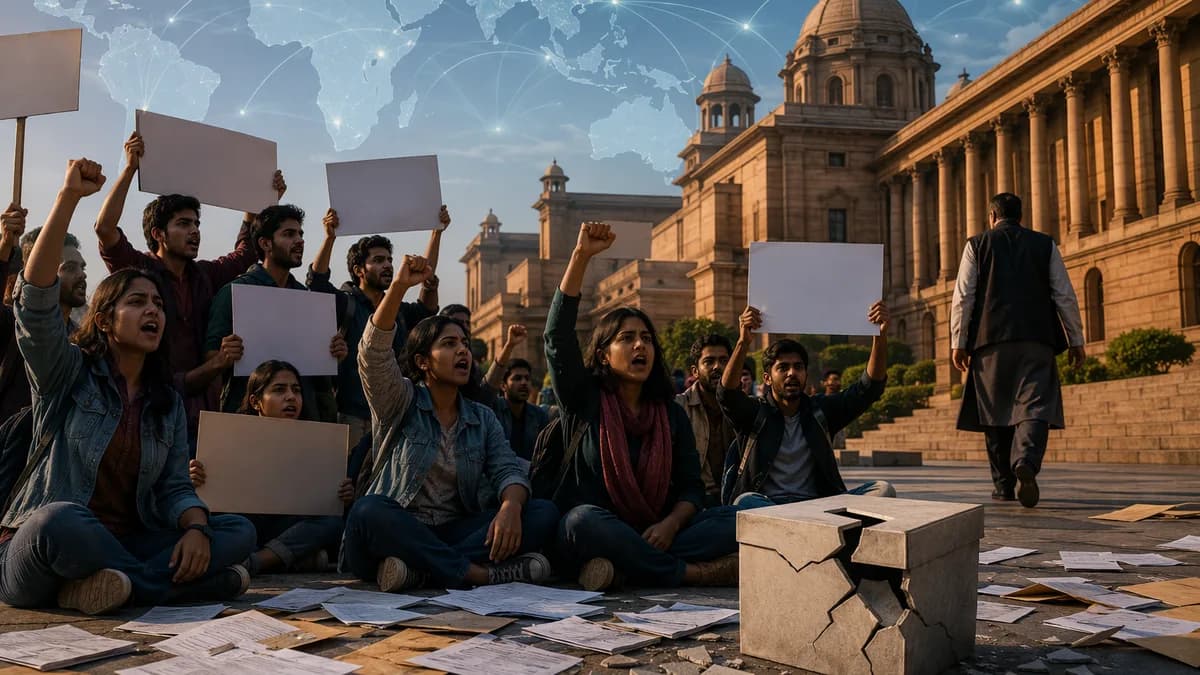
The government’s handling of the protests made the accountability question harder to contain. Time reports that tens of thousands of protesters attempted to march on Parliament despite police orders not to do so. The next day, protesters tried to block public transportation, setting up barricades at key metro stations and disrupting travel for millions of daily commuters. Police used tear gas and batons to disperse protesters, sparking public outrage.
Then activist Sonam Wangchuk was forcibly taken to hospital after 26 days of a hunger strike. He later said he ended his campaign after receiving assurances that the “issue of accountability” for the exam failures would be discussed by Parliament.
That word, accountability, is the center of this story.
Can one resignation repair the trust deficit in India's education system?
No. A resignation is a consequence. It is not a repair.
Pradhan said the government would switch to a computer-based testing model in the future to help prevent fraud and confirmed that a replacement exam had been successfully completed in June. Pralhad Joshi, already overseeing Consumer Affairs, Food and Public Distribution, and New and Renewable Energy, was assigned the Education Ministry “in addition to his existing portfolio” on the advice of Prime Minister Narendra Modi.
Joshi had already addressed the exam leak in May:
“The reforms are needed, we are bringing them, but they cannot be done within a year. By next year, technology-driven examination will be there."
That is a start, not a settlement.
The next phase should be judged by measurable fixes, not calmer headlines. The government needs timelines, public explanations, and clear ownership for exam integrity. It needs direct communication with students, not scripted reassurance after the crowd has already gathered.
| Political act | What it solves | What it does not solve |
|---|---|---|
| Pradhan resigns | Gives protesters a visible accountability marker | Does not prove the exam system is secure |
| Computer-based testing pledge | Signals a technical response to fraud | Does not explain oversight, audits, or failure points |
| Joshi takes charge | Fills the Cabinet vacancy | Does not guarantee durable education reform |
| CJP ends protests | Lowers immediate street pressure | Does not close the trust gap |
The oldest trick in crisis management is removing one face while preserving the habits underneath. India’s students should not accept that trade.
Where should protest pressure stop and due process begin?
Here is the strongest counterargument: resignations driven by street pressure can reward symbolic politics. They can also punish individuals before every fact has been tested.
That concern is valid. Education ministries operate inside a tangle of exam bodies, courts, universities, and state-level systems. Blame is rarely as neat as a protest slogan. A minister’s exit does not automatically identify every failure point, every official lapse, or every private actor involved in a leak.
But due process cannot become a shield for delay, secrecy, or political insulation. Protest should force answers. Institutions must deliver evidence, reform, and accountability.
The Cockroach Movement’s own demands now create a test for the protesters too. The CJP asked for compensation of 10 million rupees ($104,000) for each student who died by suicide following the leak, greater legislative oversight of the education system, gender equity in government roles, a fully independent media, and political reforms including a 20-year ban on politicians switching parties before seeking election. It also asked the central government to drop any potential charges against protesters.
On Saturday, CJP spokesperson Saurav Das said:
"All our demands have been accepted,” he said, without elaboration. “We request the protesters to withdraw immediately and return home peacefully."
That “without elaboration” matters. The public needs details. Accepted how? On what timeline? By which ministry? With what legal force?
Will India's leaders answer students before the next resignation is forced?
They should start now.
The government should meet student representatives in public-facing formats, publish clear reform steps, explain how computer-based testing will prevent leaks, and identify who owns exam security at each stage. It should also clarify the status of protest-related cases and the four-week follow-up meeting the CJP says will address broader reforms.
Opposition parties should resist the temptation to turn the Cockroach Movement into a trophy. Students deserve functioning exams, not photo opportunities. Their anger was not created to decorate someone else’s campaign speech.
Sonam Wangchuk put the limit clearly after welcoming Pradhan’s resignation:
"I hope we maintain this peace and that no wrongdoing occurs anywhere in the future. We need to work on reforms. A nation isn't built by resignation alone."
That is the right standard. Pradhan’s resignation proves students can force attention. It does not prove the system has changed.
The Cockroach Movement has already shown that young Indians can survive official indifference. The question now is whether India’s leaders can survive ignoring them again.
Impact Analysis
- Pradhan’s resignation shows student protests can still force accountability at the highest levels of government.
- The NEET leak has turned exam integrity into a national political issue tied to jobs, family finances, and public trust.
- The government now faces pressure to deliver structural exam reforms rather than treating the resignation as the end of the crisis.
Primary Sources & Disclosures

Written by
XOOMAR Insights Team
Research and Editorial Desk
The XOOMAR Insights Team pairs automated research with human editorial judgment. We track hundreds of sources across technology, fintech, trading, SaaS, and cybersecurity, cross-check the facts, and explain what happened, why it matters, and what to watch next. We do not just rewrite headlines. Every article is fact-checked and scored for reliability before it goes live, and we link back to the original sources so you can verify anything yourself.