
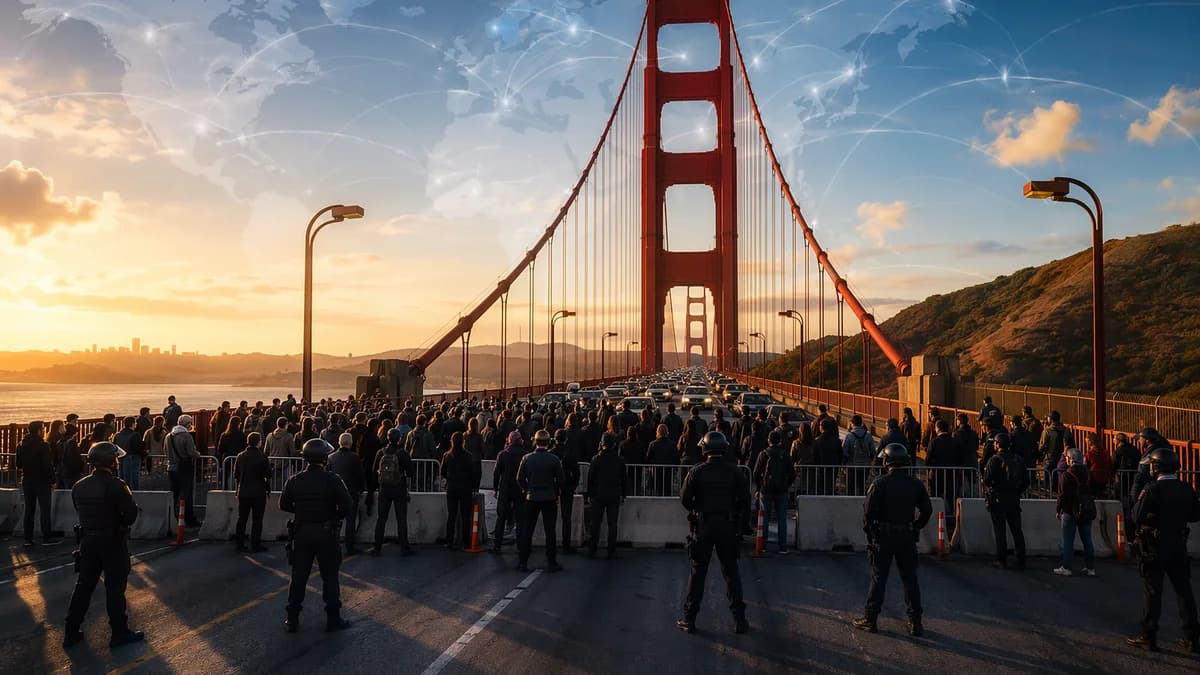
Seven Golden Gate Bridge protesters avoided an immediate felony conviction that could have carried a potential 15-year sentence, but a San Francisco jury still found each of them guilty of multiple misdemeanors for blocking traffic during an April 2024 pro-Palestine action.
Global TrendsJuly 3, 2026· 8 min read· By XOOMAR Insights Team
Felony Threat Fizzles for Golden Gate Bridge Protesters
Updated on July 3, 2026
XOOMAR Intelligence
Analyst Take
68/ 100
3 sources analyzedMedium confidenceTrend10Freshness96Source Trust90Factual Grounding88Signal Cluster20
That split result is the real story. The jury punished the blockade, but it could not agree on the harshest theory prosecutors brought against the defendants: felony conspiracy, according to Guardian World. For protest movements, prosecutors, and anyone who depends on major public infrastructure, the case draws a sharper line around disruptive civil disobedience in the Trump era.
Golden Gate Bridge protesters face misdemeanor convictions, but the felony theory stalls
The Golden Gate Bridge protesters were convicted after a demonstration that blocked traffic on the bridge during a 2024 anti-war protest. The jury deliberated for seven days and deadlocked on the felony conspiracy charge. It also could not reach a verdict on a misdemeanor trespassing charge.
The seven defendants were each convicted of six misdemeanors, including false imprisonment and obstruction of thoroughfare. One defendant, Sara Cantor, was convicted of an additional misdemeanor charge of refusing to disperse.
Their sentencing is scheduled for 21 August. Six defendants face a maximum of five years in county jail. Cantor faces five-and-a-half years.
“Today remains a victory,” public defender Nuha Abusamra, who represents one of the defendants, said following the verdict, according to KQED. “We do not fight solely to win. We fight for the resistance.”
XOOMAR analysis: The verdict does not cleanly vindicate either side. Prosecutors secured criminal liability on the conduct. The defense avoided, at least for now, the most severe felony outcome. That leaves the case in a tense middle ground, with punishment certain but the biggest legal threat unresolved.
The April 2024 bridge blockade became a numbers case
The core facts are stark:
- Seven defendants went to trial.
- Seven days of jury deliberations ended without a verdict on felony conspiracy.
- Each defendant was convicted of six misdemeanors.
- Sara Cantor was convicted of one additional misdemeanor.
- Sentencing is set for 21 August.
- The felony conspiracy charge could have carried a potential 15-year sentence for at least one defendant, according to the Guardian.
The protest itself occurred in April 2024. Prosecutors said the demonstration blocked traffic for more than four hours, trapping motorists on the Golden Gate Bridge. KQED reported that Assistant District Attorney Angela Roze told jurors that from 8 a.m. to noon, no cars passed through the bridge’s toll plaza, which usually records 5,000 vehicles in that period.
That number matters because it turns a protest tactic into a public infrastructure event. A bridge blockade is not just a speech act. It imposes an immediate cost on commuters, emergency movement, toll operations, and public agencies.
The Golden Gate Bridge transit authority also demanded restitution for toll revenue lost during the shutdown. Critics said the authority had not previously requested restitution from a traffic-blocking protest on the bridge. The claims were resolved before trial, with individual defendants paying three- and low-four-figure sums, according to the Guardian.
Prosecutors tested whether planning a blockade could become conspiracy
The prosecution’s strongest move was not the misdemeanor case. It was the felony conspiracy theory.
Conspiracy charges let prosecutors focus on planning and coordination, not just the moment traffic stopped. Mission Local reported that Roze argued the defendants had met in the East Bay the night before the protest and assigned roles for the action. She described that, along with other conduct such as looking up legal justifications, as “circumstantial evidence” of intent.
Her argument drew a line between motive and intent.
“Their motive may have been to get their lawmakers’ attention and stop the genocide in Gaza,” Roze said, according to Mission Local. But, she argued, their intent was to stop traffic, and “they knew the crimes that they were going to engage in were illegal.”
Defense attorneys tried to collapse that distinction. They argued the protesters were acting from a moral obligation to stop genocide and to oppose US financial and military aid to Israel. They said the defendants turned to the bridge action after more conventional tactics, including calls to congressional representatives and letters, failed.
XOOMAR analysis: The deadlock on felony conspiracy matters because it suggests jurors could accept that the blockade broke the law while still struggling with whether the planning behind it deserved a felony label. That is the pressure point future protest cases will return to.
Commuters, prosecutors, protesters, and civil rights lawyers saw different crimes
For prosecutors, the bridge shutdown created a public safety risk that could not be treated as ordinary protest. San Francisco district attorney Brooke Jenkins said in a 2024 statement that the demonstration caused “a level of safety risk, including extreme threats to the health and welfare of those trapped, that we as a society cannot ignore or allow.”
For drivers stuck on the bridge, the issue was immediate. KQED reported that Roze quoted one person who was trapped that day:
“We all have a right to protest, but I should have had a right to leave.”
For the protesters and their lawyers, the action was civil disobedience aimed at Gaza, Israeli strikes, and US policy. Defense attorney John Viola argued, according to KQED: “They weren’t there to break the law; they were there to enforce the law.”
Civil rights advocates focused on proportionality. Rachel Lederman, a senior attorney with the Partnership for Civil Justice Fund, said she was “flabbergasted” prosecutors did not reduce the most serious felony charges after charges against many other arrestees were dropped or deferred. She called the felony prosecution “outrageous and unprecedented” for a civil disobedience action she described as fairly routine for the Bay Area.
The broader legal-politics collision is familiar to readers who follow court fights spilling into public power contests, as in XOOMAR’s coverage of $5M Carroll Verdict Sticks as Supreme Court Spurns Trump and E Jean Carroll Demands $5M From Trump After High Court Snub. Those cases involve different facts, but they show the same public dynamic: legal outcomes become political signals.
The Golden Gate Bridge has a long protest history, but this case raised the stakes
The Guardian notes that since the late 1980s, the 4,200ft-long bridge connecting northern San Francisco and Marin county has hosted protests tied to the Aids epidemic, environmentalism, and the Black Lives Matter movement.
That history cuts both ways. It supports the defense view that disruptive protest on the bridge has a local precedent. It also supports the prosecution view that authorities now see coordinated infrastructure shutdowns as something they want to deter more aggressively.
The legal pattern is old: speech is protected, but obstruction, trespass, unlawful assembly, and refusal to disperse can trigger charges. The political question is how far prosecutors should go when the protest is organized, morally urgent to participants, and disruptive by design.
XOOMAR analysis: The Trump-era context matters because the Guardian frames this case as another flashpoint over institutional responses to pro-Palestinian protest. But the verdict itself is narrower. It shows a jury willing to convict on conduct charges, while leaving prosecutors short of consensus on the most punitive conspiracy count.
The warning for future infrastructure protests is already visible
For pro-Palestine organizers, the misdemeanor convictions are serious on their own. Possible county jail exposure of up to five years for six defendants and five-and-a-half years for Cantor is not symbolic.
The felony deadlock still sends a different signal. Prosecutors may continue to test conspiracy theories in cases involving bridges, freeways, ports, airports, or other infrastructure targets. Even when juries hesitate, the charge itself changes risk calculations.
For activists, planning records can become evidence. Meetings, assigned roles, legal research, liaison duties, and coordination can all be reframed in court as proof of intent. That does not make organizing illegal. It does mean the legal risk around coordinated civil disobedience has grown sharper.
The next hard question is whether prosecutors retry the deadlocked charges. A retrial would confirm that San Francisco wants to keep pressing the felony theory. Dropping the charge would suggest the misdemeanor convictions achieved enough deterrence.
Either way, the central signal is clear: the misdemeanor verdicts punish the blockade, but the failed felony verdict carries the larger message. Juries may accept accountability for stopping traffic on the Golden Gate Bridge. They may still balk when the punishment feels out of scale with the protest tactic.
Impact Analysis
- The verdict signals courts may punish disruptive protest tactics without endorsing the most severe felony theories.
- The case could shape how prosecutors charge future demonstrations that block major infrastructure.
- Sentencing in August will determine how sharply misdemeanor convictions translate into jail time.
Golden Gate Bridge Protest Case Outcomes
| Issue | Outcome | Potential Consequence |
|---|---|---|
| Felony conspiracy charge | Jury deadlocked | Could have carried a potential 15-year sentence |
| Six misdemeanor convictions per defendant | Guilty verdicts | Six defendants face up to five years in county jail |
| Sara Cantor additional misdemeanor | Convicted of refusing to disperse | Faces up to five-and-a-half years in county jail |
| Misdemeanor trespassing charge | Jury could not reach a verdict | No conviction reported on that charge |
Maximum Jail Exposure After Misdemeanor Convictions
Six defendants
years5
Sara Cantor
years5.5
Sources

Written by
XOOMAR Insights Team
Research and Editorial Desk
The XOOMAR Insights Team pairs automated research with human editorial judgment. We track hundreds of sources across technology, fintech, trading, SaaS, and cybersecurity, cross-check the facts, and explain what happened, why it matters, and what to watch next. We do not just rewrite headlines. Every article is fact-checked and scored for reliability before it goes live, and we link back to the original sources so you can verify anything yourself.
Explore More Topics
Related Articles
 Global Trends
SSPX Ordinations Defy Pope Leo as Schism Threat Grows
SSPX ordained four bishops despite Pope Leo XIV's warning, turning Écône into a public test of Rome's authority.
Jul 2, 20267 min
 Global Trends
US and Japanese Troops Drill for War in Australia’s Bush
US, Japanese and Australian troops are using North Queensland to test whether allied forces can fight together before a crisis.
Jul 1, 20268 min
 Global Trends
Venezuela Quake Survivor Cheats Death After 8 Days
Hernán Gil was pulled alive from 140 tonnes of rubble after eight days, a rare rescue as Venezuela’s quake toll climbs.
Jul 2, 20266 min
 Global Trends
E Jean Carroll Demands $5M From Trump After High Court Snub
Carroll wants a judge to make Trump pay the $5m verdict after the Supreme Court refused his appeal. The fight has shifted to collection.
Jul 2, 202611 min
 Global Trends
Trump Turns USMCA Renewal Into a Trade Pressure Trap
Trump kept USMCA alive but refused long-term renewal, turning trade certainty into leverage over Canada and Mexico.
Jul 1, 202611 min
 Trading
NZD/USD Jumps as Weak US Data Sets Payrolls Trap for Bulls
NZD/USD is riding Dollar weakness before NFP, but a hot payrolls print could yank the Kiwi's bid fast.
Jul 2, 20265 min
 Trading
Gold Price Breaks $4,100 as Jobs Shock Corners Fed
Gold jumped above $4,100 after a weak June jobs report pushed traders to doubt further Fed hikes.
Jul 3, 20267 min
 Trading
0.7000 Still Blocks AUD/USD Rally as Bears Keep Control
AUD/USD bounced on weak jobs data, but 0.7000 is still the line bears are defending.
Jul 2, 20268 min
 Technology
Brick Wall Clue Cracks NYT Strands Hints for July 3
The July 3 NYT Strands puzzle turns on the brick wall clue, with spoiler-light hints, spangram help, and answers to save your streak.
Jul 3, 20268 min
 Technology
Space Force Lets Private Satellites Stalk Targets in Orbit
Victus Haze turns private satellite operators into front-line scouts for tense orbital encounters.
Jul 3, 20267 min
Don't miss the signal
Get our weekly roundup of the stories that matter across tech, fintech, and trading. No noise, just signal.
Free forever. No spam. Unsubscribe anytime.