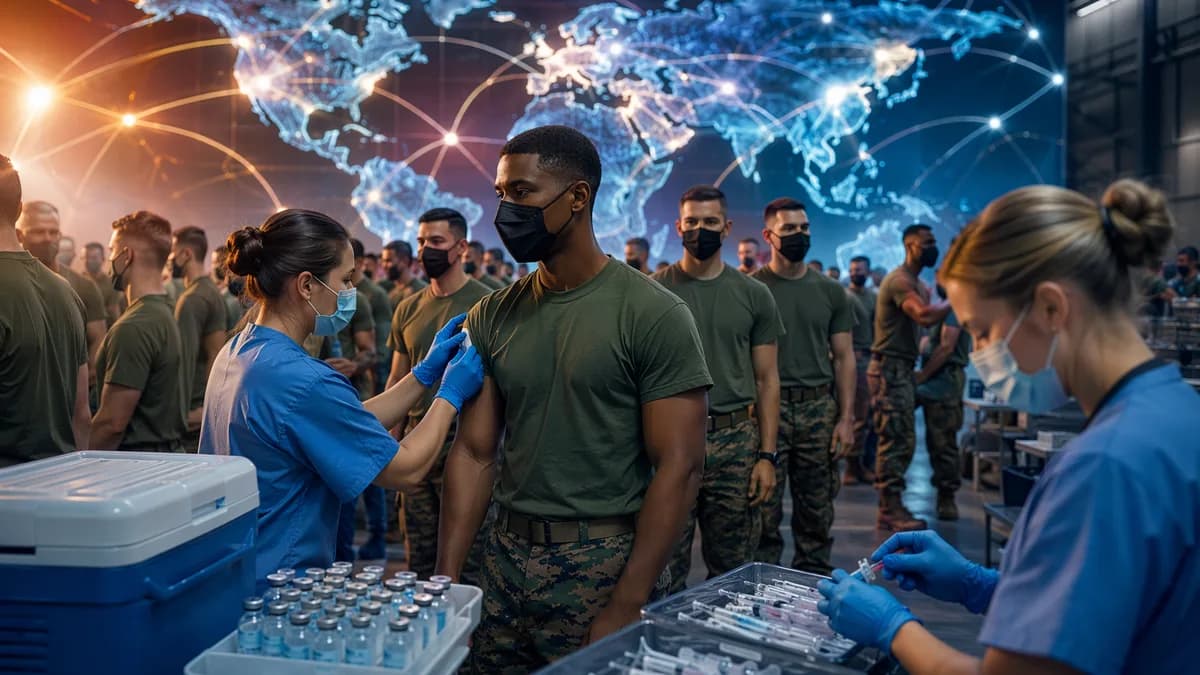
The military flu shots scramble is now a readiness problem, because the doses being used across basic training are set to expire on 30 June while replacement supply is not expected until August or later.
XOOMAR Intelligence
Analyst Take
That squeeze hits new recruits first. The US military is trying to vaccinate them after a two-month halt on mandatory flu shots, according to Guardian World, as a growing outbreak at Lackland Air Force Base in San Antonio has sickened at least 275 people and hospitalized four.
Expiring military flu shots turned routine boot camp processing into a readiness test
The central issue is not only that flu is spreading at Lackland. It’s that the Pentagon’s policy clock and the vaccine supply clock stopped matching.
Defense Secretary Pete Hegseth removed the mandatory flu shot requirement at the end of April. Military services, including the Air Force, Army, and Navy, have since reinstated requirements for new recruits through the exception process Hegseth allowed. But the timing is brutal. Current flu vaccine inventory expires on 30 June, and new doses are not expected until August or later.
Can commanders close that gap with a last-minute push? Only partly.
Basic training is built for discipline, not disease control. Recruits sleep in crowded quarters, train under high stress, move in tight groups, and arrive from different places every week. Lackland is especially exposed because it is the only Air Force basic training site. The base receives about 700 new recruits every week, according to the source material.
That makes this more than a medical story. XOOMAR analysis: the military’s flu-shot reversal shows how quickly health logistics can become an operational constraint when a mandate pause lands near the end of a seasonal vaccine cycle.
“You just can’t change that. The manufacturing timeline is basically etched in stone,” said Toti Sanchez, former deputy chief at the armed forces health surveillance division of the US Defense Health Agency.
Lackland’s Texas outbreak exposes the math behind military vaccine timing
The numbers explain why the Pentagon’s room to maneuver is narrow.
Current flu vaccines being deployed across military basic training camps expire on 30 June. New doses will not arrive until August or later. Sanchez told the Guardian that historically, “the earliest that we’ve been able to vaccinate” has been late August or early September, and that leaders should not count on supply before “maybe the fourth week of August.”
That matters because vaccine stock is typically low at this time of year as manufacturers switch to the next season’s formulation. Unused doses cannot simply be treated as an indefinite reserve.
The question for military planners is simple: what happens after the usable inventory runs out?
The confirmed answer is that officials will need to rely more heavily on non-vaccine controls. The Guardian cited measures such as splitting recruits into smaller groups for eating and showering, stressing handwashing and hand sanitizer, and potentially using masks or respirators where practical. Masks have obvious limits in basic training. Recruits cannot sleep or shower in them, and training in them is difficult.
The outbreak has already forced medical response. USA Today reported that the Air Force confirmed a “localized influenza outbreak among trainees at Basic Military Training,” with symptomatic trainees isolated and treated, including with antiviral medications such as Tamiflu.
What has not been disclosed is just as important. The supplied sources do not confirm delayed graduations, missed accession targets, or training pipeline disruption. XOOMAR analysis: those are plausible operational risks in any recruit outbreak, but the public record here only supports isolation, treatment, monitoring, hospitalization, and an urgent vaccination push.
For readers tracking how security decisions ripple through institutions, XOOMAR’s coverage of the Australia Vanuatu Military Deal Boxes Out China in Pacific offers a separate example of military planning under political pressure.
The mandatory vaccine pause changed the risk environment without proving direct causation
After the mandate was lifted, flu vaccination rates among Lackland trainees dropped to 40%, according to the source material. AP also reported that only 40% of new trainees moving through the boot camp opted to receive the shot once it became optional.
That is a major change inside a dense training environment. But the causation line needs care.
A Pentagon official told AP that permission to mandate vaccinations was unrelated to the outbreak and that exception decisions were being finalized earlier in June. CNN reported that the Air Force submitted its exception request for basic training attendees on May 5, that the request was approved on June 11, and that base officials did not learn until June 18 that shots were mandatory again.
So what can be said fairly?
XOOMAR analysis: the policy pause reduced vaccine uptake among recruits, and lower uptake increased the vulnerability of a setting already known to favor outbreaks. The sources do not prove the pause caused the Lackland outbreak by itself.
Caitlin Rivers, a senior scholar at the Johns Hopkins Center for Health Security and former civilian epidemiologist for the Army, described boot camp as “famous for being conducive to outbreaks” and a “very vulnerable environment” for infectious disease spread.
“But it only takes one case introduced into Basic for an outbreak to begin,” Rivers said.
That is the tactical problem. Even a fast restart of military flu shots does not instantly erase the exposure created by weeks of optional uptake. The sources support the urgency of vaccination, but they also show why commanders now need layered controls until new supply arrives.
Commanders, recruits, doctors, and mandate critics are reading four different crises
For commanders, this is about predictability. Training calendars depend on healthy recruits moving through a standardized process. A flu outbreak introduces uncertainty into the part of the military pipeline that is supposed to be most controlled.
For recruits, the shot may look like another medical processing step. But the stakes are personal. The confirmed record shows symptomatic trainees being isolated and treated, while four people have been hospitalized. One recruit, Keon McDaniel, died earlier this month after a medical emergency. His death remains under investigation, and it is not clear whether it is linked to the flu outbreak.
For public health officials, the answer is not vaccination alone. Rivers said the flu vaccine is “critical to preventing outbreaks and maintaining readiness.” Sanchez compared the training environment to “a petri dish.” Their shared point is blunt: dense recruit settings need prevention before an outbreak gets momentum.
For mandate critics, the episode will feed a broader fight over military medical authority. Hegseth said when ending the mandate that services could request exceptions. AP reported he cited “medical autonomy” and religious freedom. USA Today quoted him saying the military would not force troops because “your body, your faith, your convictions are not negotiable.”
Who gets to define readiness when personal choice collides with group risk? That is now the political argument wrapped around the operational one.
XOOMAR has tracked similar tensions between federal policy and individual exposure in other contexts, including 356,000 TPS Holders Face Deportation After Trump Win. The subject is different, but the pattern is familiar: a central policy shift can create immediate consequences for people inside rigid systems.
The sourced military history starts in 1945, not with loose pandemic analogies
The supplied sources do not support a detailed comparison to the 1918 influenza pandemic, so this analysis should not pretend they do. The relevant documented history here is narrower and still powerful.
Sanchez said the military flu vaccine mandate was first implemented in 1945. When he heard it was being overturned, he thought: “Here we are, 81 years later, and we’re turning back the clock.”
That quote captures the institutional memory behind the mandate. The military has long treated vaccination as a readiness tool, not just a private health decision. Disease can sideline people before they ever reach a deployment, and recruit training is one of the places where that risk concentrates fastest.
The more useful comparison is not to a distant pandemic. It is to the clockwork of military medicine itself.
Policy, supply, and command execution have to move together. In this case, Hegseth’s April decision made flu shots optional while the exception process was still working through the system. CNN reported that the Air Force request took more than a month to clear the bureaucracy. By the time mandatory shots returned at Lackland, the outbreak was already underway.
The weakness exposed here is administrative timing. A health order can be changed immediately. Vaccine manufacturing cannot.
Recruits should expect a stricter flu-control playbook until new doses arrive
Near term, recruits and families should expect a more aggressive containment posture at Lackland and other training bases. The source material supports more isolation of symptomatic trainees, treatment with antivirals, closer monitoring, smaller group management for certain activities, hygiene emphasis, and possible masking where feasible.
The military may also try to use viable doses quickly before expiration. Sanchez said leaders are probably “exercising maximum expediency in vaccinating individuals that had not been vaccinated previously” before the end of June.
The larger watch item is whether the Pentagon changes how it handles seasonal vaccine mandates before the next respiratory season. Evidence that would support that shift includes faster exception decisions, clearer pre-deadline coordination between health officials and service leaders, and earlier planning around vaccine expiration dates.
Evidence that would weaken the thesis would be a rapid containment of the Lackland outbreak without broader training disruption, followed by no visible change in policy timing before the next flu season.
For now, the signal is clear enough: military flu shots are not just a medical checkbox. In basic training, they are part of the machinery that keeps force generation predictable. When that machinery pauses, the virus does not wait for the paperwork.
Impact Analysis
- Expiring flu vaccine supplies could leave new recruits exposed during a high-risk training period.
- The Lackland outbreak shows how quickly disease spread can affect military readiness.
- A policy reversal near the end of the vaccine cycle has created a logistics gap commanders may not be able to fully close.
Lackland Air Force Base Flu Outbreak and Recruit Flow
Primary Sources & Disclosures

Written by
XOOMAR Insights Team
Research and Editorial Desk
The XOOMAR Insights Team pairs automated research with human editorial judgment. We track hundreds of sources across technology, fintech, trading, SaaS, and cybersecurity, cross-check the facts, and explain what happened, why it matters, and what to watch next. We do not just rewrite headlines. Every article is fact-checked and scored for reliability before it goes live, and we link back to the original sources so you can verify anything yourself.