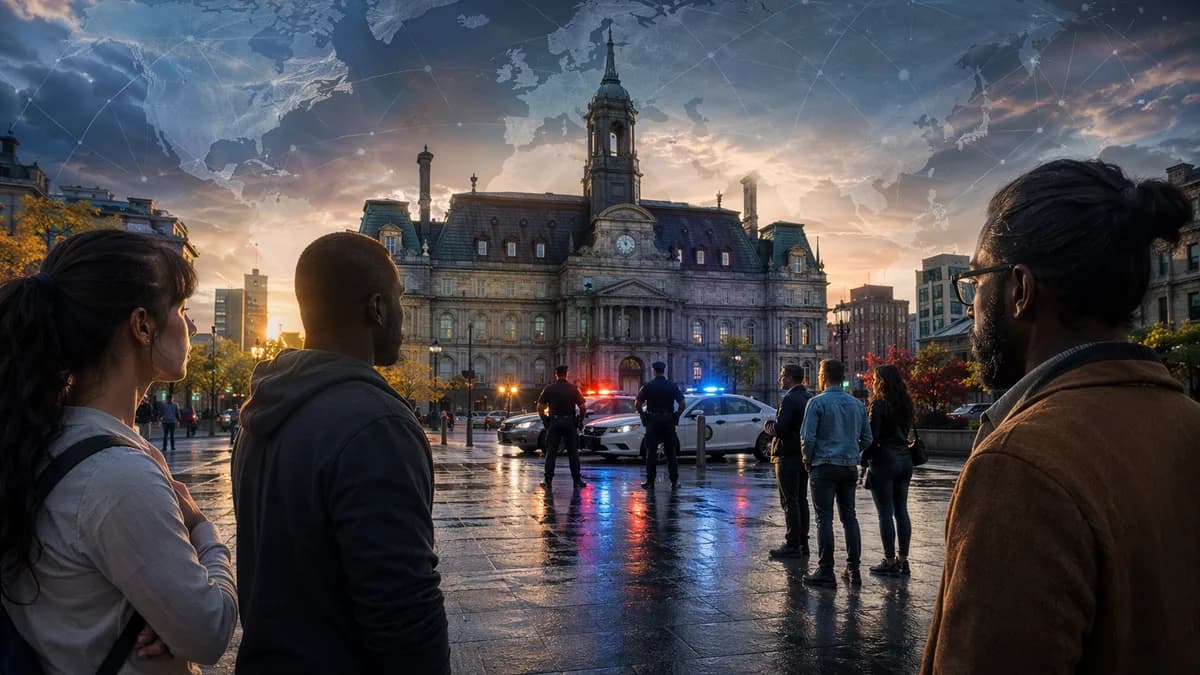
Sixteen Montreal police officers are under investigation for alleged racist conduct, and Mayor Soraya Martinez Ferrada is now calling for an end to Montreal random police checks while the force tries to contain a credibility crisis, according to Guardian World.
XOOMAR Intelligence
Analyst Take
The mayor’s demand lands because it isn’t abstract. Martinez Ferrada told reporters that her husband, who is Black, has been stopped by police while driving at least five times within the last year for “no reason at all.” That turns a policy dispute into a blunt political test: can Montreal say it is confronting racial profiling while preserving a practice residents say makes them feel targeted before any wrongdoing is established?
“Like many other Black people in our city and the racialized people this happens too many times,” Martinez Ferrada said.
Montreal random police checks have become a city hall legitimacy crisis
The mayor is asking for a moratorium on random checks as a “first step” toward repairing trust. That phrase matters. It signals she knows the problem is deeper than one unit, one station, or one ugly investigation.
The immediate trigger is the probe into officers accused of disproportionately targeting Black and Arab residents. The political force behind it is broader: the mayor has put her own family’s experience inside the public record. That makes it harder for officials to treat the issue as a technical policing matter.
XOOMAR analysis: Montreal’s central problem is legitimacy. If a driver believes a stop is based on identity rather than conduct, the damage doesn’t end when the officer leaves. It changes how that person sees the police, city hall, and the rules that are supposed to protect them.
Sixteen officers, Station 39, and allegations the SPVM can’t minimize
The known facts are stark. Sixteen officers from Station 39 in Montréal-Nord are under investigation. Two officers have been suspended, while others have been reassigned or relocated as the investigation proceeds. Two cases have been submitted to Quebec’s director of criminal and penal prosecutions to determine whether criminal charges should be laid.
The allegations include officers cutting pieces of dreadlocks from people during police stops. Officers are also accused of issuing tickets solely on the basis of ethnic background. Police Chief Fady Dagher said he was “extremely surprised” and described the officers as “tarnishing our uniform.”
CBC reported that the internal investigation began a little more than two months before its June 13 coverage, following information obtained by fellow officers. That detail cuts both ways. It suggests internal reporting mechanisms worked in this case, but it also raises the harder question of how long affected residents felt unheard before officers escalated the matter.
The missing data will decide whether this is treated as misconduct or a pattern
Internal investigations can establish individual misconduct. They rarely answer the larger question by themselves: how often did the practice happen, who was stopped, where, by whom, at what time, and with what result?
For Montreal random police checks, the data that would matter most is straightforward:
- Race and identity data: who was stopped, and whether Black, Arab, Indigenous, or other racialized residents were overrepresented.
- Geography: whether stops clustered around Montréal-Nord or particular patrol zones.
- Officer-level patterns: whether a small group drove the disparities or whether the pattern spread wider.
- Outcomes: whether stops led to tickets, arrests, warnings, or no action.
- Repeat encounters: whether the same residents were stopped multiple times.
The Guardian source cites a 2024 Quebec class-action ruling in which a judge awarded damages to residents who were racially profiled and arrested without justification by Montreal police. The judge also awarded compensation for “physically racialized people” whose rights were violated by police but whose evidence wasn’t recorded. In that ruling, the judge found racialized groups were overrepresented in police stops and that “the plausible explanation for this disparity is the racial profiling that characterizes many arrests.”
That history makes Premier Christine Fréchette’s framing politically charged. She called the alleged behavior “unacceptable,” but rejected the idea that it reflected systemic racism, saying: “If it’s a small group, it’s not necessarily systemic. For me, systemic means on a larger scale.”
Martinez Ferrada has taken a different line. CBC reported that she acknowledged systemic racism and said, “The only way to get through this is to openly acknowledge that it exists so we can implement measures to correct it.”
Random checks now sit at the fault line between discretion and profiling
The supplied reporting does not spell out the operational rules governing random checks in Montreal. That gap is part of the problem. When residents hear “random” but experience repeated stops, the word loses credibility.
The mayor’s husband being stopped at least five times in a year gives the debate its human scale. A police stop may last minutes. The memory lasts longer, especially if the person stopped believes race shaped the encounter.
Civil-rights voices are already treating the allegations as a break-glass moment. Fo Niemi, executive director of the Center for Research-Action on Race Relations, told CBC he had “never seen anything like this” and said his office had received many complaints from residents near Station 39 involving issues such as excessive force, unjustified tickets, and arrests.
XOOMAR analysis: If city hall keeps random checks while calling the allegations unacceptable, it risks splitting its message. Condemning profiling while leaving broad discretionary practices intact will not persuade residents who say those practices are where profiling happens.
Body cameras are a tool, but not the repair
Martinez Ferrada has also backed faster deployment of body-worn cameras. The Canadian Press reported that her January budget included $40 million to buy and deploy the cameras for officers between 2026 and 2034, though no concrete rollout timeline had been set.
The mayor called body cameras crucial, but she also put a limit on the promise.
“This will not solve the problem. This is one tool that we have in our toolbox, but it will not solve the whole thing.”
That’s the right caution. Cameras can document encounters. They don’t decide which encounters happen in the first place.
The police union, Fraternité des policiers et policières de Montréal, said any form of racism on the force is intolerable, while stressing the presumption of innocence and saying virtually all of Montreal’s 4,600 police officers act properly. That argument will matter in the coming fight, because reforms will run through operational rules, discipline, budgets, and workplace constraints.
For readers following XOOMAR’s broader coverage of institutional accountability, the same pressure point appears in very different settings, from political leadership questions in Burnham May Force Keir Starmer Resignation Clock to Start to legacy scrutiny in Alan Greenspan’s Fed Legacy Faces Trial After Death at 100: public trust turns on whether leaders impose consequences, not whether they express concern.
Montréal-Nord’s history makes official reassurance harder to sell
The current investigation is not the first major controversy tied to Station 39. The Canadian Press reported that in 2008, Fredy Villanueva, an unarmed 18-year-old, was shot to death by a police officer in a north-end park. A public inquiry later found in 2013 that the shooting was legally justified on self-defence grounds but unnecessary.
That history does not prove the present allegations. It does explain why reassurance alone will struggle in Montréal-Nord.
Local residents quoted in the supplied reporting did not sound shocked. One resident, Ricky Peter, said, “I grew up on the streets, I grew up in Montréal-Nord. So I’ve seen worse than that.” But he drew a sharp line at the alleged hair-cutting: “But to go and cut someone else's hair, a regular citizen. Why?”
The next test is whether outrage becomes enforceable policy
The immediate path is clear. The SPVM investigation will face demands for public findings, named accountability where misconduct is proven, and a clear policy on Montreal random police checks.
A vague pause will not carry much weight. A serious response would need rules that residents can understand, supervisors can enforce, and outside bodies can review. Body cameras may help document future stops, but the deeper question is whether the city narrows the conditions under which stops occur.
The evidence that would confirm the mayor’s position is simple: public stop data, transparent investigation results, disciplinary outcomes if allegations are substantiated, and a binding policy that reduces discretionary encounters residents experience as racial profiling.
The evidence that would weaken it would be equally plain: an investigation sealed from public view, a temporary moratorium with no enforcement mechanism, or a return to random checks after the headlines fade. Montreal’s choice is no longer whether racial profiling exists as a concern. The live question is whether city hall is willing to remove the practices that let it persist.
Impact Analysis
- The case puts Montreal’s policing practices under direct political pressure amid racial profiling allegations.
- The mayor’s personal account makes the debate harder to dismiss as an isolated operational issue.
- Public trust in the SPVM could erode further if residents believe stops are based on race rather than conduct.
Random police checks vs. proposed moratorium
| Issue | Random police checks continue | Mayor's proposed moratorium |
|---|---|---|
| Public trust | Residents may continue to see stops as identity-based rather than conduct-based. | Frames a pause as a first step toward repairing trust. |
| Policy context | Practice remains under scrutiny during a racial profiling investigation. | Would suspend the practice while the SPVM faces credibility questions. |
| Political pressure | SPVM is dealing with allegations involving officers from Station 39. | Mayor cites her Black husband being stopped at least five times in the past year. |
Key figures in Montreal police profiling controversy
Primary Sources & Disclosures
- [1]Guardian World
- [2]Montreal mayor urges calm, vows people will learn the truth after police unit suspected of racist behaviour | CBC News
- [3]Montreal mayor calls police racism allegations ‘extremely disturbing,’ urges calm
- [4]Montreal mayor calls police racism allegations ‘extremely disturbing,’ urges calm

Written by
XOOMAR Insights Team
Research and Editorial Desk
The XOOMAR Insights Team pairs automated research with human editorial judgment. We track hundreds of sources across technology, fintech, trading, SaaS, and cybersecurity, cross-check the facts, and explain what happened, why it matters, and what to watch next. We do not just rewrite headlines. Every article is fact-checked and scored for reliability before it goes live, and we link back to the original sources so you can verify anything yourself.