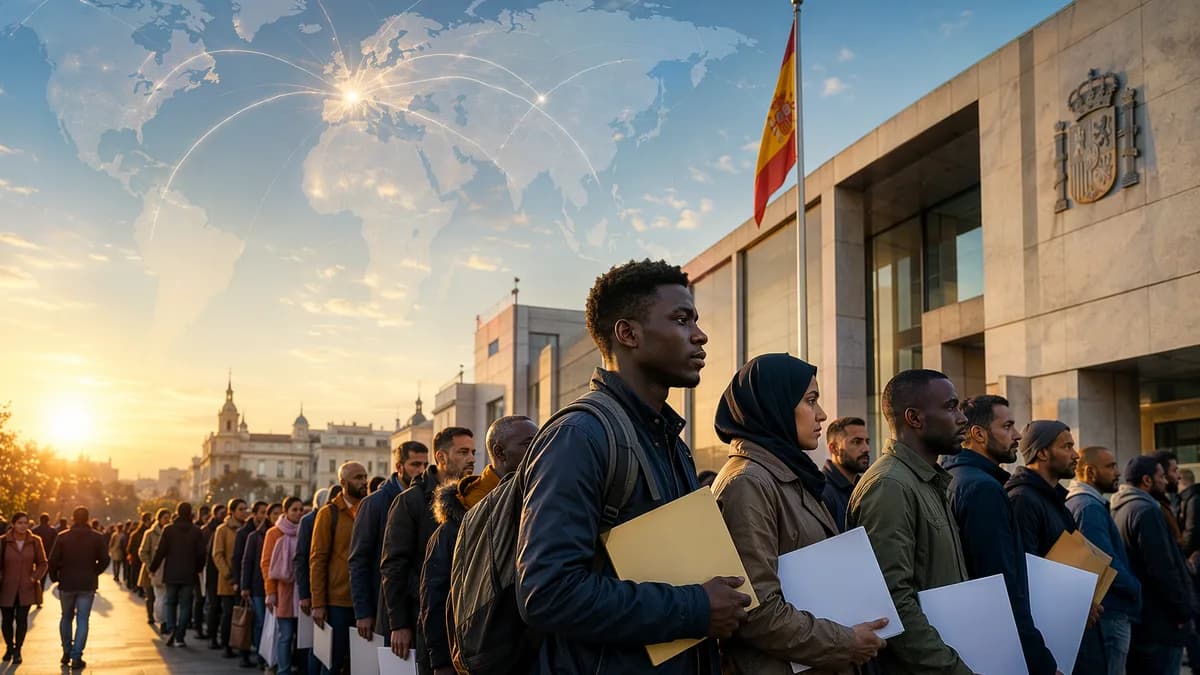
Spain expected 500,000 applicants for its new regularisation scheme. It got more than 1 million, exposing a migration reality that was already inside the country, not waiting at the border.
XOOMAR Intelligence
Analyst Take
The Spain regularisation scheme offers undocumented migrants and asylum seekers an initial one-year residence and work permit if they meet conditions on residence, asylum status, and criminal record, according to Guardian World. The political wager is blunt: Prime Minister Pedro Sánchez is betting that managed inclusion will serve Spain better than deterrence-first politics now dominating much of Europe.
Spain just forced Europe to confront the workers already inside its economy
The headline number matters because it breaks the original policy assumption. The socialist-led government announced the initiative in January and expected it to benefit about 500,000 people. By the time registration closed on Tuesday, more than twice that number had applied.
That does not automatically prove every applicant will qualify. It does prove the pool of people seeking legal status is far larger than the government first projected.
The scheme applies to applicants who can prove they have no criminal record and had lived in Spain for at least five months, or had sought international protection, before 31 December 2025. Other reports said applicants must show they spent at least five consecutive months in Spain before 1 January, and that authorities have three months to process paperwork.
“The fact that more than 1 million people submitted applications shows just how necessary this recognition of rights and responsibilities was,” Sánchez said in Madrid.
XOOMAR analysis: the scale of demand turns the Spain regularisation scheme into more than a migration measure. It is a test of whether a state can pull a large irregular population into formal legal status without triggering an administrative and political backlash.
The million-applicant figure blew past Spain’s original estimate
The immediate pressure point is execution. A programme built around 500,000 expected beneficiaries now has to deal with more than 1 million applications.
That gap creates four practical tests:
- Processing: Authorities must check residence history, asylum status, and criminal records.
- Credibility: Delays could weaken trust in the programme.
- Legal risk: Opposition challenges could slow or reshape the decree.
- Local burden: Documentation, appointments, and support services will land unevenly across regions.
Politico reported that over 900,000 people had applied by mid-June, and that about 360,000 had already been granted provisional work and residence permits, citing Spanish officials. RTE also reported that around 360,000 applications had been deemed “admissible,” according to government sources.
The before-and-after is stark:
| Measure | Government expectation | Reported outcome |
|---|---|---|
| Expected beneficiaries | About 500,000 | More than 1 million applications |
| Permit offered | One-year residence and work permit | Same, subject to approval |
| Processing status cited by officials | Not applicable at launch | Around 360,000 deemed admissible or granted provisional permits |
The policy’s success will not be judged by the application total alone. It will be judged by whether permits become real access to lawful work, enforceable contracts, and administrative certainty.
Sánchez is making the business case for immigration, not just the rights case
Sánchez’s argument is unusually direct for a European leader under pressure on migration. He says Spain needs immigration to grow, to manage its demographic crunch, and to finance the welfare state.
His most concrete claim was economic:
“Without immigration, Spain’s GDP would be 19% lower in 2050,” he said.
He then translated that into daily life: 90,000 bars would close, 50,000 primary and secondary classrooms would lack students, and around 220,000 farms would disappear.
Those examples are political messaging, but they also show the structure of Sánchez’s case. Immigration is not being presented as charity. It is being framed as a condition for keeping businesses open, schools viable, and rural production alive.
That is why the Spain regularisation scheme sits apart from much of the European debate. While other governments focus on returns, border procedures, and offshore processing ideas, Madrid is arguing that invisibility is the problem.
A Moroccan jobseeker in Cantabria told AFP, cited by RTE and Yahoo, that he hopes “to be able to work legally, to pay contributions.” That line captures the government’s preferred logic: legal status should move people from vulnerability into formal participation. Whether that happens at scale depends on approvals, employers, inspections, and follow-through.
The opposition sees an amnesty, Sánchez sees recognition
Spain has used extraordinary regularisation programmes before under both socialist and conservative governments, according to the Guardian. That history matters because it undercuts the idea that this tool belongs only to one political camp.
Still, the latest version has triggered fierce resistance. The People’s party, or PP, has suggested the move will overwhelm public services. Vox has claimed Sánchez is trying to bring about “the demographic, social, labour and electoral transformation of Spain.”
The PP regional governments of Valencia and Aragón have lodged appeals. On Tuesday, the court said it was considering asking the European court of justice whether parts of the Spanish decree could conflict with EU law.
The fight also overlaps with citizenship policy. PP leader Alberto Núñez Feijóo attacked a democratic memory law introduced four years ago that offered Spanish citizenship to descendants of Spaniards forced into exile during the civil war and Franco dictatorship. More than 2.4 million people applied under that law, and more than 544,000 have been approved.
Feijóo called it “electoral engineering.”
“Seeing as the current voters aren’t working out, let’s see if manufacturing [new] voters pans out,” he told Es Radio.
The government fired back. Elma Saiz, Spain’s minister for inclusion, social security and migration, called the accusations “incredibly irresponsible” and said they showed “the desperation and frustration of someone who has no political project for our country.”
Brussels is tightening while Madrid opens a legal door
The European contrast is sharp. Politico reported that the EU finalized a migration overhaul this month aimed at faster returns, stricter border procedures, and “return hubs” outside the bloc for rejected asylum seekers. Spain opposed those policies in a letter to member-state representatives, citing “the serious legal, foreign relations and operational doubts raised by the return centers, and the lack of proportionality of certain measures.”
That makes Madrid’s position more than domestic politics. Spain is testing a rival migration model inside the EU debate.
For readers tracking how migration policy is turning into a legal and administrative stress test in other countries, XOOMAR has covered related fights over UK asylum reform costs and Labour’s internal battle and U.S. Supreme Court immigration rulings affecting TPS protections. Spain’s case points in the opposite direction: instead of narrowing status, it is offering a path into it.
Sánchez also announced a €500m (£431m) “integration and citizenship” plan. Yahoo, citing AFP, described the package as 505 million euros ($575 million) for integration and ordered migration, including professional training and language learning.
His framing paired rights with obligations:
“Spanish society must guarantee equal treatment, combat discrimination, and offer opportunities,” he said. “And those who arrive must respect our laws, learn our official languages, and share the democratic values that define us.”
Spain’s migration gamble now depends on paperwork, courts, and proof
The next phase is less dramatic than the application surge, but more important. Spain has to process files, withstand legal challenges, and show that legal status translates into lawful work rather than just another layer of bureaucracy.
If approvals move efficiently and the government can show that regularised workers are entering formal employment under clear rules, Sánchez will have evidence for his argument that migration can support growth and demographic stability. If backlogs spread, courts intervene, or local services visibly strain, the PP and Vox will use the programme as proof that the government overreached.
The evidence to watch is concrete: approval rates, processing delays, court rulings, regional service pressures, and whether the promised integration funding reaches the places handling the heaviest demand.
Europe’s migration fight will not be settled by border policy alone. Spain has made the harder question unavoidable: ageing economies still need workers, even when their politics wants those workers kept out of sight.
Impact Analysis
- The number of applications shows Spain’s undocumented population was far larger than the government expected.
- The scheme tests whether legal inclusion can work better than deterrence-focused migration policy.
- Processing more than 1 million applications will put major pressure on Spain’s immigration administration.
Spain Regularisation Scheme: Expected vs Actual Demand
| Metric | Government Expectation | Actual Outcome |
|---|---|---|
| Applicants | 500,000 | More than 1 million |
| Policy implication | Targeted regularisation for a smaller group | A much larger undocumented population seeking legal status |
Applications to Spain's Regularisation Scheme
Primary Sources & Disclosures

Written by
XOOMAR Insights Team
Research and Editorial Desk
The XOOMAR Insights Team pairs automated research with human editorial judgment. We track hundreds of sources across technology, fintech, trading, SaaS, and cybersecurity, cross-check the facts, and explain what happened, why it matters, and what to watch next. We do not just rewrite headlines. Every article is fact-checked and scored for reliability before it goes live, and we link back to the original sources so you can verify anything yourself.