
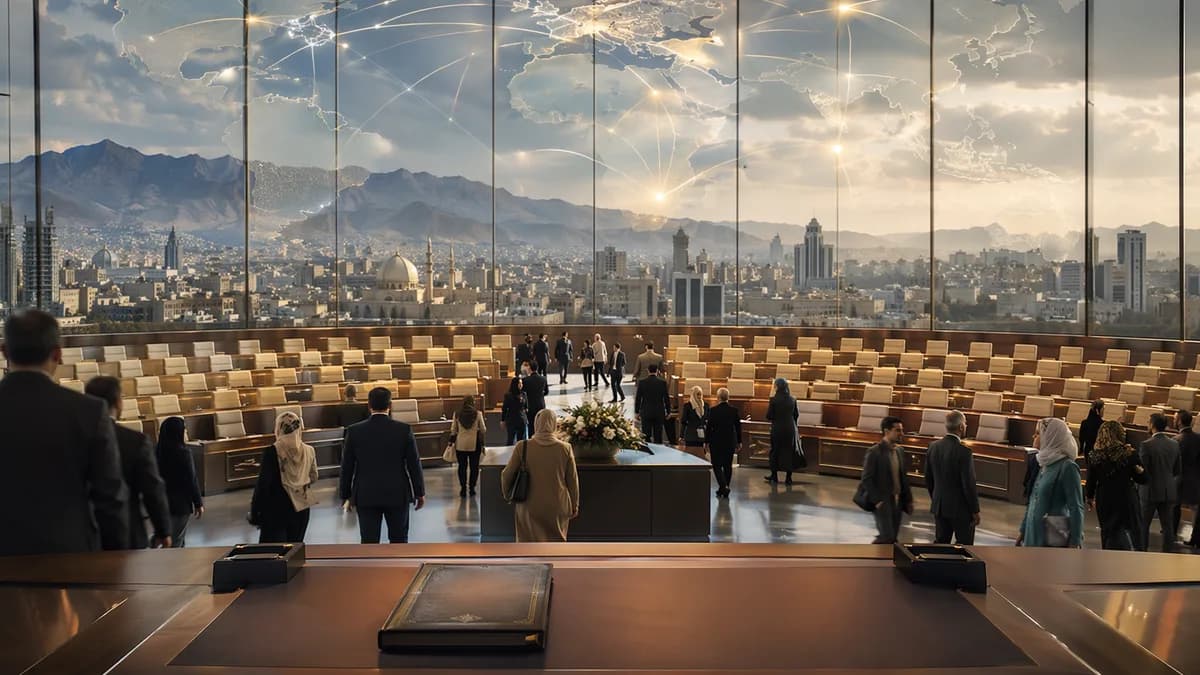
Fifteen women were appointed to Syria's new parliament by interim President Ahmed al-Sharaa, a late correction to a selection process that had previously produced only six female lawmakers through regional electoral colleges.
Global TrendsJuly 2, 2026· 7 min read· By XOOMAR Insights Team
Sharaa's 70 Picks Tighten Grip on Syria's Parliament
Updated on July 2, 2026
XOOMAR Intelligence
Analyst Take
58/ 100
4 sources analyzedLow confidenceTrend10Freshness96Source Trust92Factual Grounding90Signal Cluster20
That single number captures the promise and the problem of the new 210-seat People's Assembly. The appointments broaden the chamber on paper, but they also show how much Syria's transition still depends on presidential discretion, according to BBC World.
Syria's appointed 70 lawmakers test post-Assad renewal
Sharaa has named the final 70 lawmakers to Syria's new post-Assad parliament, clearing the way for its first session next week. The chamber will handle legislation during the transitional period after Bashar al-Assad was overthrown in 2024.
This is not routine parliamentary housekeeping. It is an early test of whether Syria's post-Assad political order can build institutions fast without making them look managed from the top.
The president's appointments do two things at once. They address visible gaps left by the earlier selection process, especially on women's representation. They also concentrate enormous agenda-setting power in the presidency, because one-third of the legislature entered through direct appointment.
Mohammed Taha al-Ahmed, chairman of the Higher Committee for the Syrian People's Assembly Elections, said Sharaa's choices represented different parts of Syrian society and reinforced national unity.
The president's selections combined "the voice of sacrifice and the voice of experience" within the People's Assembly.
XOOMAR analysis: That phrase is doing political work. It frames the chamber as both revolutionary and technocratic. The harder question is whether it will behave like an independent legislature once executive decisions need scrutiny.
The gender numbers expose how narrow Syria's new parliament still is
The gender data is the clearest measurable shift in the announcement.
| Stage | Seats or lawmakers | Women identified in source material |
|---|---|---|
| Regional electoral college process, initial October phase | Part of the 140 selected seats | Six women won seats, according to BBC World |
| Presidential appointments | 70 lawmakers | 15 women |
| Final legislature total cited by AP and Al Jazeera | 210 seats | 22 women |
The apparent difference between the BBC's initial six and the final 22 reflects the staged nature of the process. The selection did not end in October. Votes were delayed in parts of Raqqa and Hassakeh and later held in May after government forces captured areas from the Kurdish-led Syrian Democratic Forces militia alliance.
The appointments look partly designed to compensate for underrepresentation. Electoral officials had already said Sharaa would use his one-third appointment power to address the imbalance after only six women and 10 minority candidates emerged from the earlier selection stage.
Still, numbers are not influence. The next test is whether women lawmakers receive committee authority, sponsor major legislation, and speak publicly on contentious issues. If they remain visible only as a representation statistic, the correction will be shallow.
Electoral colleges plus presidential picks create a built-in legitimacy problem
Syria's new parliament is a hybrid body. Regional electoral colleges selected most members, while Sharaa directly appointed the final third.
That model can be defended in a fractured country where some areas have faced insecurity, delayed votes, or disputed control. Suweida, a predominantly Druze southern province, has not held electoral college polls because it remains outside state control after 1,700 people were killed in sectarian fighting last July between government forces, Sunni Bedouin tribes, and Druze militias.
Ahmed said two of the appointees came from Suweida, and that elections there would be held later.
"When conditions become suitable to hold elections in this good and blessed governorate, God willing, we will conduct the elections there," Ahmed said.
XOOMAR analysis: Temporary shortcuts may be unavoidable in a transition. They become dangerous when they harden into the operating system. A parliament that is meant to embody a break from the Assad era cannot rely indefinitely on indirect selection and presidential correction.
Civil society groups already flagged that risk. Fourteen Syrian civil society organizations criticized the electoral system last year as "plagued by deep structural flaws", arguing that presidential influence over the Higher Committee and electoral colleges made the elections symbolic.
For readers tracking institutions under pressure elsewhere, XOOMAR has also covered governance strain in Iraq Corruption Arrests Breach Baghdad's Green Zone and migration-policy pressure in 55% Still Stay After Article 8 Asylum Reforms Clamp Down. Those are separate stories, but they sit in the same file: institutions are judged by what they can enforce, not by what they announce.
Post-Assad credibility depends on behavior, not branding
The source material describes Syria as emerging from decades of autocratic rule under the Assad family and more than 13 years of civil war. That legacy gives the new People's Assembly a narrow path.
It has to pass laws. It also has to prove that it can review executive actions, host real debate, and make room for constituencies that do not already trust Damascus.
UN deputy special envoy Claudio Cordone told the Security Council that Syria's transition was "at a critical phase, with opportunity and fragility existing side-by-side." He also said the scale of the parliament's task "cannot be overstated."
The chamber's credibility will not come from the word "new." It will come from whether lawmakers challenge ministers, debate sensitive files, and give minorities and women more than ceremonial presence.
Kurds, Druze communities, civil society groups, and former detainees will read this differently
The appointments include 13 people who were imprisoned during Assad's rule. Ahmed also said appointees included "relatives of martyrs and survivors of detention and chemical attacks", along with academics, experts, professionals, community leaders, and national figures.
That mix signals an attempt to combine victimhood, expertise, and local legitimacy. It may resonate with families harmed by the war and with communities seeking recognition after Assad's fall.
But not every constituency is likely to read the process the same way.
More than 20 Kurdish parties rejected lawmakers selected by electoral colleges in May, saying the process showed "an approach of exclusion and marginalisation." That matters because votes in parts of Raqqa and Hassakeh were delayed by seven months, then held after government forces captured areas from the SDF at the start of this year.
Suweida is another unresolved pressure point. Cordone said there had been no progress on the roadmap for confidence-building and reintegration there. He also warned that unresolved accountability issues and calls within Suweida for secession threatened Syria's unity and territorial integrity.
The first session will matter more than the appointment list
The new legislature is expected to begin work next week. Al Jazeera and the Associated Press reported that the chamber will have a 30-month term and work on a new elections law ahead of future voting.
That is the practical hinge. If Syria's new parliament uses that term to clarify election rules, review executive action, and give real visibility to women, minorities, and war-affected communities, the appointment list may look like a bridge. If it stays quiet, the appointments will look like consolidation.
The source material does not establish whether this parliament will shift sanctions, reconstruction financing, or foreign engagement. Those claims would be premature. What it does show is that international officials are already treating representation and legislative independence as central tests of the transition.
XOOMAR analysis: Sharaa's 70 appointments give Syria's new system a broader face. They do not yet give it durable legitimacy. That will require competitive politics, a credible path to wider elections, and early proof that the People's Assembly can do more than ratify decisions made elsewhere.
Impact Analysis
- The appointments complete Syria's 210-seat transitional parliament after Assad's overthrow in 2024.
- Adding 15 women improves representation but highlights how limited the earlier selection process was.
- With one-third of lawmakers directly appointed, the new parliament's independence from the presidency will be closely watched.
Routes into Syria's new People's Assembly
| Selection route | Lawmakers | Representation detail |
|---|---|---|
| Regional electoral colleges | 140 | Produced 6 female lawmakers |
| Presidential appointments | 70 | Included 15 women appointed by Ahmed al-Sharaa |
Female lawmakers by selection route
Regional electoral colleges
lawmakers6
Presidential appointments
lawmakers15
Sources

Written by
XOOMAR Insights Team
Research and Editorial Desk
The XOOMAR Insights Team pairs automated research with human editorial judgment. We track hundreds of sources across technology, fintech, trading, SaaS, and cybersecurity, cross-check the facts, and explain what happened, why it matters, and what to watch next. We do not just rewrite headlines. Every article is fact-checked and scored for reliability before it goes live, and we link back to the original sources so you can verify anything yourself.
Explore More Topics
Related Articles
 Global Trends
356,000 TPS Holders Face Deportation After Trump Win
The Supreme Court let Trump end TPS for Haitians and Syrians, putting 356,000-plus legal residents at risk of removal.
Jun 27, 20268 min
 Global Trends
Supreme Court Immigration Rulings Let Trump Strip TPS
The court's conservative bloc gave Trump officials new power over TPS and asylum, triggering fury from immigrant rights groups.
Jun 26, 20269 min
 Global Trends
Israel Strikes Lebanon as Hezbollah Rages at Peace Deal
A Washington peace framework is already under fire after Israeli strikes killed one in southern Lebanon and Hezbollah called the deal surrender.
Jun 27, 20266 min
 Global Trends
Cargo Ship Attack Triggers US Strikes on Iran Sites
US strikes hit Iranian missile, drone and radar sites after a cargo ship attack near Hormuz raised shipping and energy risks.
Jun 26, 20266 min
 Technology
Proton Lumo 2.0 Locks Your Prompts Away From AI Training
Proton Lumo 2.0 sells privacy as its ChatGPT fight, promising prompts won't become training data.
Jul 2, 20268 min
 Global Trends
SSPX Ordinations Defy Pope Leo as Schism Threat Grows
SSPX ordained four bishops despite Pope Leo XIV's warning, turning Écône into a public test of Rome's authority.
Jul 2, 20267 min
 Technology
A Decade Late, Boeing Starliner Leaves NASA with SpaceX
Starliner may not be certified until 2027, forcing NASA to lean on SpaceX for most of the ISS's remaining life.
Jul 2, 20268 min
 Technology
43% Off SweetNight CoolNest Mattress Takes On Heat
SweetNight’s CoolNest queen is $399.99, and early testing says its cooling claim may have bite. A rare budget mattress deal worth watching.
Jul 2, 20267 min
 Fintech
Robinhood Chain Grabs the Rails for Tokenized Stocks
Robinhood Chain pushes the broker into crypto infrastructure, bringing stock tokens, DeFi collateral, and USDG yield into its wallet.
Jul 2, 20268 min
 Technology
$183B AI Bet Turns Meta Cloud Into Direct AWS Fight
Meta may sell AI compute to outsiders, turning its $183B infrastructure splurge into a cloud fight with AWS, Google and Azure.
Jul 2, 20268 min
Don't miss the signal
Get our weekly roundup of the stories that matter across tech, fintech, and trading. No noise, just signal.
Free forever. No spam. Unsubscribe anytime.