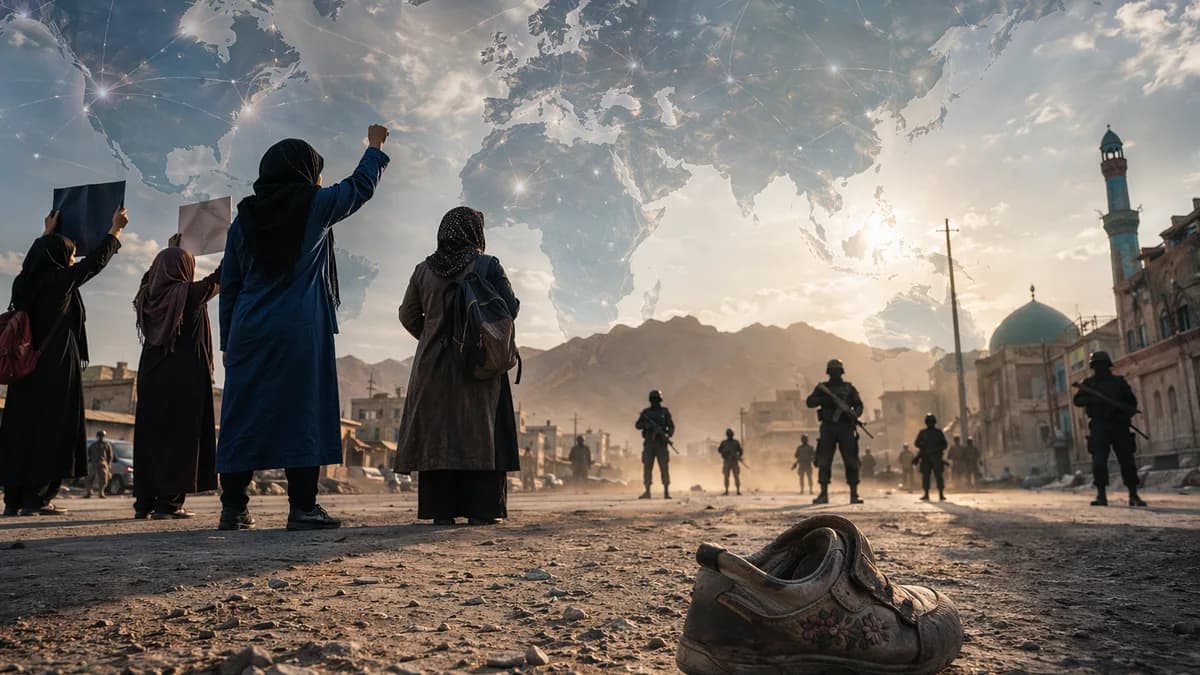
One boy is confirmed dead after a protest of about 100 to 150 people in Herat challenged the Taliban’s arrests of women accused of violating dress code rules, turning a local enforcement action into a stark test of Taliban authority.
XOOMAR Intelligence
Analyst Take
The United Nations mission in Afghanistan, UNAMA, said the violent crackdown happened after weekend arrests in the western city of Herat, according to ABC International. XOOMAR analysis: the incident matters because it shows how quickly the Taliban’s policing of women’s public presence can spill into broader civic confrontation, even in a country where protests are rare and government dissent is illegal.
One confirmed death turns Herat’s hijab arrests into a test of Taliban control
UNAMA said Wednesday that it had “confirmed that at least one person, a boy, was killed by gunfire, while several others suffered injuries including from being beaten with sticks.” The mission said it was also verifying reports of a second fatality.
Eyewitnesses said Taliban police opened fire during Tuesday’s protest. The gathering was aimed at arrests of women over the weekend for allegedly violating dress code regulations. That sequence matters. The immediate trigger was not a national political campaign or a formal opposition movement. It was enforcement of rules governing how women appear in public.
That makes the Taliban response revealing. Herat police did not frame the gathering as a grievance over arrests. They framed it as a public order threat. Sayed Masoud Hosseini, spokesperson for the Herat police command, said police take a “serious, Shariah, and principled approach to any action that disrupts public security.”
“Individuals have the right to express dissent peacefully without fear of violence, intimidation or reprisals,” UNAMA said.
XOOMAR analysis: the Taliban’s core governing claim rests on enforcing its interpretation of Shariah through state power. A protest over women’s arrests challenges that claim at street level. It asks whether citizens can publicly contest morality policing. The reported answer in Herat was force.
At least 30 women arrested, one death confirmed, and a second fatality still unverified
The reported numbers are limited but sharp.
| Issue | UNAMA account | Taliban-linked official account |
|---|---|---|
| Protest size | Eyewitnesses described about 100 to 150 people | Herat police said “a number of rioters” gathered |
| Fatalities | At least one person, a boy, killed by gunfire | No confirmed casualty figure cited in the supplied police statement |
| Injuries | Several injured, including from being beaten with sticks | Police said security forces brought the situation under control |
| Women arrested | At least 30 women arrested Saturday and Sunday, then released on 8 June | Vice and virtue ministry said arrest reports were “all rumors” |
UNAMA said at least 30 women were arrested in Herat on Saturday and Sunday. It said dozens more women reportedly received verbal warnings, and that the women were released on 8 June.
The Taliban’s vice and virtue ministry denied the reports on Monday.
“The issues being spread about women being arrested in Herat are all rumors,” the ministry said, adding that wearing the “hijab is a divine command, a law that we are obliged to implement.”
The gap between those accounts is the story’s pressure point. UNAMA says arrests happened. The ministry says they did not. UNAMA says one boy was killed by gunfire. It is still checking whether another person died.
XOOMAR analysis: in Afghanistan, even the basic act of establishing a death toll becomes politically charged when the alleged cause is enforcement by Taliban police. The uncertainty does not dilute the confirmed fact. It sharpens the stakes around who gets to count harm, define disorder, and decide whether a protest is lawful dissent or a security threat.
Women’s dress rules sit at the center of the Taliban’s governing project
Since returning to power in 2021 after the withdrawal of U.S.-led forces, the Taliban has imposed rules under a strict interpretation of Islamic law. The source material points to several restrictions on women and girls, including bans on education beyond primary school and rules on what women can wear in public.
The dress code requires women to appear in public wearing full hijab, including a headscarf, a long robe covering the entire body, and a face covering that leaves only the eyes visible. Enforcement falls to the Ministry for the Propagation of Virtue and the Prevention of Vice.
That ministry’s role is central. It is not a side agency issuing symbolic guidance. In this case, the reported arrests were tied to alleged dress code violations, and the ministry publicly defended the hijab rule as a divine command and legal obligation.
XOOMAR analysis: when a government ties its legitimacy to visible compliance, women’s clothing becomes a public loyalty test. That helps explain why a protest over arrests could draw a hard response. The issue is not only whether specific women violated rules. It is whether ordinary people can collectively object to the state’s right to police those rules.
This is also where a distant but useful governance parallel appears. XOOMAR has written about why rule-by-discretion creates instability in another arena, in Hill Says Crypto Bill Needs Law, Not Regulator Mercy. The Afghanistan case is far more severe and concerns basic rights, not market supervision, but the institutional lesson is similar: when enforcement depends on official discretion and dissent has no safe channel, conflict moves from process to power.
UNAMA, Herat police, and the vice ministry are describing different realities
UNAMA’s language focuses on rights, arbitrary detention, and the dangers women face even after release. Georgette Gagnon, the U.N.’s Deputy Special Representative of the Secretary-General and officer in charge of UNAMA, said detention of women in Afghanistan “carries enormous stigma, which can put women at risk of further violence and isolation in their families and communities even after they are released.”
That point matters because release does not erase harm. UNAMA said the impact of arbitrary arrests and detentions on women and their families is “profound.” In a society where detention itself can damage a woman’s standing at home and in the community, a short arrest can have consequences far beyond the police station.
Herat police described the protest in very different terms. Hosseini said “a number of rioters” gathered “under the pretext of protesting issues related to the observance of the hijab and opposition to the Islamic hijab, and acted to disrupt public order.” He said security forces’ presence “brought the situation under control in the shortest possible time.”
The contrast is stark:
- UNAMA: peaceful dissent must be protected, and law enforcement must meet international legal standards.
- Herat police: the gathering disrupted public security and order.
- Vice and virtue ministry: reports of women’s arrests were rumors, while hijab enforcement is mandatory.
XOOMAR analysis: each side is fighting over the legal category of the event. If it was peaceful dissent, the crackdown is an abuse. If it was disorder by “rioters,” the police claim authority to suppress it. That classification battle will shape how the death in Herat is remembered, investigated, or buried.
A rare protest under a system where government dissent is illegal
The source states plainly that protests are rare in Afghanistan. It also says dissent is not tolerated and protests against government decisions are illegal.
That makes the size of the Herat gathering, about 100 to 150 people, more significant than it would be in a freer political system. A crowd of that size can look small on paper. Under Taliban rule, it carries a higher personal cost.
The crackdown also fits within the restrictions cited in the source: bans on education beyond primary school for girls, strict dress requirements, and policing by the vice and virtue ministry. The article does not establish a full timeline of every Taliban policy since 2021, so the analysis should stay narrow. The confirmed pattern here is that women’s mobility, education, and public appearance are subject to Taliban rules, and those rules are enforced through state power.
UNAMA called on authorities to rescind policies restricting the rights of women and girls. It also said law enforcement “must comply with international legal standards.”
XOOMAR analysis: the Herat case shows how cumulative restrictions can turn a single enforcement action into a flashpoint. When education, dress, and protest are all constrained, there are fewer legal outlets for grievance. That does not guarantee larger unrest. It does mean each arrest can carry more political weight than officials may admit.
The next signal will be whether Herat becomes an exception or a template
For Afghan women, the immediate implication is fear. UNAMA’s warning about stigma, isolation, and further violence after detention shows that arrests can punish women twice: first through state action, then through social consequences after release.
For Taliban authorities, the reputational cost is also clear from the source. UNAMA is publicly tying the crackdown to international legal obligations, including freedom of expression, peaceful assembly, liberty and security of person, and freedom from arbitrary detention. The Taliban’s own statements reject that framing and place individual and social freedoms “within the framework of Shariah law and social values.”
The next phase turns on evidence. Watch for whether UNAMA verifies a second fatality, whether more arrests are confirmed, and whether the Taliban repeats the Herat approach in other cities when women or families contest dress code enforcement.
If Herat remains isolated, the Taliban may contain the immediate fallout. If similar protests and crackdowns recur, the deeper signal will be harder to ignore: controlling women’s public lives may be central to Taliban rule, but enforcing that control can create the very public resistance the system is designed to prevent.
Impact Analysis
- The crackdown shows how Taliban enforcement of women’s dress rules can trigger wider public unrest.
- UNAMA’s confirmation of a death raises international scrutiny over Taliban policing and use of force.
- The protest is notable because public dissent remains rare and risky under Taliban rule.
Reported Herat Protest Figures
Primary Sources & Disclosures

Written by
XOOMAR
Data desk
XOOMAR is a capital markets software and data company. Every brief on this site starts from a dataset the company collects itself from primary sources (CFTC, SEC EDGAR, FINRA, the Federal Reserve, exchange APIs) and names the numbers it is built on, with a link to the data page so you can check them. Briefs are reviewed before they go out and corrected in place when the data is revised.