One of the top three companies by market cap in Europe is already an early customer for Synthesia AI Roleplay Sessions, a new enterprise training product that swaps passive AI videos for live workplace practice with avatars that talk back.
XOOMAR Intelligence
Analyst Take
The British startup launched Roleplay Sessions on Wednesday as the first release under a broader Sessions platform, according to TechCrunch. The move pushes Synthesia beyond its original pitch, helping companies generate training videos quickly and cheaply, and into a harder enterprise AI question: did the training actually change behavior?
3 early enterprise customers put Synthesia AI Roleplay Sessions beyond demo territory
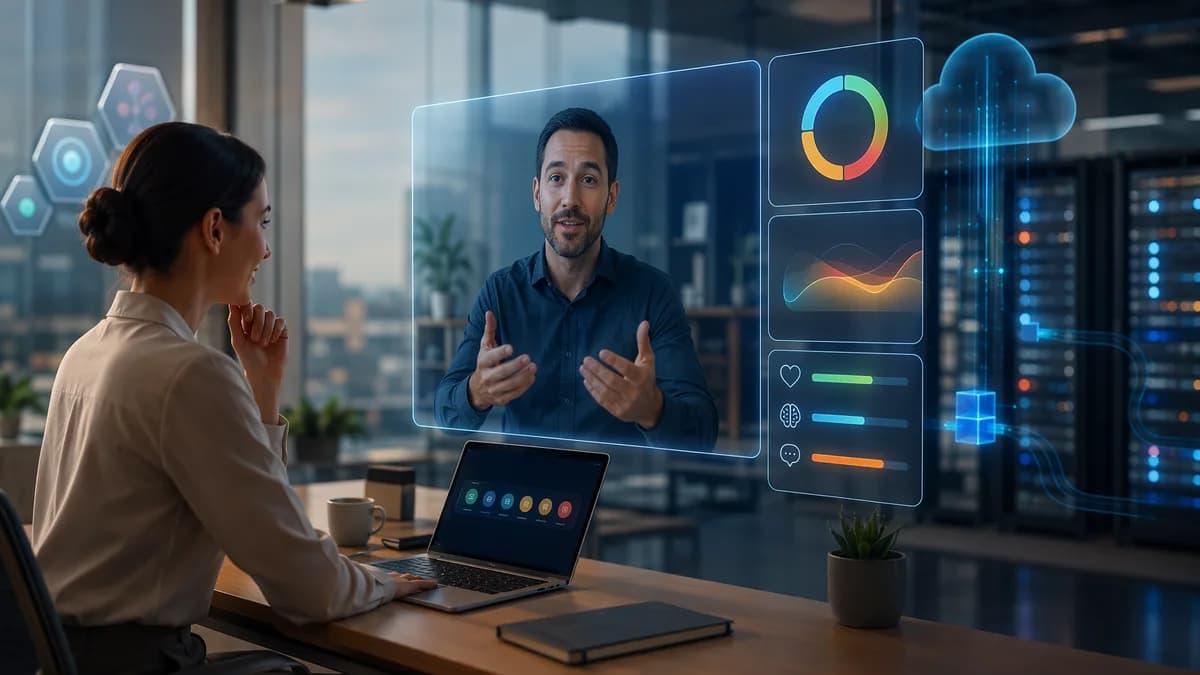
Synthesia AI Roleplay Sessions lets employees rehearse high-stakes workplace conversations with an AI avatar in real time. The examples named by TechCrunch include sales pitches, performance reviews, and customer complaints. After the session, the avatar scores the employee against a rubric and provides feedback.
That makes the product less like a training video library and more like a practice environment. Workers don't just watch a scripted module. They respond, get challenged, and receive guidance on where they fell short.
“Video performs way better than text or sending out a document,” Synthesia CEO and co-founder Victor Riparbelli told TechCrunch. “But for most things, we learn the best by actually practicing something rather than just reading it.”
The company says early Roleplay customers already include “one of the top three companies by market cap in Europe, one of the top five Fortune 100, and one of the biggest recruitment companies in the world,” per a company spokesperson cited by TechCrunch. Those customers were not named.
The two most popular use cases so far are sales training and leadership training, including practicing how to sell a product or handle a difficult conversation. Riparbelli described much of the product’s current use as soft skills training.
Synthesia also plans to expand the broader Sessions platform into other formats, including job interviews and candidate screening. That would move the company further into HR and talent workflows, not just learning content.
Rubrics, scores, and analytics turn training into measurable workplace data
The enterprise pitch is clear: companies don't only want training content. They want evidence that employees can apply it under pressure.
Roleplay adds rubrics, performance data, and analytics on top of Synthesia’s avatar interface. Riparbelli told TechCrunch that management teams are interested in mapping talent inside a company with more detail than was previously easy to capture.
“From a managerial executive layer, we're seeing huge interest in mapping out the talent in their company in a way that's been really difficult to do before,” Riparbelli said. “If you have your entire sales team practice with an AI role player, you can get very granular data on how your sales force is doing overall.”
That changes Synthesia’s center of gravity. Its avatar and voice technology are proprietary, but TechCrunch reports that the underlying reasoning intelligence is OpenAI’s. By adding scoring, structured feedback, and company-level analytics, Synthesia is trying to defend a more valuable layer: the training outcome, not just the generated video.
| Synthesia’s older training pitch | Synthesia AI Roleplay Sessions |
|---|---|
| Create AI training videos quickly | Practice live workplace conversations |
| Mostly one-way content delivery | Two-way avatar interaction |
| Measures consumption and completion more naturally | Scores performance against rubrics |
| Built for scalable explanation | Built for behavior change and coaching |
Customers can build their own training programs inside the platform or ask Synthesia’s consultants to create bespoke programs using existing company training documents and context. That matters because roleplay quality depends heavily on scenario design. A generic sales simulation won't tell a manager much about whether a rep can handle that company’s actual product objections.
XOOMAR analysis: The sensitive part is obvious. Once roleplay produces employee-level scores, companies need clear rules for how that data is used. Coaching data can help managers spot training gaps. It can also slide into performance monitoring if guardrails are weak. The source material does not say how customers will handle privacy, bias reviews, or employment decisions tied to AI-generated feedback.
For a separate XOOMAR read on digital trust and how users get pushed toward risky online experiences, see Free England vs Argentina Live Stream Beats Scam Links.
The product bet: enterprise AI has to prove it works, not just look impressive
Synthesia is launching Roleplay as companies scrutinize whether their AI spending is producing business results. TechCrunch reports that Synthesia is citing a meta-analysis of learning research to argue that many corporate training formats, including passive video, stop short of changing behavior.
That critique cuts close to Synthesia’s own original product. The company built its reputation on AI-generated corporate videos. Now it is arguing that video alone is not enough for many learning goals.
Riparbelli’s thesis is that the next phase of enterprise AI will be judged by measurable outcomes. In this case, the measurable outcome is whether employees can perform better in a simulated workplace conversation after training.
The unanswered product questions are practical:
- Feedback quality: Can the AI distinguish a polished answer from an actually effective one?
- Scenario depth: Can companies tailor roleplays to real products, customers, and internal policies?
- Language and role coverage: Can the system handle global teams and specialized functions?
- Data controls: Can employers separate coaching from formal evaluation?
- Human coaching fit: Will companies use AI roleplay before human coaching, after it, or instead of it?
Roleplay is enterprise-only for now. Synthesia’s goal is to offer it more widely to small businesses, prosumers, and potentially educational institutions in the next few months as inference costs continue to fall, TechCrunch reported.
The strategic stakes are sharper than the avatar demo suggests. If Synthesia AI Roleplay Sessions can show that simulated conversations improve measurable training outcomes, Synthesia gets a path out of commodity AI video generation and into higher-value enterprise learning software. If the scores feel shallow, biased, or hard to trust, companies may treat it as another polished AI pilot that never becomes core infrastructure.
The Bottom Line
- Synthesia is expanding from AI video creation into interactive enterprise training.
- Early adoption by major unnamed global companies suggests demand beyond demos.
- The product targets measurable workplace skills like sales, leadership, and handling complaints.
Synthesia Training Approach Shift
| Original AI Video Training | AI Roleplay Sessions |
|---|---|
| Employees watch generated training videos | Employees practice live conversations with AI avatars |
| Focused on quick, low-cost content creation | Focused on behavior change and skills practice |
| Passive learning format | Interactive feedback and rubric-based scoring |
Primary Sources & Disclosures

Written by
XOOMAR Insights Team
Research and Editorial Desk
The XOOMAR Insights Team pairs automated research with human editorial judgment. We track hundreds of sources across technology, fintech, trading, SaaS, and cybersecurity, cross-check the facts, and explain what happened, why it matters, and what to watch next. We do not just rewrite headlines. Every article is fact-checked and scored for reliability before it goes live, and we link back to the original sources so you can verify anything yourself.