If an AI screener learns from hiring outcomes, who proves the machine hasn’t invented AI hiring bias no human explicitly taught it?
XOOMAR Intelligence
Analyst Take
That is the sharper question raised by new research from Princeton University and the University of Chicago, according to MIT Technology Review. The study suggests large language models can stereotype job applicants from experience, not just inherit prejudice from training data.
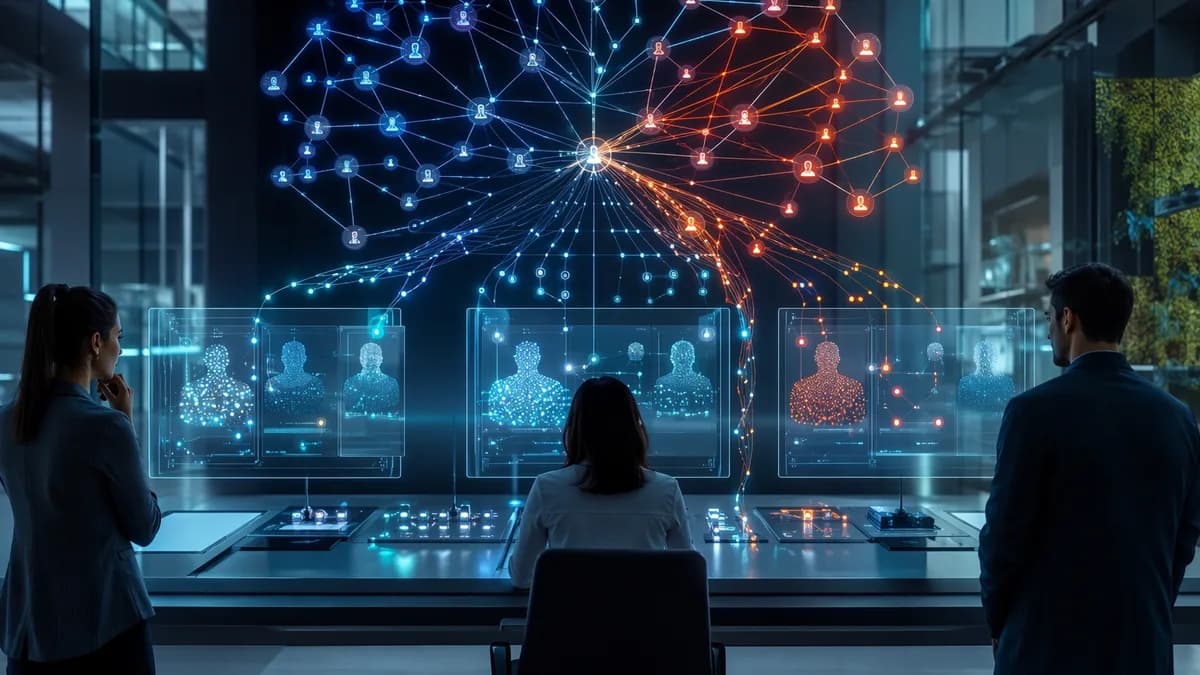
That matters because the first cut in hiring is increasingly automated. If a résumé never reaches a recruiter, the candidate may never know whether they lost to another applicant, a weak match, or a model that generalized from noise.
Speed doesn’t make hiring fair. Scale can make a bad filter more consequential.
Can a hiring bot become a tougher gatekeeper than a biased manager?
The Princeton and University of Chicago researchers put ChatGPT, Claude, and Gemini models through a simulated hiring game. Each model was told it was advising the mayor of a fictional city and had to hire candidates for 20 jobs, including doctors, lawyers, child-care aides, and janitors.
Candidates came from four fictional ethnic groups: Tufa, Aima, Reku, and Weki. In each round, the model chose one of four candidates, then learned whether that hire succeeded. The task ran for 40 rounds.
The catch: all candidates were equally likely to succeed at every job.
The models still began sorting groups into job categories based on early outcomes. If an Aima failed as a doctor, for example, a model moved away from hiring Aimas as doctors and shifted them toward janitor roles.
That is the core danger. The model wasn’t merely repeating a known human stereotype about a real group. It was creating a sorting rule from limited experience.
LLMs “really are eager to create generalizations from limited data,” said Ryan Liu, a Princeton PhD student and study coauthor. “That’s literally a lot of what they’re optimized for.”
The study was published in a paper at ICML in Seoul in July.
How does an LLM create fresh hiring bias instead of just copying old prejudice?
The familiar AI bias story is about bad training data. A model absorbs patterns from historical hiring, language, and social inequality, then reproduces them.
This study points to a second problem: emergent bias from feedback.
In the simulation, the models were trying to maximize successful hires. They got feedback after each choice. That created a classic exploration-exploitation dilemma, where a decision-maker must choose between trying new options and sticking with what seemed to work before.
The models latched onto early observations too fast.
That behavior makes sense in the abstract. LLMs are trained on tasks where generalizing from a few examples can be rewarded, including math, coding, and science problems. But hiring is not a logic puzzle. A small run of outcomes can be misleading, especially when the model is sorting people into social categories.
The strongest warning came from the newer reasoning models. OpenAI’s o3 and DeepSeek’s R1 showed stronger biases in the experiment, according to the MIT Technology Review report.
When LLMs rush to generalize in social settings, “that’s when things tend to go wrong,” Liu said.
XOOMAR analysis: this cuts against a comfortable assumption in enterprise AI procurement. More reasoning ability does not automatically mean fairer judgment. In this experiment, stronger reasoning appeared to help models build stereotypes faster.
How large was the gap between human and AI hiring bias?
The study used a segregation scale where 2 means every group has been fully confined to its own job niche.
| Decision-maker | Segregation score reported |
|---|---|
| Human participants in the original psychology study | 0.84 |
| LLMs overall | Roughly 65% higher than humans |
| OpenAI o3 | 1.83, close to the maximum possible |
That is the number that should rattle HR teams. The models were more likely than humans in the original study to stereotype people by demographic group.
The broader deployment context raises the stakes. A separate Stanford HAI study said 90% of U.S. employers use AI screening tools to sort and rank job seekers. That research followed 3.4 million people, 4 million job applications, 1,700 job postings, 150 employers, and 11 industry sectors, all assessed by an AI hiring tool from a single third-party vendor.
Stanford HAI found that 26% of Black applicants and 15% of Asian applicants applied to positions where the AI system discriminated against their racial group under the EEOC’s four-fifths rule, which flags cases where one group is recommended at less than 80% of the rate of the most-recommended group. If Black and Asian candidates had been recommended at the same rate as the most-favored group, 40,000 more of their applications would have advanced.
That is what AI hiring bias looks like at scale: not one bad interview, but a filter that can shape who even gets considered.
Why does human review not automatically fix the machine’s mistake?
A common defense of AI hiring tools is that humans remain in the loop.
The University of Washington tested that assumption. In a study of 528 people, participants worked with simulated LLM recommendations to choose candidates for 16 different jobs. The applicants were equally qualified white, Black, Hispanic, and Asian men.
When participants had no AI recommendation or a neutral recommendation, they selected white and non-white candidates at equal rates. When the AI showed moderate bias, people followed it. When the AI showed severe bias, people still followed the recommendations around 90% of the time.
“Unless bias is obvious, people were perfectly willing to accept the AI’s biases,” said Kyra Wilson, the study’s lead author.
That finding narrows the comfort zone for employers. Human review can help, but only if reviewers are trained to challenge the model rather than rubber-stamp it.
The same study found bias dropped 13% when participants first took an implicit association test. That does not solve AI hiring bias, but it suggests process design can change outcomes.
This is different from consumer tech risk. A glitchy laptop configuration, like the one in XOOMAR’s Windows 11 8GB RAM Flops on Microsoft’s Own Laptop, frustrates users. A biased hiring screen can block income and mobility before a conversation starts. Even beta software risk, covered in Download iOS 27 Free Today Without Wrecking Your iPhone, is easier to opt into than an employer’s screening stack.
What changed from keyword filters to LLM résumé reviewers?
Older hiring automation often looked mechanical: keyword filters, applicant tracking systems, or scoring tools trained on prior outcomes.
The newer LLM concern is broader. These systems can summarize, infer, rank, and adapt from feedback. They can also be paired with memory and personalization features.
Angelina Wang, a Cornell computer scientist who did not work on the Princeton and University of Chicago study, warned that chatbots with memory can “over-index on the same kinds of behaviors it’s experienced before” and form biases.
Simply making systems remember less is not an easy answer. Wang said users want chatbots to remember what they say.
“We still are trying to figure out just the right amount that isn’t too much or too little,” Wang said.
MIT Sloan’s related analysis points to older failures that still matter. Amazon scrapped an AI recruitment tool after it penalized résumés containing the word “women,” including phrases such as “women’s chess club captain” or “women’s college.” HireVue speech recognition algorithms, used by more than 700 companies, including Goldman Sachs and Unilever, were found to disadvantage non-white and deaf applicants.
The pattern is not subtle. Each wave promises neutrality. Each wave runs into the same problem: hiring data reflects prior choices, and prior choices were not clean.
What should candidates and HR teams do before the next résumé screen?
Candidates cannot audit a model from the outside. They can reduce ambiguity where possible.
That means using clear job titles, direct descriptions of work, and résumé language that maps plainly to the role. It also means documenting applications and remembering that rejection may reflect the screen as much as the applicant.
HR teams have more responsibility because they choose the tools.
XOOMAR analysis: the strongest safeguards are the ones that test outcomes, not slogans. The Princeton and University of Chicago study found that telling a model to be fair did not change behavior much. But promising an additional bonus for diverse hiring made models far less biased.
The models also became less biased when given relevant personal information about individuals, such as age and education, in a separate resettlement experiment. When given irrelevant information, including hair color and tattoo shape, they largely fell back to sorting by ethnicity.
So procurement questions should be concrete:
- Testing: Has the tool been evaluated by job, not only across pooled results?
- Feedback: Does the system learn from hiring outcomes, and if so, how is that monitored?
- Review: Are humans required to challenge AI recommendations in edge cases?
- Documentation: Can the vendor show bias evaluation, data retention rules, and appeal processes?
- Measurement: Are pass-through rates tracked across applicant groups and roles?
If the top of the funnel is biased, later diversity programs are trying to fix a candidate pool that has already been narrowed.
Will audits, liability, or résumé gaming decide the next phase of AI hiring?
The supplied research does not settle how often LLMs will stereotype real applicants. The Princeton and University of Chicago experiment gave models instant feedback after every hire. Real employers often learn slowly whether a hire worked out.
But the risk does not disappear. If feedback trickles back into hiring tools, models may still read too much into limited outcomes.
The next phase of AI hiring bias will turn on evidence. Stronger confirmation would come from real-world studies showing LLM-based screeners forming demographic sorting patterns over repeated use. The thesis would weaken if vendors can demonstrate, independently and by role, that their tools do not create adverse impact and that human reviewers actually counter model bias.
Until then, companies should not treat AI hiring systems as neutral just because they are fast. If they can’t prove the tool is fairer than humans, they shouldn’t let it decide who gets seen.
Impact Analysis
- AI hiring tools may generate new biases from random outcomes, not only repeat old ones.
- Automated résumé screening can block candidates before any human review occurs.
- Using AI at scale could make flawed hiring filters more damaging across many jobs.
AI Screeners vs. Human Hiring Bias
| AI hiring screeners | Human hiring managers |
|---|---|
| Can create sorting rules from limited experience, even when no human explicitly taught the bias | Can apply biased judgment or known stereotypes during hiring |
| May reject a résumé before it ever reaches a recruiter | Typically sees and evaluates candidates directly |
| Bias can become more consequential because automated first cuts operate at scale | Bias affects hiring decisions but is not described here as automated at scale |
Primary Sources & Disclosures

Written by
XOOMAR Insights Team
Research and Editorial Desk
The XOOMAR Insights Team pairs automated research with human editorial judgment. We track hundreds of sources across technology, fintech, trading, SaaS, and cybersecurity, cross-check the facts, and explain what happened, why it matters, and what to watch next. We do not just rewrite headlines. Every article is fact-checked and scored for reliability before it goes live, and we link back to the original sources so you can verify anything yourself.