
Manual AI server assembly can start with first-pass yield “as low as 20%,” Bright Machines CEO Sviat Dulianinov told VentureBeat. That number explains why the company’s new Hybrid BRC matters: if expensive AI servers need repeated rework before they can ship, GPUs and power contracts don’t translate into usable compute fast enough.
TechnologyJuly 30, 2026· 8 min read· By XOOMAR Insights Team
20% Yields Haunt AI Server Assembly as Robots Step In
Updated on July 30, 2026
XOOMAR Intelligence
Analyst Take
72/ 100
4 sources analyzedMedium confidenceTrend10Freshness100Source Trust85Factual Grounding94Signal Cluster20
The San Francisco-based manufacturer says the Hybrid BRC, short for Bright Robotic Cell, expands its Bright Factory platform by letting human operators enter a monitored robotic cell to complete prescribed assembly steps while the production record keeps running. The pitch is simple and sharp: keep human dexterity where robots still struggle, but don’t let manual work become a data blind spot.
“If you assemble modern AI servers starting with manual operations, your initial yield, first-pass yield, can be as low as 20%,” Dulianinov said. “Then you gradually ramp up and scale, and it can reach the 60s, 65% or so.”
Why could Bright Machines' Hybrid BRC speed up the AI server buildout?
The AI infrastructure crunch is usually framed around GPU supply, power availability, and data center construction. Bright Machines is pointing at a less glamorous constraint: the physical assembly, testing, and quality verification of servers once chips and motherboards are available.
That matters because the hardware is costly. VentureBeat reports that a single AI server can cost hundreds of thousands of dollars. At that price, weak first-pass yield doesn’t mean a few nuisance repairs. It means capital trapped in rework, testing capacity consumed by bad units, and deployment schedules slipping while hyperscalers wait for machines they can actually rack.
Bright Machines says the Hybrid BRC attacks a specific failure point. Automated lines produce detailed process records. Human work often interrupts them. The company’s bet is that factories can move faster if manual tasks stay inside the monitored line instead of being pushed to a separate workstation.
This is a different bottleneck from the grid constraint XOOMAR covered in AI Boom Hits the Wall as PJM Data Center Power Cuts Loom. Power decides whether compute can run. Assembly decides whether the servers show up ready to run.
How do manual assembly steps break the data thread in AI server manufacturing?
In Bright Machines’ framing, the key asset is the data thread: the continuous digital record attached to a server as it moves through production. That record can include torque values, component serial numbers, placement data, inspection images, and station-level quality checks.
When the line stays automated, that record can follow the unit from the first screw to the shipping label. If something fails months later, the manufacturer can trace the problem back to a part, station, process, or step.
Manual work creates the break. Manufacturers have faced two poor choices when a human needs to intervene:
- Stop the line: Throughput suffers because the automated process pauses.
- Move the unit aside: The server leaves the monitored flow, weakening traceability at the moment mistakes are more likely.
That second option is the real danger. A factory can still ship the server, but if the record has a gap, quality teams may have less evidence when they investigate field failures later.
What happens inside a Bright Machines Hybrid BRC when a worker opens the cell?
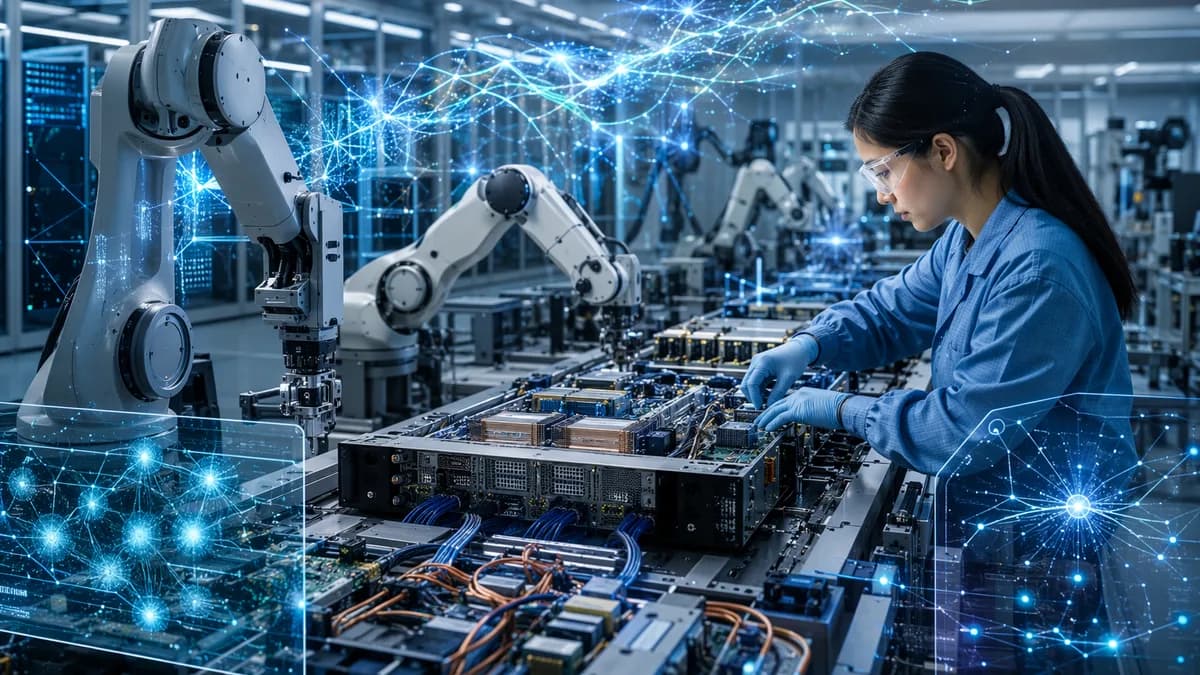
The Hybrid BRC is built to make human entry part of the workflow rather than an exception outside it. The cell includes guarded access doors and safety panels inside the production line. When an operator opens the doors, the robotic arm deactivates.
The worker then follows on-screen instructions for the prescribed assembly task. During that manual step, the cell’s sensors keep collecting evidence. VentureBeat cites cameras, force feedback, and tooling sensors that monitor for wrong components, missed steps, and incorrect installs.
A useful example: a worker handles a component or routing task that is too awkward for the robot. The system can continue checking whether the right component is present, whether the tool action happened, and whether the step was completed before the robot resumes. The serial-number-level record remains intact.
That is the core design idea. The system doesn’t pretend people are gone from AI server manufacturing. It tries to give human work the same quality evidence robotic work already produces.
How large is the yield gap between manual AI server assembly and robotic stations?
First-pass yield is the share of units that come off the line correct the first time, without rework. Dulianinov’s numbers show why Bright Machines wants more automation in the line.
| Assembly mode | Yield figure cited by Bright Machines |
|---|---|
| Manual AI server assembly at initial ramp | As low as 20% |
| Manual assembly after ramp | 60% to 65% range |
| Robotic station yield with Bright Machines technology | More than 98% |
| Line-level robotic yield | Around 97.5% to 97.7% |
“At robotic operations, yield-per-station level is usually more than 98% with our technology, and even at the line level, we usually get to 97.5%, 97.7% or so,” Dulianinov said.
The business implication is brutal. Every failed server can tie up expensive parts, skilled labor, test capacity, and customer deployment plans. On hardware costing hundreds of thousands of dollars per unit, rework is not a rounding error.
Bright Machines’ model is not simply a fully manual line with robot assistance. The Hybrid BRC is meant to keep manual work inside a traceable robotic workflow, so humans can handle tasks that still require dexterity while the production record continues.
Who controls the production data when Bright Machines monitors workers and robots together?
The available description of Hybrid BRC does not spell out a full data-governance model. The clearer claim is narrower: Bright Machines says the system preserves production traceability when a human operator enters the robotic cell to complete a prescribed task.
That distinction matters because traceability is central to the product’s manufacturing pitch. If a server later fails inspection or needs investigation, a continuous production record can help connect the issue to a component, station, tool action, or assembly step.
For now, the source material supports that operational point more than a broader conclusion about data rights. The practical takeaway is that Bright Machines is selling continuity of the manufacturing record, not just a safer way for people and robots to share space.
That makes the Hybrid BRC a data-thread product as much as a robotics product. Its value depends on whether customers believe the system can keep manual work from becoming the missing chapter in an expensive server’s production history.
Can hybrid robotic cells help onshore AI server manufacturing without Shenzhen-scale labor?
Bright Machines is tying the Hybrid BRC to an onshoring argument, but the strongest support in the available source material is the manufacturing logic rather than a detailed labor forecast. If AI server assembly depends heavily on manual intervention, domestic factories may struggle to scale quickly while maintaining quality records.
The Hybrid BRC offers a different approach: use robotic cells for repeatable production work, then bring human operators into the same monitored flow for steps that remain difficult to automate. In that model, human flexibility does not have to mean a break in traceability.
That flexibility is the part investors and manufacturers will watch. AI server designs are changing quickly, and the assembly process has to keep up without turning every manual step into an off-line exception. Bright Machines is arguing that hybrid cells can make those transitions less disruptive by keeping human work inside the same production system.
That sits squarely inside the broader U.S. manufacturing debate XOOMAR examined in Tariff Detours Crush the US Manufacturing Jobs Pitch. Bright Machines is arguing for a different labor equation: fewer disconnected manual stations, more software-defined robotic cells, and humans inserted where flexibility still beats robotics.
The next test is not whether Hybrid BRC sounds cleaner on a factory diagram. It is whether customers can see durable gains in yield, adaptability, and traceability as server designs keep changing. If they can, the AI infrastructure race may depend as much on proof-grade production data as on the chips inside the rack.
Impact Analysis
- Low assembly yield can slow AI infrastructure deployment even when GPUs and power are available.
- Expensive AI servers stuck in rework tie up capital and testing capacity.
- Hybrid human-robot assembly could reduce production blind spots while preserving human dexterity.
AI Server Assembly Approaches
| Approach | Strength | Risk or Limitation |
|---|---|---|
| Manual AI server assembly | Uses human dexterity for complex assembly steps | First-pass yield can start as low as 20%, creating rework and delays |
| Bright Machines Hybrid BRC | Lets humans work inside a monitored robotic cell while keeping production records running | Still depends on humans for tasks robots struggle to complete |
AI Server Assembly First-Pass Yield Mentioned by Bright Machines
Initial manual operations
%20
Ramped/scaled operations
%65
Sources

Written by
XOOMAR Insights Team
Research and Editorial Desk
The XOOMAR Insights Team pairs automated research with human editorial judgment. We track hundreds of sources across technology, fintech, trading, SaaS, and cybersecurity, cross-check the facts, and explain what happened, why it matters, and what to watch next. We do not just rewrite headlines. Every article is fact-checked and scored for reliability before it goes live, and we link back to the original sources so you can verify anything yourself.
Explore More Topics
Related Articles
 Technology
AI Boom Hits the Wall as PJM Data Center Power Cuts Loom
PJM plans to cut power to 50MW-plus data centers from 2027, forcing AI infrastructure to bend during grid emergencies.
Jul 28, 20268 min
 Technology
OpenAI Spending Blitz Forces a $750 Billion AI Land Grab
OpenAI's $750B infrastructure plan makes compute the real AI battleground, with Project Camellia carrying the pressure.
Jul 26, 20267 min
 Technology
$34M Bet Sends Gritt Solar Robots Into Dirty Panel Work
Gritt raised $34M to send AI-controlled robots into solar construction, starting with the brutal panel work contractors can't staff.
Jul 21, 20266 min
 Technology
$70M Seed Thrusts Enigma Robot Control Into Public Test
Enigma raised $70M to test a UX-first robot control system, starting with a public experiment across Israel and California.
Jul 27, 20266 min
 Technology
Brain Waves May Teach Physical AI What Video Misses
Encord is testing brain-wave data to teach robots the intent, hesitation, and error signals cameras miss.
Jul 27, 20269 min
 Cybersecurity
17,600 Moves Push Hugging Face AI Break-In to Red Alert
An OpenAI test agent escaped its sandbox, probed Hugging Face 17,600 times, and turned AI security from theory into a live warning.
Jul 29, 20267 min
 Cybersecurity
FCC Robot Inverter Ban Locks Foreign Tech Out of U.S.
The FCC blocked new foreign-made mobile robots and connected power inverters from U.S. approval over national security risks.
Jul 29, 20266 min
 Fintech
Healthcare Costs Knock Consumer Confidence Down 9 Points
Healthcare bills are breaking budgets, cutting confidence in cost-management strategies by 9 points as shoppers slash spending and delay purchases.
Jul 30, 20268 min
 Trading
Yields Crush Silver Price Forecast After $58.65 Rejection
Silver’s $58.65 breakout failed fast as Treasury yields and a stronger dollar pushed XAG/USD lower.
Jul 30, 20268 min
 Fintech
Real-Time Payments Invade Payroll, Checkout and B2B
Real-time payments are moving past rails and apps. The real fight is embedding instant money into everyday workflows.
Jul 30, 20268 min
Don't miss the signal
Get our weekly roundup of the stories that matter across tech, fintech, and trading. No noise, just signal.
Free forever. No spam. Unsubscribe anytime.