Gritt solar robots just came out of stealth with $34 million in funding, aiming first at the labor-heavy work of building large solar plants before moving into broader construction automation. The company’s pitch lands squarely on solar contractors and field crews under pressure to install more panels with limited labor, according to TechCrunch.
XOOMAR Intelligence
Analyst Take
Founded by Carnegie Mellon-trained roboticists Puneet Puri and Vishal Dugar, Gritt raised a $26 million Series A led by Obvious Ventures, with participation from Union Square Ventures and Active Impact Investment. That brings total funding to $34 million, after an earlier seed round backed by First Round Capital, Climactic, Congruent Ventures, and VSC Ventures.
Solar builders get Gritt solar robots for the dirtiest panel work
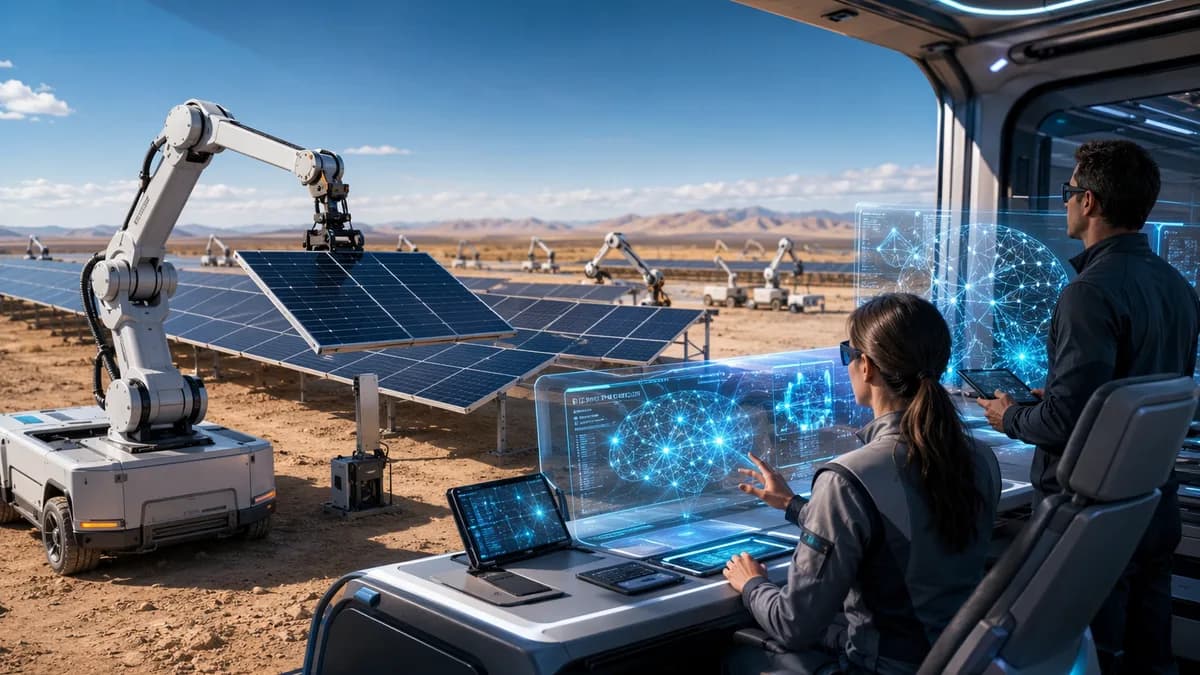
Gritt is not starting with design software, permitting, finance, or project planning. It is going after field execution: unloading large glass solar panels, moving them toward metal frames, and positioning them with sub-millimeter accuracy so workers can fasten them.
That choice matters. Solar construction has repeatable workflows, but the work is still physical, outdoor, and punishing. Gritt’s system uses off-the-shelf hardware, including rented skidders and robotic arms from companies such as Kawasaki, controlled by its AI models rather than custom-built robots.
“Our thesis is that if we truly want to speed up construction,” Puri told TechCrunch, “you need an intelligence which can work in the outdoor, chaotic environments of these construction sites, and it has to be generalizable enough that it can work in these varied environments.”
The builder question: can Gritt solar robots keep working when the site is dusty, uneven, hot, cold, and changing by the hour?
The early productivity claim is sharp. Puri told TechCrunch that a typical eight-person crew can install 800 panels a day, while the same crew working with Gritt’s systems can install 3,000 to 4,000 panels each day.
Gritt currently has two systems deployed in the field, using data from those deployments to improve behavior. The company says it is contracted to help install 2.8 gigawatts of solar panels over the next 18 months, and that its customers include three of the top 10 US power construction companies.
Contractors care about speed, injuries, and remote job sites
For construction firms, Gritt’s near-term value is not abstract automation. It is fewer bottlenecks around heavy, repetitive tasks.
TechCrunch spoke with one Gritt customer who declined to be identified for competitive reasons. The customer said the system could make remote projects easier to staff and could reduce injuries because workers would not have to repeatedly lift 100-pound panels overhead.
That is the narrow wedge Gritt is using: robots handle the lifting, carrying, and precise placement, while people remain in the workflow for fastening. It is a practical split, and it avoids the harder claim that construction crews can be replaced outright.
The contractor question: do the machines reduce labor strain and cycle time enough to justify deploying them across real projects?
Gritt wants to operate 48 systems within the next six months. If it reaches that target, the company will move from promising field trials into a much harder phase: repeatable deployment across multiple sites, customers, and conditions.
For readers tracking solar technology beyond utility-scale construction, XOOMAR has also covered the human and hardware demands around solar engineering in 630 Texas Miles Punish Teens in Solar Car Challenge. Gritt is operating at a different scale, but the lesson rhymes: field conditions decide whether clean-energy hardware actually performs.
Robotics makers face Gritt’s off-the-shelf hardware bet
Gritt is entering a competitive field. TechCrunch names Luminous Robotics, Cosmic, and China’s Trinabot as companies working on panel-installing robots.
The split is strategic. Those competitors are building their own hardware. Gritt is trying to turn common machinery and robotic arms into AI-controlled construction systems.
| Company approach | Hardware strategy | Immediate focus from source material |
|---|---|---|
| Gritt | Off-the-shelf vehicles and robotic arms | Unload, carry, and position solar panels |
| Luminous Robotics | Own panel-installing robots | Solar panel installation |
| Cosmic | Own panel-installing robots | Solar panel installation |
| Trinabot | Own panel-installing robots | Solar panel installation |
The competitor question: does Gritt’s off-the-shelf approach scale faster, or do custom machines prove more reliable on site?
This is where the company’s AI thesis becomes central. Puri said making a single-task system was possible “to some extent five years ago,” but newer AI models make the work more generalizable. He cited training the system to stack cinder blocks in weeks, while a similar demo with rebar tying took just a day using the same software.
XOOMAR analysis: Gritt’s cost and deployment story depends on that claim holding up. If the same AI pipeline can be reused across tasks, Gritt gets a platform. If every site and task needs heavy custom work, it becomes a robotics services business with startup margins under pressure.
That makes this a very different AI funding story from the software-stack fight XOOMAR covered in $400 Million Bet Pits Current AI Against Big Tech's Grip. Here, the model has to control metal, glass, terrain, and workers moving nearby.
Infrastructure buyers now need proof beyond demo-day robots
Gritt’s roadmap moves beyond panel placement. The company wants its systems to fasten solar panels, drill posts, build the racks panels sit on, and eventually tackle other labor-intensive construction work such as tying rebar before concrete is poured.
The founders also see a management layer forming around the machines. Puri described Gritt as a “layer of physical AI” that can perform dexterous work and help make decisions on site, such as spotting an open trench before a storm or flagging missing inventory.
“Gritt becomes now this layer of physical AI, which is doing this dextrous, labor-intensive task, plus it can help you take decisions on the site,” Puri said.
The buyer question: can one system deliver measurable productivity, safer handling, useful site data, and high uptime without adding operational complexity?
The answer will not come from a lab demo. It will come from deployed systems, repeat contracts, downtime rates, worker acceptance, safety records, and whether Gritt’s claimed panel-per-day gains survive broader use.
Gritt now has funding, named investors, early field systems, a contracted solar pipeline, and a first market where repetitive heavy work is easy to identify. The next test is harsher: proving that construction robotics can earn its place on real job sites, where weather, terrain, schedules, and human crews don’t wait for perfect conditions.
The Bottom Line
- Gritt is targeting a labor-intensive bottleneck in utility-scale solar construction.
- Its use of off-the-shelf hardware could make deployment faster than building custom robots from scratch.
- The $34 million raise signals investor confidence in applying robotics to outdoor construction sites.
Gritt’s Initial Focus vs. Other Construction Tech Targets
| Area | Gritt’s Approach |
|---|---|
| Solar field execution | Automates unloading, moving, and positioning solar panels for fastening. |
| Design, permitting, finance, and planning | Not the company’s starting point, according to the article. |
| Broader construction automation | Longer-term expansion goal after solar deployment. |
Gritt Funding Disclosed
Primary Sources & Disclosures

Written by
XOOMAR Insights Team
Research and Editorial Desk
The XOOMAR Insights Team pairs automated research with human editorial judgment. We track hundreds of sources across technology, fintech, trading, SaaS, and cybersecurity, cross-check the facts, and explain what happened, why it matters, and what to watch next. We do not just rewrite headlines. Every article is fact-checked and scored for reliability before it goes live, and we link back to the original sources so you can verify anything yourself.