On June 19, TechCrunch reported that Jean-Baptiste Kempf, the lead developer behind VLC Media Player, is now building Kyber robot control infrastructure for real-time remote devices, with investor interest around the company including Lightspeed.
XOOMAR Intelligence
Analyst Take
That timing matters because Kyber is not pitching another robot. It is pitching the layer underneath the robot: the software that keeps video, audio, sensor data, and control inputs synchronized when the operator, compute, and machine are not in the same place, according to TechCrunch.
Kempf’s credibility comes from a very different icon: the orange traffic cone. VLC Media Player has been downloaded more than 6 billion times. Now Kempf is applying that same infrastructure mindset to machines that move in the physical world.
“If you control things in the real world, every millisecond matters,” Kempf told TechCrunch.
June 19 put Kyber robot control in front of the physical AI crowd
Kyber’s pitch lands at the intersection of two hard problems: real-time media and real-world machines.
The company is building an SDK that synchronizes live media, sensor feeds, and control inputs with minimal latency. That makes Kyber robot control relevant to robotics, drones, remote IT access, and AI systems that act beyond a screen.
Lightspeed’s investment is part of the signal. The firm, which TechCrunch notes has also backed Anthropic and Mistral AI, framed the deal around physical AI.
“Physical AI is only as good as the underlying systems running it,” Lightspeed wrote in a LinkedIn post announcing its investment.
That sentence explains the bet. AI models may decide what should happen. Kyber wants to help make sure the device receives the right signal fast enough for the decision to matter.
Kempf’s own description is broader than robotics. He told TechCrunch Kyber is built for:
“all the use cases where the person who’s operating is not in the same place as the compute, which is not in the same place as the action.”
That covers a lot of territory. But it also keeps the product grounded. Kyber is not presented as a robot brain or a robot body. It is the connective layer between operators, compute, and machines.
From VLC to Kyber: the same obsession, a less forgiving target
Kyber began as a side project while Kempf was CTO at Shadow, the cloud gaming startup. That origin matters because cloud gaming and remote device control share one core demand: the system has to feel immediate.
A video player can tolerate some friction. A remote machine has less room for delay. Kyber’s name nods to Star Wars lightsaber crystals, but the substance is latency. The source material does not detail Kyber’s full networking architecture, so claims about specific techniques would be speculation. What TechCrunch does confirm is the goal: synchronized video, audio, sensor data, and commands with minimal lag.
That is where Kempf’s VLC history becomes relevant without turning this into nostalgia. VLC made complex media playback feel ordinary for users. Kyber is trying to make remote control infrastructure feel ordinary for developers.
| Layer | VLC world | Kyber world |
|---|---|---|
| Core challenge | Play media reliably | Control remote devices in real time |
| Data involved | Video and audio | Video, audio, sensor data, control inputs |
| User expectation | It just plays | The device reacts fast enough |
| Business model signal | Open-source roots | Open-source core, enterprise product |
Kyber’s core project is open source, while the company sells a productized enterprise version. That split will be familiar to teams that follow open infrastructure debates. For adjacent context, XOOMAR has covered how engineering teams weigh open tooling in Open Source Model Registry Tools MLOps Teams Should Bet On and why simpler open stacks can matter in Minimum Viable Open Source MLOps Stack Beats Tool Sprawl.
The comparison is not that MLOps and robotics are the same. They aren’t. The useful link is the operating model: open core for adoption, paid packaging for teams that need reliability, support, and deployment help.
Kyber’s scale problem starts at 2,000 vehicles and points toward millions
Kempf told TechCrunch that some companies have already built similar systems for their own needs, including remote driving. His point is that those systems were built for specific fleets, not a broad infrastructure market.
“But the largest fleets today have maybe 2,000 or 3,000 vehicles. Imagine you need to manage millions of them; that’s not the same thing.”
That is the clearest business case in the source material. The first version of a remote control stack can be custom. The thousandth version becomes a maintenance problem. The millionth version becomes an observability problem.
TechCrunch says Kyber sees observability as more important when AI agents, rather than people, manage fleets and networks. That does not mean Kyber has solved every operational issue. The source does not specify how Kyber handles degraded connections, safety fallbacks, authentication, or other deployment details. Those remain open technical questions from the outside.
What is clear is the pain point Kyber is trying to remove: companies should not have to physically reach every device just to push a software update. Even at smaller scale, remote control and fleet management can cut friction if the infrastructure works as promised.
A warehouse robot example shows the appeal, and the limits
TechCrunch does not say Kyber is deployed in a warehouse inspection robot. But a warehouse robot is a useful example of the type of problem Kyber is describing.
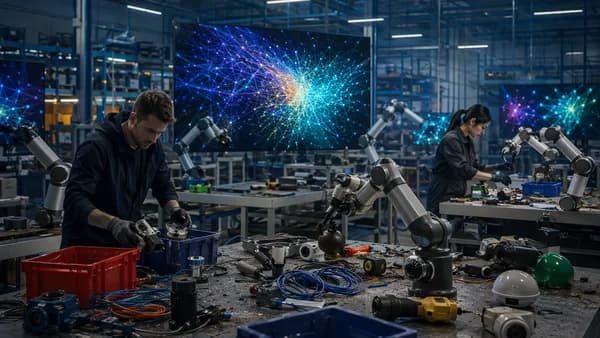
Picture a small wheeled machine checking aisles after hours. The operator is elsewhere. The compute may be in another place. The action happens on the warehouse floor. For that setup to work, the operator needs the robot’s live view, sensor context, and steering inputs to stay aligned closely enough to make remote operation practical.
Kyber’s claimed role would be the infrastructure between those pieces. A robotics team could focus more on the machine, sensors, and customer workflow instead of repeatedly rebuilding a real-time communication layer.
The limit is just as important. Better infrastructure does not erase physics, poor coverage, or safety requirements. It can only make the control layer more consistent and observable if Kyber’s software performs as intended in the field.
That distinction matters because the company is already in commercial deployment with customers in defense, telco, robotics, and AI, according to TechCrunch. Those are not casual environments. They test whether an infrastructure promise can survive outside demos.
Kyber’s next test is remote IT access, not just robots and drones
Kyber is prioritizing three segments: robotics, drones of every kind, and remote IT access. The last one is less glamorous, but TechCrunch reports demand has been particularly strong there.
Kempf says Kyber wants to be more than a Citrix challenger. Still, even that comparison signals the size of the opportunity Kyber is chasing. Remote IT access gives the company a path beyond robotics companies, while still using the same underlying idea: the operator, compute, and action are separated.
Kyber is also building for hands-on enterprise deployment. Like Palantir and others, it uses forward-deployed engineers, or FDEs. In plain terms, those are engineers who work close to customers to adapt software to real operating conditions. TechCrunch says FDEs make up a large part of Kyber’s 25 full-time employees.
The company is headquartered in Paris, with offices in San Francisco and Singapore. That footprint matches Kyber’s stated expectation of a global client base across multiple industries.
For readers tracking Kyber robot control, the practical watch item is simple: can an open-source core plus enterprise deployment model work in environments where milliseconds matter and physical machines are involved? Kempf already helped make complex media infrastructure feel invisible to billions of users. Robots will be a harsher test, because when the stream stutters, something in the real world may move wrong.
The Bottom Line
- Kyber targets the infrastructure layer needed to make remote robots and physical AI respond in real time.
- Kempf’s VLC track record gives the startup credibility in low-latency media synchronization.
- Investor interest from Lightspeed signals growing demand for software foundations behind physical AI.
VLC Media Player vs. Kyber Robot Control
| Aspect | VLC Media Player | Kyber Robot Control |
|---|---|---|
| Core role | Free media player known for smooth video playback | Infrastructure SDK for real-time remote devices |
| Technical focus | Synchronizing and playing video/audio reliably | Synchronizing video, audio, sensor data, and control inputs with minimal latency |
| Domain | Consumer and desktop media | Robotics, drones, remote IT access, and physical AI systems |
| Credibility signal | More than 6 billion downloads | Investor interest including Lightspeed |
VLC Media Player Downloads
Primary Sources & Disclosures

Written by
XOOMAR
Data desk
XOOMAR is a capital markets software and data company. Every brief on this site starts from a dataset the company collects itself from primary sources (CFTC, SEC EDGAR, FINRA, the Federal Reserve, exchange APIs) and names the numbers it is built on, with a link to the data page so you can check them. Briefs are reviewed before they go out and corrected in place when the data is revised.