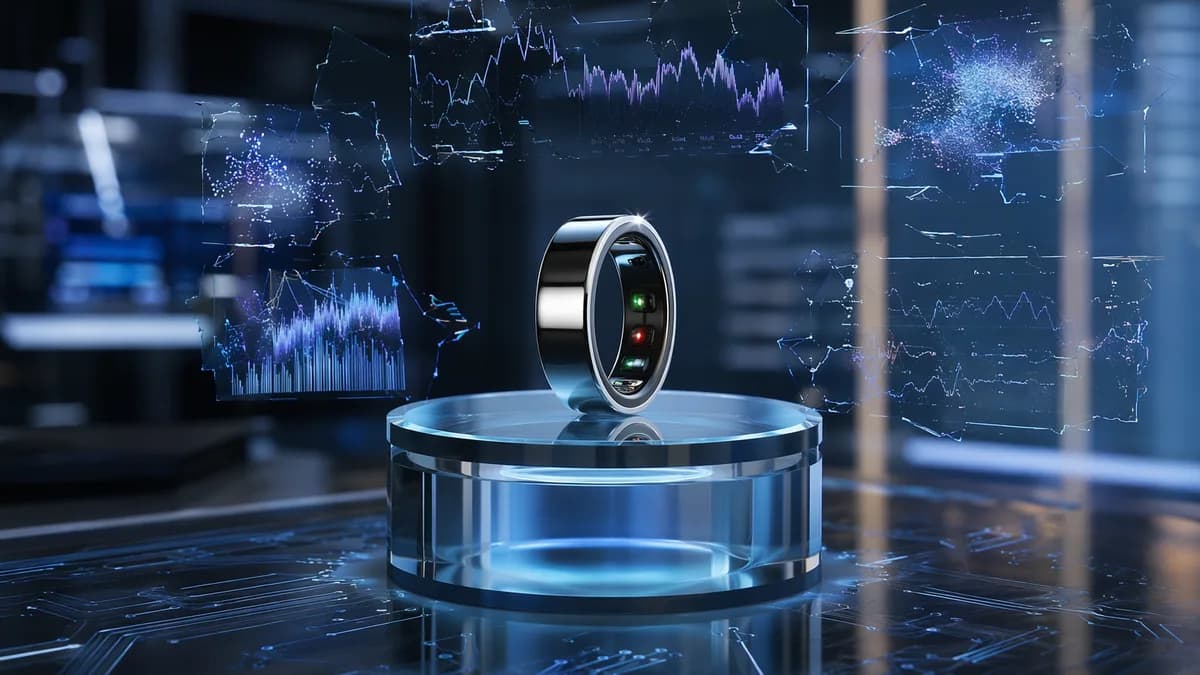
The RingConn 3 was returned after roughly 10 days because its prettiest trick did not make its health tracking useful enough. That should matter most to buyers who want a screen-free wearable that disappears into daily life, then earns its place with reliable signals.
XOOMAR Intelligence
Analyst Take
In a sharply skeptical TechCrunch review, Amanda Silberling praises the rose gold RingConn 3 for doing what many wearables still fail to do: look like something a person might actually choose to wear. My thesis is simple: the RingConn 3 solves the style problem, then stumbles on the reason anyone buys a health tracker in the first place.
RingConn 3 looks like jewelry, but I still wouldn’t buy it
The RingConn 3’s best argument is visual. It can pass as a normal ring, especially when paired with another stackable ring. At 2.3 mm thick, it matches the Oura Ring 5, according to the review, and it avoids the flashing-wrist-gadget look that turns many people away from wearables.
But what happens when a wearable looks good enough to lower your skepticism? That’s the trap.
The reviewer chose RingConn partly because it starts at $349, while the Oura Ring 5 starts at $399 and requires a $6 monthly subscription. That comparison makes RingConn feel like the more rational buy. No subscription. Lower upfront price. Better jewelry disguise.
Here’s the XOOMAR read: that bargain only holds if the ring’s tracking feels dependable. If the data disappoints, the lower price becomes a discount on confidence.
The RingConn 3’s polished design solves the wrong smart ring problem
For smart ring makers, the RingConn 3 sends a clear product lesson: industrial design is no longer the hard part. The ring looks polished, feels solid, and comes with a sizing kit that the reviewer found genuinely useful. She was tempted to order her usual ring size, then discovered she needed a bigger size for comfort.
That’s exactly the kind of detail hardware teams should obsess over. Rings are less forgiving than watches. A bad fit nags you every minute.
| Product detail | RingConn 3 in the review | Why it matters |
|---|---|---|
| Starting price | $349 | Lower than Oura Ring 5 in the cited comparison |
| Thickness | 2.3 mm | Same as Oura Ring 5, per TechCrunch |
| Battery claim | 14 days | Not fully tested by the reviewer |
| Water resistance | Can be worn swimming | Useful for passive daily wear |
| Subscription | No subscription mentioned in source | Contrast with Oura’s $6 monthly subscription |
The problem is that good hardware design can mask unfinished utility. Should a ring that looks this refined get more benefit of the doubt? No. If anything, it deserves more scrutiny, because the design makes the purchase feel emotionally easier.
Fitness tracking disappoints where a smart ring has to earn trust
For buyers, the RingConn 3’s fitness tracking problem is blunt: it asks for daily wear, then requires too much manual correction. According to TechCrunch, the ring only detects workouts if the user is physically moving through space. That means gym sessions or Pilates may not register automatically.
At the same time, it can flag a short walk across an apartment building as a brief workout. That mismatch cuts at the core value of passive tracking. What’s the point of a quiet wearable if the user has to keep supervising it?
The reviewer liked checking early data on heart rate and stress levels. She found sleep insights interesting too. But the sleep feedback mostly confirmed what she already knew without spending $349: drinking hurt her sleep, and a consistent bedtime helped.
This is where smart rings face a harder test than smartwatches. They don’t have screens, rich controls, or obvious real-time interaction. They live or die on interpretation. If the interpretation feels obvious, late, or wrong, the ring becomes a sensor bundle with jewelry styling.
For readers comparing this against broader wearable limits, our guide to Fitness Tracker Accuracy Cracks on 3 Workout Stats is the right companion read. The RingConn 3 case is a clean reminder that accuracy problems don’t need to be dramatic to be costly. Small misreads can still change behavior.
Headache detection sounds clever, but weak execution makes it feel premature
The headache detection feature is the most tempting part of the RingConn 3 pitch. For migraine sufferers, an early warning based on heart rate variability could be worth the price by itself. Who wouldn’t want a nudge before pain takes over the weekend?
But the TechCrunch review gives the feature a brutal real-world test. About a week into ownership, the reviewer had what she described as the worst migraine attack of her life. It lasted an entire weekend, and she sold tickets to see one of her favorite bands because the pain was so severe.
The ring’s response was not helpful.
All the while, the ring told me I was in “top form.”
That line should haunt RingConn’s product team. Not because one user’s migraine proves the feature never works. It doesn’t. But health-adjacent features carry a higher burden than novelty metrics. If a device claims to warn users about headache signs, the output has to be actionable, conservative, and clearly framed.
Here’s the editorial line: a missed workout is annoying. A missed health-adjacent warning can change how someone interprets their body. That deserves more caution than marketing gloss.
A beautiful wearable still needs software that feels finished
For software teams, the RingConn 3 review points to the real battleground: not sensors, but translation. The app can show heart rate, stress, sleep, and activity signals, but the question is whether it turns those signals into confidence.
The reviewer wanted a passive device she could wear all day, check once daily at most, and reflect on later. That’s a reasonable expectation for a screen-less ring. But passive tracking only works when the software understands enough context to reduce user labor.
If Pilates doesn’t register, but getting the mail does, the app is not just missing nuance. It’s asking the user to mentally audit the product. That breaks the bargain.
This is also where buyers should be careful with pretty wearables. Raw metrics feel scientific, but the value sits in classification, timing, and explanation. A number without context is decoration. A notification without reliability is noise. If you want to pressure-test that idea further, revisit Fitness Tracker Accuracy Cracks on 3 Workout Stats, because the same problem keeps showing up in different hardware shapes.
The case for buying the RingConn 3 anyway is real, but narrow
There is a fair counterargument for RingConn 3 buyers. Some people don’t need intense workout tracking. They want comfort, long battery life, a screen-free form factor, and a ring that won’t announce itself as a gadget.
That user exists. The TechCrunch reviewer found the RingConn 3 comfortable, attractive, solidly built, and easy enough on battery during her short test. She also did not run into battery issues, though she did not keep it long enough to verify the 14-day claim.
So who should still consider it? Someone who mainly wants passive wellness prompts, likes the look, hates subscriptions, and won’t treat the ring as a serious training or migraine-management tool.
That last boundary matters. The RingConn 3 may be acceptable as a low-friction wellness accessory. It should not be bought on the assumption that its prettier hardware makes its health signals stronger than the review shows.
Skip the RingConn 3 until the health tracking matches the design
For competitors and the broader wearable market, the RingConn 3 review carries a clean signal: screen-less wearables have real appeal, but the next fight is trust. TechCrunch cites Circana data showing American spending on fitness trackers grew 88% year-over-year, largely due to screenless wearables like the Oura ring and Whoop wristband. Demand is not the issue.
Execution is.
My recommendation is to skip the RingConn 3 for now unless style is your top priority and health accuracy is secondary. Wait for stronger evidence from longer reviews, clearer software behavior, or a future model that pairs the same jewelry-like design with better tracking.
A smart ring can look beautiful. If you can’t trust the numbers, it’s just jewelry with a charger.
Key Takeaways
- The RingConn 3 may look better than many wearables, but style does not compensate for unreliable health tracking.
- Its lower $349 price only feels like a bargain if users can trust the data it produces.
- Smart ring buyers should prioritize dependable signals over a screen-free design that blends into daily life.
RingConn 3 vs. Oura Ring 5
| Feature | RingConn 3 | Oura Ring 5 |
|---|---|---|
| Starting price | $349 | $399 |
| Monthly subscription | No subscription | $6/month |
| Thickness | 2.3 mm | 2.3 mm |
| Core appeal | Looks like jewelry, lower upfront cost | Established smart ring alternative |
Starting Price Comparison
Primary Sources & Disclosures

Written by
XOOMAR Insights Team
Research and Editorial Desk
The XOOMAR Insights Team pairs automated research with human editorial judgment. We track hundreds of sources across technology, fintech, trading, SaaS, and cybersecurity, cross-check the facts, and explain what happened, why it matters, and what to watch next. We do not just rewrite headlines. Every article is fact-checked and scored for reliability before it goes live, and we link back to the original sources so you can verify anything yourself.