
A Tesla China sale would not be routine restructuring. It would be the price of making a Tesla SpaceX merger look less toxic to national-security gatekeepers.
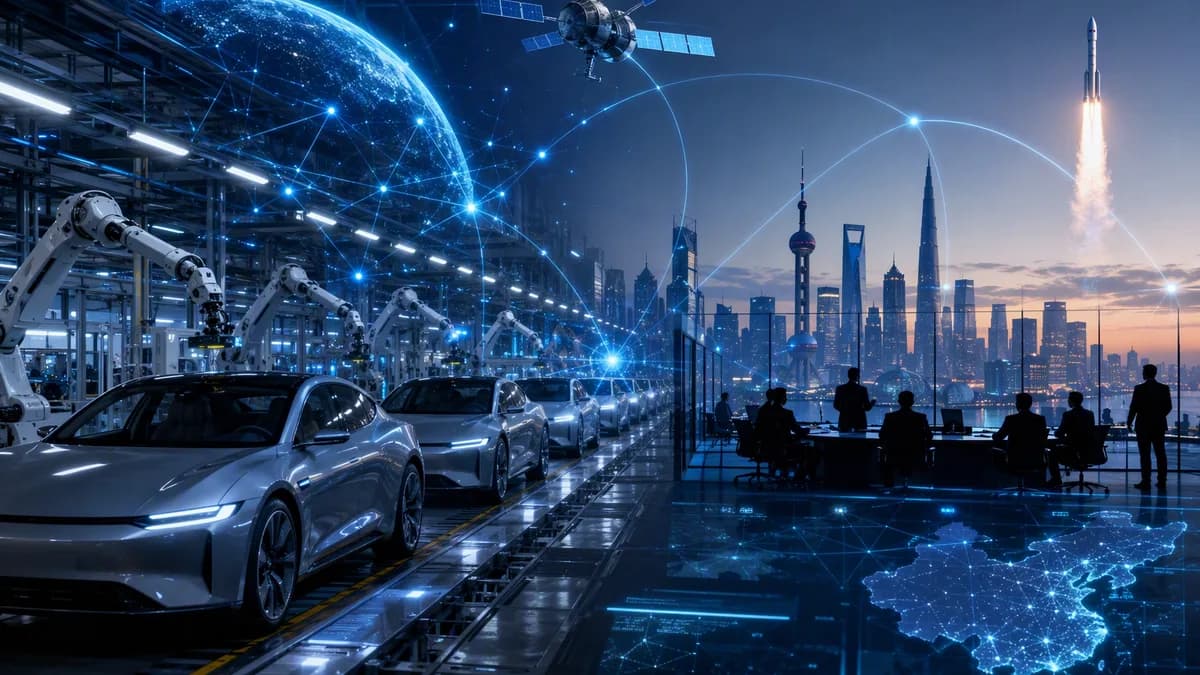
TechnologyJuly 31, 2026· 8 min read· By XOOMAR Insights Team
Tesla China Sale Could Defuse SpaceX Merger Threat
Updated on July 31, 2026
XOOMAR Intelligence
Analyst Take
57/ 100
4 sources analyzedLow confidenceTrend10Freshness96Source Trust90Factual Grounding90Signal Cluster20
Tesla is reportedly considering separating its China business before a possible combination with SpaceX, according to TechCrunch, which cited a Wall Street Journal report. The idea reportedly includes a spinoff, sale or closure of the China operation.
The report remains conditional. Elon Musk has denied the WSJ report, according to Electrek, and CnEVPost said local Chinese media outlet Yicai cited a Tesla China insider saying the report was untrue. Still, the structure of the alleged planning makes sense. SpaceX is tied to U.S. national security. Tesla is deeply tied to China. Put them together, and the China exposure becomes the first thing regulators, defense officials, and investors would interrogate.
A Tesla China sale would turn geopolitical risk into merger currency
The reported instruction is narrow but explosive: some Tesla executives have reportedly been told to prepare for a China separation ahead of a possible SpaceX deal.
“some Tesla executives have been told to prepare for a separation of the China business,” which could include a “spinoff, sale or closure,” according to the report cited by TechCrunch.
That framing matters. A Tesla China sale would not be about pruning a weak asset. It would mean cutting away one of Tesla’s strongest industrial positions to reduce political exposure before a bigger Musk-controlled transaction.
The tension is simple. SpaceX is a major U.S. defense and space contractor. CnEVPost, citing the WSJ, said U.S. government sales made up 20.9% of SpaceX’s business in 2025. Tesla’s China operation, meanwhile, is a manufacturing base, a local sales engine, and an export hub.
XOOMAR analysis: if Musk ever pushes a formal Tesla SpaceX merger, China is the obvious vulnerability. A combined company would invite questions about ownership, data, supply chains, military contracts, and whether a defense-linked U.S. entity should directly control a large manufacturing footprint inside China.
That does not mean a deal happens. It means the China question can’t be treated as an afterthought.
Shanghai is the asset that makes separation painful
Giga Shanghai is the reason this story cuts so deep. CnEVPost reported that the plant has annual capacity of about 1 million vehicles and is Tesla’s largest and most productive factory globally. Electrek said the Shanghai factory builds more than half of all Tesla vehicles.
That makes any carveout hard to price. Tesla would not be selling a peripheral business. It would be separating a production machine that supports China, Europe, and the Asia-Pacific region.
The most recent China figures show both dependence and strain:
| Metric | Reported figure |
|---|---|
| Tesla China Q2 deliveries | 126,157 vehicles |
| Year-over-year change | down 2.05% |
| Share of global deliveries | 26.28% |
| Shanghai Q2 exports | 128,394 vehicles |
| Local sourcing for China-made Model 3 and Model Y | more than 95% |
| Domestic supplier base | over 400 suppliers |
CnEVPost said Tesla’s China delivery share fell below 30% for the first time since the fourth quarter of 2020. At the same time, Shanghai exports exceeded domestic China deliveries in the second quarter, showing the plant’s growing role as a global export base.
This is the tradeoff. Shedding China could improve the political profile of a Tesla SpaceX merger. It could also strip Tesla of scale, local sourcing depth, and one of its most valuable production advantages.
For context on how much Tesla’s scale now matters to Musk’s broader incentives, see XOOMAR’s coverage of Tesla 10 Million EVs Drag Musk’s $1T Prize Into View.
The Taiwan contingency explains why this is more than deal prep
The reported China separation planning did not begin only as merger housekeeping. TechCrunch said Musk had already tasked executives to prepare for a split in the event that Beijing invades Taiwan.
CnEVPost added a sharper detail: Musk had instructed executives in recent years to organize Tesla with a “laser” between its U.S. and China businesses. The goal was to ensure at least the U.S. half of Tesla could survive geopolitical strife between the two countries. The preparations were reportedly aimed at 2026 or 2027.
The operational concerns were specific. CnEVPost said Musk was particularly worried about Tesla’s dependence on China for lithium iron phosphate battery cells, and about the risk that a Taiwan conflict could cut off chip supply.
That changes the interpretation. A Tesla China sale would not only be merger prep. It would be the monetization, or forced acceleration, of contingency planning that already existed for a geopolitical shock.
There is an irony here. China helped Tesla become a global mass-market EV company. CnEVPost noted that Tesla’s China vehicle business is not structured as a joint venture, and that it was China’s first automotive business wholly owned by foreign capital. Now that same China exposure may complicate Musk’s ambitions across space, defense, AI, and robotics.
Washington and Beijing would read the same carveout differently
Washington’s concern is visible in the source material. SpaceX launches sensitive payloads and operates services in war zones such as Ukraine, according to CnEVPost’s summary of the WSJ report. Fold Tesla into SpaceX, and a defense contractor would sit above factories in China.
Beijing would see a different problem. CnEVPost reported one concern that a deal could put data of about 2 million Tesla owners in China in the hands of an American defense company. That is not a minor governance issue. It goes straight to control.
Tesla has reportedly considered ways to reduce that friction without leaving China entirely. CnEVPost said executives discussed creating a separate sales entity for exports from Shanghai, along with separate office systems that would prevent China-based employees from directly accessing other company units.
That sounds less dramatic than a sale, but it points to the same diagnosis: Tesla’s China operation may need to be walled off before any SpaceX transaction can be presented as politically manageable.
The same national-security lens is already reshaping connected hardware debates elsewhere. XOOMAR covered that pressure in Robot Dogs, Solar Inverters Face FCC Humanoid Robots Ban, a useful parallel for how hardware, data, and foreign exposure can become policy problems fast.
A Tesla SpaceX merger collides with defense-contractor constraints
A normal corporate merger asks whether the assets fit and whether the valuation is fair. A Tesla SpaceX merger would ask harder questions.
SpaceX is not just another Musk company. TechCrunch noted that it is a defense contractor subject to strict rules around citizenship and national security. That makes Tesla’s China footprint more than a business exposure. It becomes a potential foreign-influence concern.
Musk has kept the door open rhetorically while avoiding specifics. Electrek reported that on Tesla’s second-quarter earnings call, Musk said there is “more and more overlap, especially with Terafab,” then added: “we can’t talk about combining companies. It’s got to be done with the appropriate process.”
SpaceX president Gwynne Shotwell also told CNBC in June that combining the companies “might make Elon's life a little easier,” according to CnEVPost.
XOOMAR analysis: the governance issue is as important as the industrial issue. SpaceX was valued at $1.48 trillion as of Thursday’s close after a reported IPO that raised about $75 billion, according to CnEVPost. Tesla’s market capitalization was $1.22 trillion. Any merger would force investors to scrutinize valuation, control, and whether Tesla holders are being asked to trade a manufacturing-heavy EV company for a broader Musk industrial platform.
China separation could make that pitch cleaner. It could also make Tesla less attractive.
Three paths through 2027 now matter more than the denial
The first path is no sale, but tighter ring-fencing. Tesla keeps China while adding separate data, office, sales, and governance systems. That would fit the reported “laser” between U.S. and China operations.
The second path is a partial carveout. Tesla could restructure exports, create a separate China entity, or bring in a structure that reduces direct exposure without abandoning Shanghai.
The third path is full divestment under pressure. That could come from a Taiwan crisis, sanctions risk, or a merger-driven political demand. If that happens, the asset’s quality may not protect its valuation. Forced sellers rarely get ideal terms.
The evidence to track is practical: whether Tesla formalizes China ring-fencing, whether SpaceX merger language returns in filings or earnings calls, whether export flows from Shanghai keep rising, and whether either Washington or Beijing signals discomfort with the ownership structure.
The more SpaceX sits at the center of U.S. security work, the harder it gets for Musk to treat Tesla’s China footprint as a normal factory problem. That is the real signal inside the reported Tesla China sale planning.
Impact Analysis
- A Tesla China separation would signal how seriously regulators may scrutinize any Tesla-SpaceX merger.
- China is a key Tesla manufacturing, sales and export hub, so divesting it would be a major strategic sacrifice.
- SpaceX’s U.S. defense ties make Tesla’s China exposure a potential national-security flashpoint.
Reported Tesla China Separation Options
| Option | What It Would Mean |
|---|---|
| Spinoff | Tesla China would become a separate entity while potentially preserving some strategic distance. |
| Sale | Tesla would divest the China business to reduce geopolitical and regulatory exposure. |
| Closure | Tesla would shut down the China operation, the most disruptive option for manufacturing and exports. |
SpaceX U.S. Government Sales Share
2025
%20.9
Sources

Written by
XOOMAR Insights Team
Research and Editorial Desk
The XOOMAR Insights Team pairs automated research with human editorial judgment. We track hundreds of sources across technology, fintech, trading, SaaS, and cybersecurity, cross-check the facts, and explain what happened, why it matters, and what to watch next. We do not just rewrite headlines. Every article is fact-checked and scored for reliability before it goes live, and we link back to the original sources so you can verify anything yourself.
Explore More Topics
Related Articles
 Technology
Robot Dogs, Solar Inverters Face FCC Humanoid Robots Ban
The FCC is blocking new foreign-made humanoids, robot dogs and inverters unless they clear national security review.
Jul 29, 20268 min
 Technology
Chinese Humanoid Robot Ban Locks Out New US Machines
Washington is blocking new Chinese humanoid robots before they spread in the US, treating connected machines as a supply chain threat.
Jul 29, 20268 min
 Technology
Tesla 10 Million EVs Drag Musk’s $1T Prize Into View
Tesla hit 10 million EVs, halfway to Musk’s vehicle target. The tougher pay-package tests are FSD, bots and robotaxis.
Jul 30, 20268 min
 Technology
Cash Burn Clouds Tesla Q2 Earnings After $28.2B Haul
Tesla's revenue rebound beat expectations, but a $1.1B free cash flow loss leaves investors with a spending problem.
Jul 26, 20267 min
 Technology
Tesla Robotaxi Miles Crash 36% as Expansion Backfires
Tesla expanded robotaxis, but paid miles fell 36%. The autonomy growth story now has a usage problem.
Jul 23, 20269 min
 Trading
Oil Shock Pins British Pound Below $1.33 After Iran Threat
WTI ripped higher on Iran war risk, but GBP/USD stayed stuck below $1.33. The calm in sterling looks fragile.
Jul 30, 20265 min
 Fintech
Options Sellers Smother Bitcoin Bull Run Hopes at $63K
Options sellers, AI capital and slow U.S. rules are capping Bitcoin's rally, STS Digital CEO Maxime Seiler says.
Jul 31, 20268 min
 Global Trends
US-Escorted Tankers Hit as Strait of Hormuz Shuts Down
Iran says it struck two US-escorted tankers, nearly closing Hormuz and forcing Trump to weigh war strategy as energy prices jump.
Jul 31, 20267 min
 Global Trends
Hamas Disarmament Plan Forces Gaza’s Hardest Trade
Hamas disarmament offers rare hope for Gaza, but sequencing, trust and enforcement could break the deal fast.
Jul 31, 20268 min
 Fintech
Mastercard and Amex Seize the B2B Payments Rulebook
Mastercard and Amex are shifting B2B payments from faster settlement to live controls that can stop bad transactions before they settle.
Jul 31, 20268 min
Don't miss the signal
Get our weekly roundup of the stories that matter across tech, fintech, and trading. No noise, just signal.
Free forever. No spam. Unsubscribe anytime.