
On June 11, Theker turned a modular robot thesis into an $85 million test of whether factories want adaptable machines more than humanoid spectacle. The Barcelona-based AI robotics startup raised what it calls “Europe’s largest ever robotics Series A”, led by CRV and backed by Samsung, Aglaé Ventures, and others, according to TechCrunch.
TechnologyJune 12, 2026· 8 min read· By XOOMAR Insights Team
Theker's $85M Factory Robot Bet Breaks the One-Job Mold
Updated on June 13, 2026
XOOMAR Intelligence
Analyst Take
58/ 100
4 sources analyzedLow confidenceTrend10Freshness96Source Trust90Factual Grounding92Signal Cluster20
The timing matters because the round came less than a year after a record seed round and after Theker had already attracted Inditex, Zara’s parent company, as an early backer. That sequence says more than “AI robotics is hot.” It says investors are buying into a specific claim: factory automation has been too rigid for the real work factories and warehouses now need done.
June 11: Theker’s $85M bet says factory robots have been too obedient for too long
Theker is attacking a blunt limitation in industrial automation: many robots are excellent when the task stays narrow and repetitive, then become awkward when the work changes.
Co-founder Carla Gómez Cano put it plainly:
“If you always have to put the same cookie in the same box, that works perfectly, but most processes aren’t like that.”
That line is the core of Theker’s pitch. The company isn’t trying to win a beauty contest against humanoid robots. It’s trying to build machines that can shift between messy, variable jobs: sorting packages, packing clothing, or handling bottles and cans in a warehouse.
XOOMAR analysis: The stronger claim here is not that specialization is dead. Factories still need precise automation. Theker’s argument is that specialization should become temporary. A robot should be able to take on a job through software, tooling, and physical configuration, then move to another workflow without forcing the operator into a full rebuild.
That’s why the Inditex connection matters. Retail and logistics offer high variability, mixed products, and constant operational churn. Theker’s stated ambition goes beyond that, into heavier industrial settings like manufacturing, where manual task complexity and scale are greater.
Less than a year after seed: Theker is selling modularity, not a humanoid body
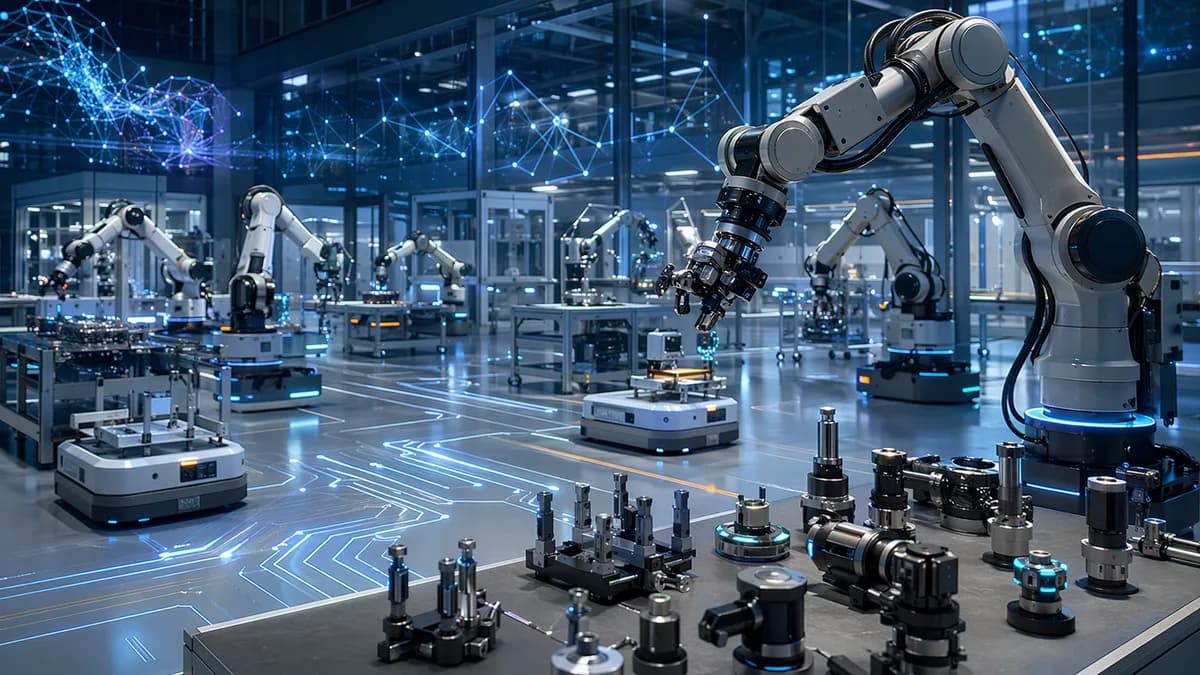
Theker’s machines are not built around a fixed humanoid form. Their hands, arms, and overall form can be swapped out or resized depending on the task.
That puts the company on a different track from humanoid robotics companies such as Boston Dynamics, which TechCrunch references as a contrast. Humanoid designs can be compelling because factories were built for human workers. Theker is making a different bet: if the job changes, the robot’s body should change too.
| Approach | Source-supported distinction | Practical implication |
|---|---|---|
| Humanoid robot | Built around a fixed human-like form | May fit human-designed spaces, but the form itself is less reconfigurable |
| Theker’s modular robot | Hands, arms, and overall form can be swapped or resized | Can be adapted to tasks such as sorting, packing, or handling varied goods |
The phrase “doesn’t specialize in anything” sounds weak until you frame it correctly. Theker is not saying one machine magically does every factory job. It is saying its system can be reconfigured for different jobs instead of being locked into one process.
That distinction matters. “Generalist robot” has become a slippery phrase in robotics. Theker’s version is grounded in physical modularity and live production use, not just a demo video.
The company also says it skips innovation departments and goes straight to logistics or operations teams. Gómez Cano’s reasoning is sharp:
“We didn’t build Theker to run pilots,”
That sales motion is important. Innovation teams can test technology for years. Operations teams have throughput targets, labor constraints, and deadlines.
The $85M round forces Theker out of the showroom phase
Theker has a showroom in central Barcelona and plans to open others as it expands across Europe, the U.S., and Asia. It also plans to grow headcount across tech, deployment, and sales.
Gómez Cano said the company has already received 15,000 job applications and estimated the team could grow from dozens to up to 120 people by the end of the year. Then she undercut her own forecast with a telling admission:
“I am saying that, but I also said that we’d raise $30 or $40 million!”
The raise landed at more than double that stated target. Bright Pixel Capital, one of the investors, said the round included CRV, Samsung, LVMH, Cathay Innovation, 20VC, Henkel Ventures, Korelya, and others, alongside existing investors including Inditex, Kfund, Kibo Ventures, and Mission.
The same investor note says Theker’s robots are already deployed in live production operations across Europe. That matters because hardware startups don’t get much credit for theory. A factory robot has to survive real operating conditions.
There’s a useful parallel with software operations here. As we wrote in Build an ML CI/CD Pipeline That Won't Fail in Production, the hard part is not showing intelligence in a controlled setting. It is keeping systems reliable once they hit production. Theker’s robotics challenge has the same shape, only with motors, grippers, downtime, and physical safety added to the equation.
Samsung discussions could turn capital into manufacturing credibility
Samsung is already an investor. Gómez Cano told TechCrunch that Samsung is not a client yet, but that the two companies are in advanced discussions.
Theker would welcome Samsung as a customer, supplier, and investor at the same time. That would be a powerful trio: revenue, industrial validation, and potential supply-chain relevance in one relationship.
XOOMAR analysis: This is the most important commercial thread in the story. Theker’s funding gives it room to hire and expand, but a relationship with a manufacturing giant would test whether its robots can move from promising deployments to demanding industrial scale. If Samsung becomes a customer, it would strengthen Theker’s claim that its machines belong beyond retail and logistics.
If those talks stall, the thesis doesn’t collapse. But the bar gets higher. Theker would need other live industrial customers to prove that “generalist” means more than adaptable packaging and warehouse tasks.
Factory owners, workers, investors, and rivals won’t read this round the same way
For manufacturers, the appeal is direct: flexible automation that can be pointed at changing work without starting from zero each time. Theker’s promise is strongest where products vary, shapes are irregular, and operations don’t fit a single fixed pattern.
For workers, the labor question is uncomfortable. TechCrunch frames the broader demand around labor shortages and manufacturers’ interest in faster automation. Reconfigurable robots could reduce demand for some repetitive manual roles. They could also increase the need for deployment staff, robot operators, maintenance workers, and technicians. The source doesn’t quantify either side, so the honest answer is that the workforce mix is likely to change, but the scale is still unclear.
For investors, Theker offers the outline of a platform robotics company: reusable AI, modular hardware, and multiple industrial use cases. The risk is just as clear. Factories punish unreliable hardware fast. A robot that works in a showroom but disrupts a line in production becomes a liability, not an asset.
Public market investors watching automation and AI robotics should treat this kind of private funding signal carefully. It can indicate where capital is flowing, but it is not the same as revenue durability or margin proof. That discipline is the same reason we push structured decision-making in Stop Trading Blind: Build a Technical Analysis Workflow, even when a narrative looks persuasive.
The next milestone is not another demo. It is repeatable deployment
Theker’s strongest idea is that the winning factory robot may not look human at all. It may look boring, adjustable, and deeply integrated into the workflow.
That is a harder story to market than a humanoid walking through a plant. It may also be closer to what operations teams actually buy.
The company now has several proof points to convert into evidence:
- Samsung talks: A customer relationship would validate Theker’s manufacturing ambitions.
- Live deployments: More production use across Europe would support the claim that the system works outside controlled environments.
- Expansion showrooms: New sites in Europe, the U.S., and Asia could help turn demonstrations into sales conversations.
- Hiring pace: Growing toward 120 people by the end of the year would show whether Theker can staff deployment and support, not just engineering.
The thesis weakens if Theker’s robots remain concentrated in narrow warehouse tasks, if Samsung stays only an investor, or if expansion produces more showcases than operating customers. It strengthens if the company proves that modular robots can be installed quickly, retasked reliably, and trusted by operations teams that don’t have time for science projects.
The Bottom Line
- Theker’s $85 million round signals investor confidence in adaptable factory automation.
- The company is betting warehouses and factories need robots that can change tasks without full rebuilds.
- Backing from Samsung, CRV, Aglaé Ventures, and Inditex gives Theker both capital and industrial credibility.
Factory Automation Approaches Compared
| Approach | What It Optimizes For | Limitation |
|---|---|---|
| Traditional industrial robots | Narrow, repetitive tasks | Struggle when factory or warehouse workflows change |
| Theker’s modular robots | Adaptable work across sorting, packing, and handling tasks | Must prove flexibility works reliably at industrial scale |
| Humanoid robot push | General-purpose spectacle and human-like form factors | May be less practical than task-focused modular systems in factories |
Theker Series A Funding
Series A
$M85
Sources

Written by
XOOMAR Insights Team
Research and Editorial Desk
The XOOMAR Insights Team pairs automated research with human editorial judgment. We track hundreds of sources across technology, fintech, trading, SaaS, and cybersecurity, cross-check the facts, and explain what happened, why it matters, and what to watch next. We do not just rewrite headlines. Every article is fact-checked and scored for reliability before it goes live, and we link back to the original sources so you can verify anything yourself.
Explore More Topics
Related Articles
 Technology
Access Race Grips European Technology Network After $1.6M
European Technology Network's $1.6M raise turns a daily tech show into Europe's newest startup access stage.
Jul 27, 20268 min
 Technology
$34M Bet Sends Gritt Solar Robots Into Dirty Panel Work
Gritt raised $34M to send AI-controlled robots into solar construction, starting with the brutal panel work contractors can't staff.
Jul 21, 20266 min
 Technology
PRIMA Retinal Implant Wins EU Approval, Tests $100M Bet
PRIMA can now be sold in Europe. Science Corp.'s next fight is proving restored vision can become a real medical business.
Jul 26, 20267 min
 Technology
Mobileye CEO Exit Jolts Its Robotaxi and Robotics Bet
Shashua is leaving the CEO seat while Mobileye asks Wall Street to buy a robotaxi and robotics future.
Jul 24, 202611 min
 Technology
Ride or Die Online Skips the Streaming Guesswork on Prime
Ride or Die streams globally on Prime Video July 15, with all eight episodes arriving at once and no country-by-country app hunt.
Jul 19, 20268 min
 Global Trends
300,000 Flee as European Wildfire Maps Expose Risk
European wildfire maps show fires outrunning evacuations and response, with 300,000 people displaced across France and Spain.
Jul 27, 20268 min
 Fintech
Revolut Valuation Rockets to $115B in Employee Share Sale
Revolut’s $115B employee share sale crowns it Europe’s top private company and puts fresh heat on its banking ambitions.
Jul 27, 20265 min
 Global Trends
Logo Revolt Haunts Cracker Barrel CEO Masino's Exit
Julie Masino is leaving after Cracker Barrel's logo revolt became a culture-war test. David Deno inherits the bruised brand.
Jul 27, 20266 min
 Global Trends
53 Years Later, Chile Jails Víctor Jara Murder Fugitive
Chile jailed Nelson Haase Mazzei, the last fugitive in the Víctor Jara murder case, 53 years after the singer was killed.
Jul 27, 20268 min
 Technology
A $9 Autonomous Key Turns App Addiction Into Real Work
Autonomous Key uses a $9 NFC fob to make addictive apps harder to reopen, betting tiny friction can beat reflexive scrolling.
Jul 27, 20268 min
Don't miss the signal
Get our weekly roundup of the stories that matter across tech, fintech, and trading. No noise, just signal.
Free forever. No spam. Unsubscribe anytime.